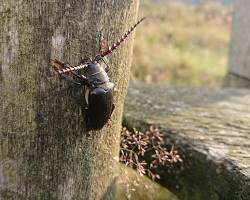
The Broad-necked Root Borer Beetle is a large wood-boring beetle belonging to the longhorn beetle family (Cerambycidae). These impressive beetles are recognized for their thick neck region, elongated bodies, and exceptionally long antennae. The larvae develop underground where they feed on roots and woody tissues of trees and shrubs. Although they are typically associated with natural forest ecosystems, large populations can occasionally weaken stressed trees.
Broad-necked root borers are most commonly encountered during summer months when adults emerge from the soil and become active around hardwood forests, woodland edges, and wooded residential landscapes.
Quick Facts
- Family: Cerambycidae
- Habitat: Forests, wooded landscapes, tree root systems
- Larval Diet: Roots and woody plant tissues
- Adult Activity: Summer and early fall
- Status: Occasional tree pest
Identification
Adult broad-necked root borer beetles are among the larger species of longhorn beetles. Adults may reach lengths of nearly 2 inches, not including their antennae.
Key identification features include:
- Large elongated body
- Broad thorax or “neck” region
- Reddish-brown or dark brown coloration
- Extremely long antennae
- Hard wing covers
- Strong jaws
Males often possess longer antennae than females. The antennae may exceed the total body length in some individuals.
The larvae are cream-colored grubs with large chewing mouthparts adapted for tunneling through wood and roots.
Distribution and Habitat
Broad-necked root borer beetles occur throughout much of North America, especially in regions containing mature hardwood forests.
Common habitats include:
- Oak forests
- Mixed hardwood woodlands
- Forest edges
- Wooded parks
- Rural landscapes
- Tree-lined residential areas
The larvae spend most of their lives hidden underground within tree roots or buried woody material.
Adults are commonly attracted to lights at night and may occasionally appear around porches or outdoor lighting during summer.
Life Cycle
The life cycle of broad-necked root borers is relatively long compared with many other insects.
The developmental stages include:
- Egg
- Larva
- Pupa
- Adult
Females deposit eggs in soil near tree roots or decaying woody material.
After hatching, larvae bore into roots and underground woody tissues where they feed for several years.
The larval stage is the longest portion of the life cycle and may continue for:
- 2 years
- 3 years
- Sometimes longer depending on environmental conditions
Once fully developed, larvae pupate underground before emerging as adults during warm weather.
Behavior
Larvae are hidden wood-borers that tunnel through underground root systems and decaying wood.
Their feeding activity may:
- Weaken roots
- Reduce nutrient transport
- Stress young trees
- Create entry points for disease organisms
Adult beetles feed very little compared with larvae. Their primary purpose is reproduction.
Adults are most active during:
- Warm evenings
- Humid summer nights
- Late spring through early fall
Many adults are nocturnal and hide beneath bark or vegetation during daylight hours.
Pest Status
In healthy forests, broad-necked root borers are usually considered minor pests or natural components of woodland ecosystems.
However, problems may occur when:
- Young trees become heavily infested
- Root systems are weakened
- Trees are stressed by drought
- Landscape trees are already damaged
Severe larval feeding can reduce tree vigor and occasionally contribute to tree decline.
Despite this, widespread destructive outbreaks are relatively uncommon.
Signs of Infestation
Because larvae develop underground, infestations are often difficult to detect.
Possible signs include:
- Wilting foliage
- Reduced tree growth
- Dieback in branches
- Root damage
- Exit holes near tree bases
- Adult beetles appearing around trees
Woodpecker activity near tree trunks may also indicate wood-boring larvae beneath the bark or within roots.
Prevention
Preventative measures focus primarily on maintaining healthy trees.
- Provide adequate watering during drought
- Avoid damaging tree roots
- Maintain proper soil health
- Remove severely damaged trees
- Reduce stress from construction near roots
- Monitor weakened trees regularly
Healthy trees are generally more resistant to wood-boring insects.
Control
Control is difficult because larvae remain hidden underground for long periods.
Management options may include:
- Removing infested trees
- Destroying heavily infested root material
- Maintaining vigorous tree growth
- Preventative insecticide applications in high-value trees
Professional arborists may be needed when infestations threaten ornamental or valuable landscape trees.
Ecological Importance
Despite their potential to damage weakened trees, broad-necked root borers also contribute to forest ecology.
They help:
- Break down dead wood
- Recycle nutrients
- Create habitats for other organisms
- Support food chains for birds and mammals
The larvae and adults serve as food sources for:
- Woodpeckers
- Small mammals
- Reptiles
- Predatory insects
Interesting Facts
- The larval stage may last several years underground.
- Longhorn beetles are named for their exceptionally long antennae.
- Some adults are attracted to lights at night.
- Larvae are powerful wood-borers capable of tunneling through roots.
- These beetles are more common in mature hardwood forests.
- Most damage occurs below ground where it is difficult to detect.