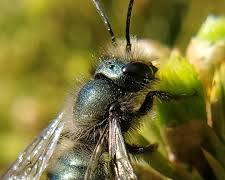
The Blue Orchard Bee (Osmia lignaria) is one of the most important native pollinators in North America. This small solitary bee is highly valued in orchards, gardens, and agricultural systems because of its exceptional pollination efficiency. Unlike honey bees, Blue Orchard Bees do not live in large colonies and are generally gentle, non-aggressive insects that rarely sting humans.
The species belongs to the mason bee group within the family Megachilidae. Mason bees are named for their habit of using mud and other materials to build partitions between nest chambers.
Blue Orchard Bees are especially important because they pollinate many economically valuable crops including:
- Apples
- Cherries
- Almonds
- Pears
- Plums
- Peaches
- Blueberries
Because of their efficiency and gentle behavior, these bees are increasingly encouraged in both commercial orchards and residential gardens.
Quick Facts
- Order: Hymenoptera
- Family: Megachilidae
- Scientific Name: Osmia lignaria
- Habitat: Orchards, gardens, woodlands
- Diet: Nectar and pollen
- Status: Beneficial native pollinator
Identification
Adult Blue Orchard Bees are relatively small insects typically measuring:
- About 1/2 inch long
Their bodies are:
- Metallic blue
- Blue-black
- Slightly fuzzy
Unlike honey bees, Blue Orchard Bees have a more compact appearance and carry pollen on specialized hairs located beneath the abdomen.
Key identifying characteristics include:
- Dark metallic coloration
- Dense body hairs
- Rounded abdomen
- Fast active flight patterns
- Solitary nesting behavior
Males and females differ slightly in appearance. Male bees are generally:
- Smaller
- Lighter in coloration
- More slender
Females possess stronger mandibles used for gathering nesting materials and constructing mud partitions.
Distribution and Habitat
Blue Orchard Bees occur widely across North America and are especially common in:
- Orchards
- Gardens
- Woodlands
- Farms
- Suburban landscapes
- Natural meadows
They thrive in areas with abundant flowering plants and suitable nesting cavities.
Preferred nesting sites include:
- Hollow plant stems
- Wood holes
- Natural cavities
- Bee hotels
- Cracks in wood
- Abandoned insect tunnels
Unlike ground-nesting bees, Blue Orchard Bees prefer enclosed above-ground nesting spaces.
Life Cycle
The life cycle of the Blue Orchard Bee includes four stages:
- Egg
- Larva
- Pupa
- Adult
Adults typically emerge during early spring when fruit trees and flowering plants begin blooming.
Female bees immediately begin searching for:
- Nesting cavities
- Pollen sources
- Nectar-producing flowers
Inside a nesting tunnel, the female constructs a series of chambers using:
- Mud partitions
- Plant material
- Moistened soil
Each chamber contains:
- A pollen and nectar food supply
- A single egg
After sealing the chamber, the larva hatches and feeds on the stored pollen before pupating.
New adults typically remain dormant through winter and emerge the following spring.
Behavior
Blue Orchard Bees are solitary insects, meaning each female independently builds and provisions her own nest.
Unlike social bees, they do not:
- Produce honey
- Defend colonies aggressively
- Maintain worker castes
- Swarm in large groups
These bees are extremely effective pollinators because they exhibit a behavior known as:
- Buzz pollination
They also carry loose pollen across their bodies, which increases pollination efficiency.
Research has shown that a relatively small number of Blue Orchard Bees can pollinate orchards as effectively as much larger populations of honey bees.
Adults feed on:
- Nectar
- Pollen
- Flower resources
Their activity is especially important during cool spring temperatures when honey bee activity may be limited.
Pest Status
Blue Orchard Bees are not pests.
Instead, they are highly beneficial pollinators that improve:
- Fruit production
- Crop yields
- Garden pollination
- Plant biodiversity
They are especially valuable in commercial agriculture because they pollinate:
- Fruit orchards
- Nut crops
- Berry plants
- Vegetable gardens
Unlike some stinging insects, Blue Orchard Bees are extremely docile and rarely sting unless directly handled or trapped.
Benefits in Agriculture
Blue Orchard Bees are considered among the most efficient orchard pollinators available.
Benefits include:
- Early spring activity
- Excellent pollination efficiency
- Low aggression toward humans
- Compatibility with orchard systems
- Support for native ecosystems
Many growers now use managed mason bee systems to supplement or replace honey bee pollination in some environments.
Prevention
No prevention is necessary because Blue Orchard Bees are beneficial insects.
In fact, many gardeners intentionally attract them by providing:
- Bee houses
- Nesting tubes
- Flowering plants
- Pesticide-free habitats
Control
Control is not recommended.
Protecting Blue Orchard Bee populations helps support:
- Pollination
- Food production
- Native biodiversity
- Healthy ecosystems
If bees establish nests in inconvenient areas, they can usually be relocated without harm.
Conservation Importance
Native pollinators such as the Blue Orchard Bee have become increasingly important due to declines in managed honey bee populations.
Conservation efforts often focus on:
- Reducing pesticide exposure
- Planting pollinator-friendly flowers
- Providing nesting habitat
- Protecting natural ecosystems
Encouraging native bees can improve both agricultural productivity and environmental health.