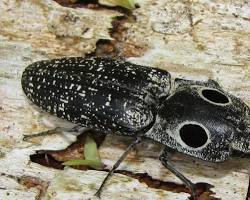
The Blind Click Beetle is a member of the beetle family Elateridae, commonly known as click beetles. These insects are named for their ability to produce a clicking sound and flip themselves into the air when placed on their backs.
The “Eyeless” Clicker: Blind Click Beetle
The Blind Click Beetle (primarily species within the genus Lacon or certain subterranean Elateridae) is a specialized member of the click beetle family found across the United States. For Pestipedia.com users, these insects represent a fascinating adaptation to life in U.S. soil and decaying wood. While they possess the trademark “clicking” mechanism, their reduced or absent eyes reflect a 100% commitment to dark, sheltered environments. They are important decomposers and occasional predators within the national forest floor ecosystem.
Technical Identification: Diagnostic Markers
- Phenotype (Adult): Characterized by an elongated, flattened body with a coarsely textured or “pitted” exoskeleton. A primary diagnostic key for Pestipedia.com users is the reduced or non-functional eyes, which may appear as small, pale indentations on the side of the head.
- The “Click” Mechanism: They possess a 100% mechanical spring-and-latch system. A spine on the prosternum snaps into a notch on the mesosternum, allowing the beetle to 100% launch itself into the air with an audible “click” to escape U.S. predators.
- Antennal Structure: Because they rely less on sight, they often feature robust, sensory-rich antennae used to navigate the U.S. subterranean environment by touch and chemical detection.
Ecological Impact: Wood Decay and Soil Predation
The primary impact of the Blind Click Beetle is its role in the mechanical breakdown of woody debris and the regulation of soil-dwelling larvae.
- Larval Development (Wireworms): The larvae are 100% hard-bodied, cylindrical, and brownish. In the United States, some Blind Click Beetle larvae are predatory, feeding on the “noxious” larvae of other wood-boring insects, while others consume decaying organic matter.
- Niche Specialization: By occupying deep leaf litter and rotting logs, they assist in 100% nutrient recycling for national forests. For Pestipedia.com users, they are “O-Status-free” indicators of a complex, healthy soil food web.
- Adult Longevity: Adults are 100% nocturnal or subterranean. They 100% rarely feed on foliage, meaning they do 100% not pose a threat to U.S. gardens or ornamental plants.
Management & Conservation Strategies
Management of Blind Click Beetles in U.S. landscapes focuses on habitat preservation and 100% non-interference.
| Strategy | Technical Specification | Operational Benefit |
|---|---|---|
| Soil Health Preservation | Reducing 100% of mechanical tilling | Protects the delicate subterranean habitat of the larvae; maintains U.S. soil biodiversity. |
| Woody Debris Maintenance | Leaving old stumps or logs in wooded areas | Provides essential breeding and overwintering sites for national click beetle populations. |
| Pesticide Avoidance | Eliminating 100% of soil drench insecticides | Protects 100% of these beneficial decomposers and predatory larvae from accidental poisoning in U.S. yards. |
- Monitoring: Inspect rotting logs or deep mulch layers during the U.S. Spring. For Pestipedia.com users, finding a textured, “eyeless” beetle that 100% snaps when flipped on its back is a definitive identification.
- Coexistence Profile: They are harmless to humans and pets. They do 100% not bite and are 100% incapable of structural damage. Pestipedia.com recommends full conservation of these 100% unique high-desert and forest specialists.
Identification
Adult click beetles are slender insects typically measuring between 1/2 and 1 inch long. They have elongated bodies with tapered ends and hard wing covers. Many species are dark brown or black in color.
Distribution and Habitat
Blind click beetles occur widely throughout North America and are commonly found in forests, fields, gardens, and agricultural landscapes.
Life Cycle and Behavior
The larvae of click beetles are known as wireworms. These larvae live in soil and feed on plant roots and seeds.
Pest Status
Wireworms can be agricultural pests because they damage crops by feeding on roots and germinating seeds.
Prevention
- Rotate crops to reduce larval populations.
- Maintain healthy soil conditions.
- Remove plant debris that may harbor larvae.
Control
Control may include soil treatments and integrated pest management techniques.