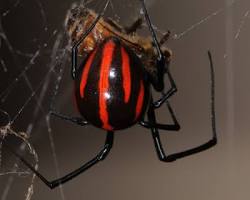
The Southern Black Widow Spider (Latrodectus mactans) is one of the most recognizable and medically significant spiders in North America. Famous for its glossy jet-black body and distinctive red hourglass marking, this spider has become a symbol of venomous spiders throughout the United States. Despite its fearsome reputation, the Southern Black Widow is generally shy, reclusive, and unlikely to bite humans unless directly threatened or accidentally disturbed.
Southern black widows belong to the cobweb spider family Theridiidae and are commonly found in dark, sheltered areas where they construct irregular tangled webs. Their venom contains neurotoxins that can cause painful symptoms in humans, although fatalities are extremely rare with modern medical treatment.
These spiders are important predators of insects and other arthropods and help regulate pest populations in natural environments. Problems generally occur only when black widows establish webs near homes, garages, sheds, or storage areas where accidental contact becomes more likely.
Quick Facts
- Scientific Name: Latrodectus mactans
- Family: Theridiidae
- Common Habitat: Woodpiles, sheds, garages, crawl spaces
- Size: Females approximately 1.5 inches including legs
- Diet: Insects and small arthropods
- Status: Medically significant venomous spider
Identification
Adult female Southern Black Widow Spiders are highly distinctive.
Key identifying features include:
- Glossy black coloration
- Large rounded abdomen
- Bright red hourglass marking on underside
- Long slender legs
- Irregular tangled web structure
Adult females are considerably larger than males and possess the classic black widow appearance most people recognize.
Males differ significantly from females and are:
- Much smaller
- Lighter brown or gray
- Marked with red or white streaks
- Less dangerous to humans
Juvenile spiders may also appear:
- Brownish or mottled
- Striped with orange or white markings
- Less glossy than adults
Southern black widows are part of the widow spider group, which also includes the Brown Widow Spider and other widow species found throughout North America.
Distribution and Habitat
The Southern Black Widow Spider occurs primarily throughout the southeastern United States but may also be found in many other warm regions across North America.
These spiders prefer:
- Dark sheltered locations
- Dry undisturbed spaces
- Areas protected from weather
- Locations with abundant insect prey
Common hiding places include:
- Woodpiles
- Sheds
- Garages
- Crawl spaces
- Basements
- Outdoor furniture
- Storage boxes
- Rock piles
- Fence posts
- Under decks
Unlike many hunting spiders, black widows remain close to their webs and rely on silk to capture prey.
Web Structure
Southern black widows build irregular tangled cobwebs rather than the symmetrical orb webs commonly associated with garden spiders.
Their webs are:
- Messy and irregular
- Exceptionally strong
- Located close to the ground
- Built in protected crevices
The spider usually hangs upside down in the center of the web, making the red hourglass marking clearly visible from below.
Sticky silk strands help trap insects and other prey that wander into the web.
Life Cycle
Southern Black Widow Spiders undergo several developmental stages.
The life cycle includes:
- Egg
- Spiderling
- Juvenile
- Adult
Females produce silk egg sacs that may contain:
- Several hundred eggs
Egg sacs are usually:
- Tan or cream-colored
- Round or pear-shaped
- Suspended within the web
After hatching, spiderlings disperse and begin building small webs of their own.
Young spiders molt several times before reaching maturity.
Adult females may survive for:
- One to three years under favorable conditions
Behavior
Southern black widows are primarily nocturnal and spend much of the day hidden in protected retreats near their webs.
These spiders are:
- Reclusive
- Non-aggressive
- Defensive when threatened
- Highly effective predators
They feed on:
- Flies
- Beetles
- Moths
- Cockroaches
- Other spiders
- Various arthropods
The spider injects venom into captured prey to immobilize and digest it.
Venom and Medical Importance
Southern Black Widow Spiders are considered medically significant because of their neurotoxic venom.
Bites may cause:
- Pain at bite site
- Muscle cramping
- Abdominal pain
- Sweating
- Nausea
- Elevated blood pressure
- Muscle stiffness
This condition is known as:
- Latrodectism
However, serious complications are relatively uncommon.
Most bites occur when:
- Spiders are trapped against skin
- People reach into hidden areas
- Firewood or debris is handled
Deaths from black widow bites are now extremely rare due to modern medical care.
Pest Status
Southern black widows are considered household nuisance pests and medically important spiders.
Problems associated with infestations include:
- Risk of venomous bites
- Web accumulation
- Fear and anxiety
- Infestations in storage areas
Despite these concerns, black widows also provide ecological benefits by controlling insect populations.
Prevention
Reducing shelter and hiding places is one of the most effective preventive measures.
- Reduce clutter around buildings.
- Wear gloves when handling firewood.
- Seal cracks and structural gaps.
- Store boxes off the floor.
- Inspect dark storage areas regularly.
- Remove webs promptly.
- Keep garages and sheds organized.
Outdoor lighting that attracts insects may also indirectly attract spiders by increasing prey availability.
Control
Management often focuses on habitat reduction and physical removal.
Control strategies include:
- Vacuuming webs and egg sacs
- Reducing clutter
- Sealing entry points
- Professional pest control treatment
- Targeted residual insecticides
Professional treatment may be recommended when infestations occur in high-risk areas such as:
- Homes with children
- Storage facilities
- Commercial buildings
- Outdoor recreational areas
Interesting Facts
- The red hourglass marking warns predators of the spider’s venom.
- Black widow silk is extremely strong compared to many spider species.
- Females are much larger than males.
- Most bites occur accidentally when spiders are disturbed.
- Southern black widows help reduce insect populations naturally.
- They prefer dark undisturbed hiding places.