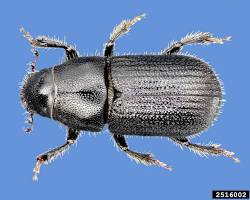
The Black Turpentine Beetle (Dendroctonus terebrans) is one of the largest bark beetle species found in North America and is a significant pest of pine trees. This beetle primarily attacks weakened, stressed, or injured pines, although severe infestations may contribute to the decline of otherwise healthy trees under environmental stress. Black turpentine beetles are especially common in pine forests, timber plantations, storm-damaged woodlands, and residential landscapes containing mature pine trees.
Unlike many smaller bark beetles that attack high portions of trees, black turpentine beetles often infest the lower trunk near the base of pine trees. Their tunneling activity beneath the bark disrupts the movement of nutrients and water within the tree, weakening its defenses and making it vulnerable to additional stress, disease, or secondary insect infestations.
One of the most noticeable signs of infestation is the production of large masses of hardened resin, commonly called pitch tubes, on the bark surface. These resin masses form as the tree attempts to defend itself by trapping invading beetles in sticky sap.
The Black Turpentine Beetle belongs to the bark beetle group within the weevil family Curculionidae, a large insect family that includes numerous wood-boring and tree-feeding pests.
Quick Facts
- Scientific Name: Dendroctonus terebrans
- Family: Curculionidae
- Common Habitat: Pine forests, timber plantations, residential landscapes
- Size: Approximately 1/4 to 3/8 inch long
- Diet: Inner bark and tree tissues
- Status: Forest and landscape pest
Identification
Adult black turpentine beetles are relatively large compared to many other bark beetles.
Key identifying features include:
- Cylindrical body shape
- Dark reddish-brown to black coloration
- Hard shiny exoskeleton
- Short clubbed antennae
- Rounded rear body section
Adults typically measure:
- Between 1/4 inch and 3/8 inch long
Larvae are:
- White or cream-colored
- Legless grubs
- Curved in shape
- Found beneath tree bark
The most recognizable signs of infestation are often found on the tree itself rather than the beetles.
Common tree symptoms include:
- Large pink or white pitch tubes
- Resin flowing from bark
- Wood dust around trunk base
- Boring holes near lower trunk
- Yellowing pine needles
- Crown thinning
Pitch tubes may measure:
- Up to several inches across
These large resin masses help distinguish black turpentine beetle infestations from attacks by smaller bark beetles.
Distribution and Habitat
The Black Turpentine Beetle occurs primarily throughout the eastern and southern United States.
It is especially common in areas containing:
- Pine forests
- Loblolly pine stands
- Slash pine plantations
- Longleaf pine forests
- Urban pine landscapes
Preferred host trees include:
- Loblolly pine
- Shortleaf pine
- Virginia pine
- Slash pine
- Longleaf pine
The beetles are strongly attracted to trees weakened by:
- Drought
- Construction damage
- Lightning strikes
- Soil compaction
- Storm injury
- Root disturbance
- Fire damage
Freshly cut pine stumps and logs may also attract adult beetles.
Life Cycle
Black turpentine beetles undergo complete metamorphosis.
The life stages include:
- Egg
- Larva
- Pupa
- Adult
Adult beetles bore through the bark of pine trees and create galleries beneath the bark surface.
Females lay eggs along these tunnels.
After hatching, larvae feed on:
- Phloem tissue
- Cambium layers
- Nutrient-conducting tissues
Larval feeding disrupts the tree’s ability to transport water and nutrients.
Once mature, larvae pupate beneath the bark before emerging as adults.
Multiple generations may occur annually in warm climates.
Behavior
Black turpentine beetles usually attack the lower trunk of pine trees.
Adults are attracted to stressed trees through chemical signals released by damaged or weakened pines.
After invading a tree, beetles produce pheromones that attract additional beetles to the same host.
Heavy infestations may result in:
- Reduced tree vigor
- Crown decline
- Needle discoloration
- Increased vulnerability to disease
- Tree death
The tree responds defensively by producing resin to flood the attack sites.
Healthy trees can sometimes successfully repel beetle attacks if resin production is strong enough.
Pest Status
The Black Turpentine Beetle is considered an important forest and landscape pest.
Problems associated with infestations include:
- Pine tree decline
- Tree mortality
- Reduced timber value
- Increased susceptibility to pathogens
- Forest stress during drought conditions
Infestations are especially problematic in:
- Drought-stressed forests
- Construction-damaged landscapes
- Recently burned pine stands
- Storm-damaged timber areas
Although healthy trees may survive isolated attacks, repeated infestations can eventually kill vulnerable pines.
Prevention
Maintaining tree health is the most important preventive strategy.
- Water pine trees during drought.
- Avoid damaging bark and roots.
- Reduce soil compaction around trees.
- Protect trees during construction activities.
- Remove severely infested trees promptly.
- Maintain overall forest health.
Preventing stress greatly reduces the likelihood of successful beetle attacks.
Control
Management depends on infestation severity and tree condition.
Common control strategies include:
- Removing heavily infested trees
- Sanitation logging
- Preventative insecticide applications
- Forest thinning practices
- Improving tree vigor
Preventative bark sprays may protect high-value landscape trees in areas with known beetle pressure.
Once larvae are beneath the bark, chemical treatment becomes significantly less effective.
Interesting Facts
- The Black Turpentine Beetle is one of the largest bark beetles in North America.
- Large pitch tubes are a major sign of infestation.
- Healthy pines often defend themselves with flowing resin.
- Stress greatly increases vulnerability to attack.
- The beetles commonly attack lower portions of pine trunks.
- Forest drought conditions can trigger widespread infestations.