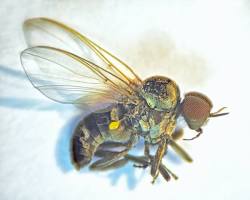
Black flies, often called turkey gnats or buffalo gnats, are small biting insects belonging to the family Simuliidae. Despite their tiny size, these flies are among the most aggressive outdoor nuisance pests in many parts of North America. Black flies are especially notorious in areas near rivers, creeks, and fast-moving streams where their larvae develop in flowing water.
Unlike mosquitoes, which breed in stagnant water, black flies require oxygen-rich moving water for development. During warm months, adults may emerge in massive swarms capable of traveling miles from breeding locations in search of blood meals. Female black flies feed on the blood of humans, livestock, birds, and wildlife, while males feed primarily on nectar and plant juices.
Black fly bites are painful because the insects slice the skin with specialized mouthparts rather than piercing directly like mosquitoes. The feeding process often leaves behind small bloody wounds accompanied by swelling, irritation, and prolonged itching. In severe infestations, black flies can create serious discomfort for hikers, campers, farmers, livestock owners, and outdoor workers.
Quick Facts
- Scientific Family: Simuliidae
- Common Names: Black Fly, Turkey Gnat, Buffalo Gnat
- Size: Approximately 1/16 to 1/8 inch long
- Habitat: Streams, rivers, wooded areas
- Diet: Blood (females), nectar (males)
- Status: Biting nuisance pest
Identification
Black flies are very small but possess several distinctive features.
Common identification characteristics include:
- Dark gray or black coloration
- Short antennae
- Broad transparent wings
- Compact humpbacked body shape
- Short strong legs
Their humpbacked thorax gives them a “buffalo-like” appearance when viewed from the side, which explains another common nickname:
- Buffalo gnat
Female black flies are the biting stage responsible for most human encounters.
Distribution and Habitat
Black flies occur throughout much of:
- North America
- Canada
- Europe
- Asia
- Other temperate regions
They are especially abundant near:
- Fast-moving streams
- Rivers
- Creeks
- Mountain waterways
- Wooded wetlands
Adult flies may disperse considerable distances from breeding sites.
Common resting areas include:
- Trees
- Shrubs
- Tall grass
- Outdoor structures
Life Cycle
Black flies undergo complete metamorphosis.
The life stages include:
- Egg
- Larva
- Pupa
- Adult fly
Females lay eggs directly on:
- Submerged rocks
- Aquatic vegetation
- Flowing water surfaces
After hatching:
- Larvae attach themselves to underwater surfaces
- They feed on microscopic organic matter carried by currents
The larvae possess specialized structures that allow them to:
- Remain attached in strong currents
Following pupation, adult flies emerge from the water surface and begin dispersing.
Behavior
Black flies are most active during:
- Spring
- Early summer
- Humid weather conditions
Peak activity often occurs during:
- Morning hours
- Late afternoon
- Cloudy conditions
Female black flies locate hosts using:
- Carbon dioxide
- Body heat
- Movement
- Odors
Unlike mosquitoes, black flies:
- Often crawl before biting
- Prefer exposed skin around the head and neck
Heavy swarms may surround:
- Humans
- Pets
- Livestock
- Wildlife
Black Fly Bites
Black fly bites are often more painful than mosquito bites.
The insects use cutting mouthparts to:
- Slice skin tissue
- Create a small pool of blood
Common bite symptoms include:
- Sharp stinging sensation
- Redness
- Swelling
- Persistent itching
- Localized bleeding
Some individuals may experience:
- Allergic reactions
- Significant swelling
- Secondary skin irritation
Impact on Humans and Animals
Black flies are major nuisance pests in many outdoor environments.
They can interfere with:
- Camping
- Fishing
- Hiking
- Farming activities
- Outdoor recreation
Large swarms may stress livestock such as:
- Cattle
- Horses
- Poultry
In severe infestations, livestock may:
- Lose weight
- Experience stress
- Reduce feeding activity
Pest Status
Black flies are considered significant nuisance pests due to:
- Painful biting behavior
- Swarming activity
- Outdoor interference
- Livestock irritation
Although they are less associated with disease transmission than some other biting insects, their bites can still create considerable discomfort.
Prevention
Several strategies can help reduce black fly exposure:
- Wear long sleeves and protective clothing
- Use insect repellents labeled for biting flies
- Avoid outdoor activity near streams during peak activity periods
- Install tight-fitting window screens
- Use fans in outdoor seating areas
- Wear light-colored clothing
Head nets are commonly used in areas with extremely high black fly populations.
Control
Black fly control is challenging because larvae develop in natural waterways.
Management approaches may include:
- Biological larvicides
- Public mosquito control programs
- Habitat monitoring
- Personal protection methods
One commonly used biological treatment is:
- Bacillus thuringiensis israelensis (Bti)
This bacterium targets fly larvae while minimizing harm to other wildlife.
Interesting Facts
- Black fly larvae require moving water to survive.
- Females may travel several miles from breeding sites.
- Some species swarm in enormous numbers during spring.
- The insects are attracted to dark colors and movement.
- Black flies are important food sources for fish and birds.
- Their humpbacked appearance helps distinguish them from gnats and mosquitoes.