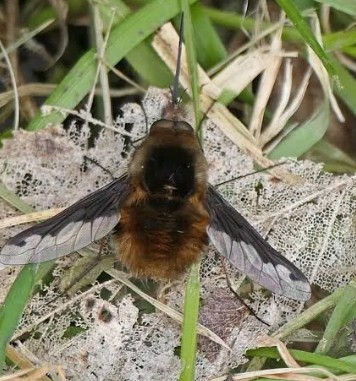
The Greater Bee Fly (Bombylius major) is a fascinating nectar-feeding insect that closely resembles a fuzzy bee but actually belongs to the fly family Bombyliidae. These insects are highly beneficial pollinators and are commonly observed hovering around flowers during spring and early summer. Their unique hovering flight, long feeding proboscis, and dense body hairs make them one of the most recognizable beneficial flies found in gardens and natural landscapes.
Quick Facts
- Family: Bombyliidae
- Habitat: Gardens, meadows, woodland edges
- Diet: Nectar (adults)
- Status: Beneficial pollinator
Identification
Greater bee flies are medium-sized flies with dense fuzzy hair that gives them a strong resemblance to bumblebees or other bees. Adults usually measure around 1/2 inch long.
- Dense fuzzy body covering
- Long needle-like proboscis
- Dark wings with brown leading edges
- Long slender legs
- Distinct hovering flight behavior
Their wings are typically held outstretched while hovering in front of flowers. Unlike bees, they possess only one pair of wings because they are true flies.
The long proboscis allows them to feed from deep tubular flowers while hovering without landing.
Distribution and Habitat
Greater bee flies occur widely throughout North America and Europe and are especially common in flower-rich habitats during spring.
Preferred habitats include:
- Gardens and pollinator landscapes
- Meadows and wildflower fields
- Woodland edges
- Open grasslands
- Parks and natural areas
- Sandy nesting habitats for solitary bees
Adults are strongly attracted to flowering plants where nectar is abundant.
Life Cycle and Behavior
Greater bee flies undergo complete metamorphosis consisting of:
- Egg
- Larva
- Pupa
- Adult
Adult females display unusual reproductive behavior. They scatter eggs near the nesting sites of solitary bees and wasps.
After hatching, the larvae enter host nests where they develop as parasites or parasitoids, feeding on stored food supplies or immature host insects.
Adult bee flies are harmless nectar feeders and spend much of their time hovering around flowers.
Common adult behaviors include:
- Hovering while feeding
- Visiting multiple flowers rapidly
- Basking in sunlight
- Searching for nesting sites of host insects
Ecological Importance
Greater bee flies are important pollinators that help support flowering plants and ecosystem biodiversity.
Ecological benefits include:
- Pollination of wildflowers
- Supporting native plant reproduction
- Serving as food for birds and predators
- Contributing to ecosystem diversity
Although their larvae parasitize some solitary bee nests, they are considered part of the natural ecological balance and rarely threaten healthy pollinator populations.
Pest Status
Greater bee flies are not considered pests. Adults are completely harmless to humans and do not bite, sting, or damage plants.
In gardens and landscapes, they are usually welcomed because of their pollination activity and unique appearance.
Their presence often indicates a healthy habitat rich in flowering plants and native pollinator activity.
Prevention
No prevention measures are necessary because greater bee flies are beneficial insects.
Many gardeners actively encourage bee flies and other pollinators by:
- Planting nectar-rich flowers
- Reducing pesticide use
- Supporting native pollinator habitats
- Maintaining flowering landscapes throughout the season
Control
Control is not recommended since greater bee flies provide pollination benefits and do not create structural, agricultural, or household problems.
Conservation of pollinator-friendly habitats helps maintain healthy populations of these beneficial insects.
Interesting Facts
- Greater bee flies mimic bees as a form of protective camouflage.
- They can hover almost motionless in midair.
- Adults feed while hovering rather than landing on flowers.
- They belong to one of the largest fly families associated with pollination.
- Their larvae develop inside the nests of solitary bees and wasps.