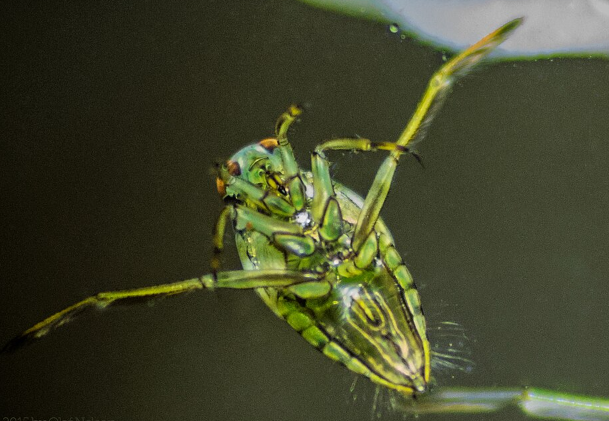
Backswimmers are aquatic insects belonging to the family Notonectidae. They are named for their unusual swimming behavior, which involves moving through the water upside down with their backs facing downward and their legs pointing upward toward the surface. These insects are commonly found in ponds, lakes, marshes, and slow-moving streams where they function as active predators of smaller aquatic organisms.
Although backswimmers are beneficial predators in freshwater ecosystems, they can occasionally become nuisance pests in swimming pools, ornamental ponds, and backyard water features. Their bite can be painful if handled or accidentally contacted, which sometimes leads to them being mistaken for more dangerous aquatic pests. Despite this, backswimmers play an important role in controlling mosquito larvae and other small aquatic insects.
Taxonomy and Classification
- Order: Hemiptera
- Suborder: Heteroptera
- Family: Notonectidae
- Common Name: Backswimmer
Physical Description
Adult backswimmers typically measure between 5 and 15 millimeters in length. Their bodies are streamlined and oval-shaped, allowing them to move efficiently through water. Unlike many aquatic insects, the backswimmer’s underside is darker while the upper side is lighter, which helps camouflage the insect while swimming upside down.
The hind legs are long, flattened, and fringed with tiny hairs that act like paddles, allowing the insect to propel itself through the water with powerful strokes. Their front legs are adapted for grasping prey.
Backswimmers also possess large compound eyes that allow them to detect movement in the water. They periodically swim to the surface to trap air bubbles beneath their wings, which serve as a portable oxygen supply while diving.
Distribution and Habitat
Backswimmers are widely distributed around the world and are commonly found in freshwater habitats. They are particularly abundant in calm or slow-moving waters where prey insects are plentiful.
- Ponds and small lakes
- Wetlands and marshes
- Slow-moving streams
- Garden ponds and decorative water features
- Swimming pools and water troughs
They are often attracted to artificial water sources such as pools or livestock tanks where insects gather.
Behavior and Ecology
Backswimmers are active predators that feed on a variety of small aquatic animals. Using their piercing mouthparts, they capture prey and inject digestive enzymes before consuming the liquefied tissues.
Common prey includes:
- Mosquito larvae
- Aquatic beetle larvae
- Small crustaceans
- Other aquatic insects
Because of their appetite for mosquito larvae, backswimmers are often considered beneficial members of the aquatic insect community.
However, they may also prey on small tadpoles, fish fry, and other delicate aquatic organisms.
Human Interaction
Backswimmers can deliver a defensive bite if handled or trapped against the skin. The bite is sometimes described as similar to a bee sting and may cause temporary pain, redness, or mild swelling. These bites are not considered medically dangerous but can be unpleasant.
People most often encounter backswimmers while swimming in natural ponds or when cleaning outdoor pools.
Management and Prevention
Because backswimmers are beneficial predators, control is rarely necessary in natural environments. In artificial water features or swimming pools, however, they can become a nuisance.
- Maintain clean pools: Proper filtration and sanitation discourage insects from breeding.
- Reduce insect prey: Limiting mosquito larvae and other aquatic insects reduces the food supply that attracts backswimmers.
- Remove manually: Pool skimmers can easily remove insects that enter swimming pools.
- Maintain circulation: Moving water discourages many aquatic insects from establishing populations.
If large numbers of aquatic insects continue appearing in pools or decorative ponds, homeowners may consider consulting a local pest control professional for guidance.