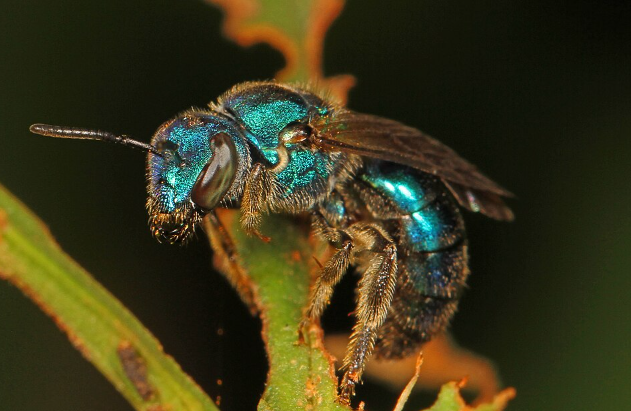
Augochlora Sweat Bee (Augochlora spp.) is a genus of metallic green bees in the family Halictidae, commonly referred to as sweat bees. These bees are native to the Americas and are frequently observed in gardens, forests, and natural landscapes. They are known for their brilliant metallic coloration and their important role as pollinators.
Augochlora sweat bees are considered highly beneficial insects. Despite their name, they are generally non-aggressive and rarely sting, even when in close proximity to humans.
Taxonomy and Classification
- Common Name: Augochlora Sweat Bee
- Scientific Group: Augochlora spp.
- Order: Hymenoptera
- Family: Halictidae
- Type: Pollinator bee
The family Halictidae includes a diverse group of bees often called sweat bees due to their occasional attraction to human perspiration.
Identification and Physical Description
Augochlora sweat bees are small to medium-sized, typically measuring 5 to 10 mm in length. They are easily recognized by their vibrant metallic coloration.
Key identifying features include:
- Bright metallic green or blue-green body
- Smooth, shiny exoskeleton
- Slender build with relatively short hair compared to other bees
Their iridescent coloration makes them one of the more visually striking native bee groups.
Females are typically slightly larger than males and are responsible for nest building and provisioning.
Life Cycle
Augochlora sweat bees undergo complete metamorphosis, progressing through egg, larva, pupa, and adult stages.
Females construct nests, often in rotting wood, plant stems, or soft substrates. Eggs are laid in individual brood cells, each provisioned with pollen and nectar.
Larvae feed on these provisions and develop through several stages before pupating and emerging as adults.
Some species are solitary, while others exhibit primitive social behavior, with small colonies or shared nesting sites.
Habitat and Distribution
Augochlora species are widely distributed across North and South America. They are commonly found in:
- Gardens and landscaped areas
- Woodlands and forest edges
- Meadows and grasslands
They prefer habitats with abundant flowering plants and suitable nesting sites.
Behavior and Ecology
These bees are active during the day and are frequently seen visiting flowers. They are efficient pollinators, moving between plants as they collect nectar and pollen.
Unlike honey bees, many Augochlora species do not form large colonies. Their nesting behavior can vary from solitary to loosely social.
They are generally docile and will only sting if directly threatened or handled.
As pollinators, they contribute significantly to the reproduction of both wild and cultivated plants.
Diet
Augochlora sweat bees feed on:
- Nectar: Provides energy for adults
- Pollen: Used to provision larvae
They visit a wide variety of flowering plants, making them generalist pollinators.
Benefits and Importance
Augochlora sweat bees provide numerous ecological and agricultural benefits:
- Pollination of wildflowers and crops
- Support of biodiversity
- Contribution to healthy ecosystems
Their role as pollinators makes them essential for plant reproduction and food production.
Human Interaction and Risks
These bees are generally harmless to humans. While they are capable of stinging, they rarely do so unless provoked.
The name “sweat bee” comes from their occasional attraction to perspiration, but this behavior is not aggressive.
Most interactions are harmless and brief.
Management and Conservation
Conservation efforts focus on supporting pollinator habitats:
- Plant native flowers to provide food sources
- Preserve nesting sites such as dead wood
- Reduce pesticide use
- Maintain habitat diversity
These practices help sustain populations of native bees.
Prevention
No prevention is necessary, as Augochlora sweat bees are beneficial.
Encouraging their presence supports pollination and ecosystem health.
Related Articles
Conclusion
Augochlora sweat bees are vibrant and valuable pollinators that play a key role in maintaining plant diversity and ecosystem stability. Their metallic coloration and active foraging behavior make them a common and beneficial presence in many landscapes.
By supporting pollinator-friendly environments, these bees can continue to thrive and contribute to both natural and agricultural systems.