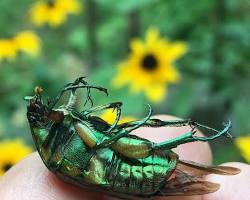
Zinc Beetles are a group of metallic wood-boring beetles belonging primarily to the genus Acmaeodera within the family Buprestidae. Their common name comes from their distinctive silver-gray, metallic, or zinc-like coloration, which often creates intricate patterns across their wing covers. Although they are related to several economically important wood-boring beetles, Zinc Beetles are generally considered beneficial insects because their larvae develop within dead or dying wood rather than attacking healthy trees or structural timber.
Adult Zinc Beetles are commonly encountered on flowers, where they feed on pollen and nectar. Their brilliant metallic coloration and active daytime behavior make them among the more attractive beetles found in gardens, woodlands, and desert habitats. While adults may occasionally cause minor cosmetic damage to ornamental flowers, their overall impact is negligible compared to the ecological benefits provided by their larvae as decomposers.
Because these beetles contribute to the breakdown of dead wood and nutrient recycling, they play an important role in maintaining healthy forest and woodland ecosystems.
Taxonomy and Classification
Zinc Beetles belong to the family of metallic wood-boring beetles, a diverse group containing thousands of species worldwide.
- Kingdom: Animalia
- Phylum: Arthropoda
- Class: Insecta
- Order: Coleoptera
- Family: Buprestidae
- Genus: Acmaeodera
The family Buprestidae is known for its striking metallic coloration and includes some of the most visually spectacular beetles in the world. Unlike destructive species such as the Emerald Ash Borer, most Zinc Beetles are associated primarily with dead or weakened wood.
Identification
Zinc Beetles possess a distinctive appearance that makes them relatively easy to recognize.
Adults
- Length: 8–15 mm.
- Shape: Elongated, cylindrical, and streamlined.
- Color: Metallic gray, silver, black, bronze, or zinc-like patterns.
- Surface: Hard and highly reflective.
- Behavior: Frequently observed basking on flowers, logs, rocks, and exposed wood.
Many species display intricate geometric markings and contrasting color patterns that help distinguish them from other beetles.
Larvae
- White to cream-colored.
- Legless body.
- Flattened appearance.
- Enlarged thoracic segment behind the head.
- Adapted for tunneling within dead wood.
The unusual flattened thoracic region gives the larvae a distinctive “hammerhead” appearance commonly associated with metallic wood-boring beetles.
Distribution and Habitat
Zinc Beetles occur throughout many regions of the world but are particularly diverse in warm and arid environments.
Common habitats include:
- Desert ecosystems
- Dry woodlands
- Oak forests
- Pine forests
- Shrublands
- Grasslands
- Urban gardens
- Parks and natural areas
In the southwestern United States, numerous species thrive in desert and semi-desert habitats where dead woody vegetation provides abundant larval habitat.
Life Cycle
Zinc Beetles undergo complete metamorphosis.
- Egg Stage: Females deposit eggs in cracks or crevices of dead or dying wood.
- Larval Stage: Larvae bore through decaying wood while feeding and developing.
- Pupal Stage: Pupation occurs within a chamber constructed inside the wood.
- Adult Stage: Adults emerge through characteristic exit holes and begin feeding on flowers.
The larval stage often lasts one to several years depending on temperature, host material, and species.
Behavior and Ecology
Adult Zinc Beetles are active during daylight hours and are strongly attracted to sunny locations.
Common behaviors include:
- Basking on exposed surfaces.
- Feeding on pollen.
- Visiting flowering plants.
- Searching for mates.
- Inspecting dead wood for egg-laying sites.
Many species are fast-moving and capable of rapid flight when disturbed.
Feeding Habits
Adult Diet
Adult Zinc Beetles primarily feed on:
- Pollen
- Nectar
- Flower parts
- Plant exudates
Although flower feeding occasionally causes minor damage to ornamental blooms, the effect is generally insignificant.
Larval Diet
Larvae feed within:
- Dead branches
- Fallen logs
- Decaying trunks
- Dead roots
- Dying woody plants
By consuming decomposing wood, the larvae accelerate natural decomposition processes.
Ecological Importance
Zinc Beetles provide several important ecological benefits.
Wood Decomposition
- Break down dead timber.
- Accelerate nutrient recycling.
- Support soil formation.
Pollination Support
- Visit flowers regularly.
- Transport pollen between plants.
- Contribute to ecosystem diversity.
Food Web Contributions
- Serve as prey for birds.
- Support reptiles and mammals.
- Provide food for predatory insects.
These ecological functions make Zinc Beetles valuable components of healthy natural ecosystems.
Damage and Economic Importance
Zinc Beetles are generally not considered significant pests.
Minor Flower Damage
- Chewing of petals.
- Consumption of pollen.
- Occasional damage to ornamental blooms.
This damage is usually cosmetic and rarely affects plant health.
Wood Utilization
- Confined primarily to dead wood.
- Rarely attacks healthy trees.
- Not considered structural pests.
Unlike certain invasive wood-boring beetles, Zinc Beetles do not pose a threat to buildings or healthy forests.
Signs of Presence
Common indicators include:
- Metallic beetles on flowers.
- Small exit holes in dead branches.
- Larval galleries in decayed wood.
- Sun-basking adults on logs or rocks.
The striking appearance of adults often makes them easier to identify than evidence of their larval activity.
Management and Prevention
Control measures are rarely necessary.
Tolerance
- Allow populations to persist naturally.
- Recognize their ecological value.
- Avoid unnecessary treatments.
Most encounters with Zinc Beetles should be viewed positively because of their role as decomposers.
Habitat Management
- Retain some dead wood in natural areas.
- Promote biodiversity.
- Support beneficial insect populations.
Conservation-oriented management often benefits Zinc Beetle populations and other beneficial insects.
Conservation and Research
Researchers study Zinc Beetles for their ecological importance, metallic coloration, and usefulness as indicators of forest health. Their dependence on dead wood habitats makes them valuable bioindicators of habitat quality and woodland continuity.
Scientists continue investigating the microscopic structures responsible for their metallic appearance, which may inspire future technological applications in optics, materials science, and engineering.
Although often overlooked, Zinc Beetles represent an important group of beneficial insects that contribute significantly to decomposition, nutrient cycling, and biodiversity in forests, deserts, and natural landscapes worldwide.