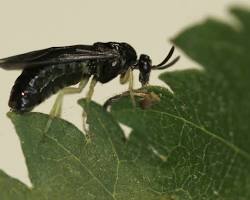
Zigzag Sawflies (Nematus oligospilus) are invasive leaf-feeding insects that primarily attack willow trees and, less commonly, certain poplar species. Native to East Asia, these sawflies have spread into Europe, North America, and other regions where they have become significant pests of ornamental landscapes, nurseries, urban forests, and riparian habitats. Their name comes from the distinctive zigzag feeding pattern created by young larvae as they consume leaf tissue along the margins of willow leaves.
Although individual larvae are relatively small, their populations can increase rapidly due to multiple generations each year. Heavy infestations often result in severe defoliation, reducing tree vigor, diminishing ornamental value, and increasing susceptibility to environmental stress. Young trees and nursery stock are particularly vulnerable, while repeated annual defoliation can weaken mature trees and reduce overall growth.
Because willow trees are commonly planted for erosion control, landscaping, shade, and wildlife habitat, Zigzag Sawflies have become an important concern for arborists, foresters, and property owners throughout their invaded range.
Taxonomy and Classification
Zigzag Sawflies belong to the order Hymenoptera, which includes ants, bees, and wasps. Unlike true wasps, sawflies lack the characteristic narrow waist found in most members of the group.
- Kingdom: Animalia
- Phylum: Arthropoda
- Class: Insecta
- Order: Hymenoptera
- Family: Tenthredinidae
- Genus: Nematus
- Species: Nematus oligospilus
Sawflies are closely related to wasps but differ significantly in appearance, behavior, and feeding habits. The larval stage resembles a caterpillar, although it is not a butterfly or moth larva.
Identification
Both adults and larvae possess distinctive characteristics that aid identification.
Adult Sawflies
- Length: Approximately 6–8 mm.
- Color: Black head and thorax with yellowish to orange abdominal segments.
- Body Shape: Slender and fly-like.
- Wings: Transparent with noticeable wing venation.
- Behavior: Harmless to humans and incapable of stinging.
Larvae
- Length: 10–12 mm when fully grown.
- Color: Greenish-yellow body with a darker head.
- Appearance: Caterpillar-like with multiple pairs of prolegs.
- Defensive Behavior: Often raise the rear end of the body when disturbed.
Key Damage Signs
- Distinctive zigzag feeding marks along leaf margins.
- Irregular holes in foliage.
- Skeletonized leaves.
- Rapid defoliation of willow trees.
- Large numbers of larvae feeding openly on foliage.
The zigzag feeding pattern is one of the most reliable indicators of an early infestation.
Distribution and Habitat
Zigzag Sawflies are native to East Asia but have spread widely through international plant trade and accidental introductions.
Common habitats include:
- Urban landscapes
- Nurseries
- Parks
- Riverbanks
- Floodplains
- Wetland edges
- Residential properties
- Forestry plantations
Any location containing suitable willow hosts may become vulnerable to infestation.
Host Plants
Willows are the primary hosts of Zigzag Sawflies.
- Weeping Willow
- White Willow
- Crack Willow
- Pussy Willow
- Various ornamental willow cultivars
- Certain poplar species
Young trees and nursery stock often experience the most severe damage because their smaller canopies can be stripped of foliage quickly.
Life Cycle
Zigzag Sawflies undergo complete metamorphosis.
- Egg Stage: Females deposit eggs along leaf margins.
- Larval Stage: Larvae emerge and begin feeding immediately.
- Pupal Stage: Mature larvae pupate in protective cocoons.
- Adult Stage: Adults emerge, mate, and begin a new generation.
In favorable climates, several generations may occur each year. This rapid reproductive cycle allows populations to expand dramatically within a single growing season.
Feeding Behavior
Young larvae begin feeding at the edges of leaves, creating the characteristic zigzag pattern that gives the insect its common name.
As larvae mature, feeding becomes more extensive.
- Leaf margins are consumed.
- Large holes develop.
- Entire leaves may be eaten.
- Defoliation progresses throughout the canopy.
Heavy infestations can strip trees of nearly all foliage within a relatively short period.
Damage and Economic Importance
The primary impact of Zigzag Sawflies is foliage loss.
Defoliation
- Loss of photosynthetic capacity.
- Reduced tree vigor.
- Slower growth.
- Declining ornamental value.
Repeated Stress
- Weakened trees.
- Reduced energy reserves.
- Greater susceptibility to drought.
- Increased vulnerability to diseases.
While mature trees often survive a single defoliation event, repeated infestations may significantly impact long-term health.
Nursery Losses
- Reduced marketability.
- Slower production.
- Increased management costs.
- Potential plant mortality.
Nurseries often experience the greatest economic impact due to the importance of maintaining attractive foliage.
Behavior and Conflict
Several biological traits contribute to the success of Zigzag Sawflies as invasive pests.
- Rapid Reproduction: Multiple generations annually.
- High Feeding Rates: Larvae consume large quantities of foliage.
- Open Feeding: Large populations can develop quickly.
- Limited Natural Enemies: Invasive populations may initially lack effective predators and parasites.
- Host Availability: Widespread willow plantings support population growth.
These characteristics enable outbreaks to develop rapidly when environmental conditions are favorable.
Monitoring and Detection
Early detection is essential for successful management.
- Inspect willow foliage regularly.
- Look for zigzag feeding patterns.
- Check leaf undersides for eggs.
- Monitor for feeding larvae.
- Watch for thinning foliage.
Monitoring is especially important during spring and summer when populations are actively developing.
Management and Prevention
An Integrated Pest Management (IPM) program provides the most effective long-term control.
Monitoring
- Inspect susceptible trees regularly.
- Identify infestations early.
- Track population growth.
Physical Control
- Hand-remove larvae from small trees.
- Prune heavily infested branches.
- Destroy infested foliage.
Physical removal can be highly effective for ornamental plantings and small infestations.
Biological Control
- Encourage natural predators.
- Protect beneficial insects.
- Support parasitoid populations.
Researchers continue investigating specialized parasitic wasps from the sawfly’s native range as potential biological control agents.
Chemical Control
- Target young larval stages.
- Use registered insecticides when necessary.
- Apply treatments according to label instructions.
Products effective against caterpillars may not always provide reliable control because sawfly larvae are biologically distinct from true caterpillars.
Conservation and Research
Current research focuses on improving detection methods, understanding population dynamics, and developing sustainable biological control programs. Scientists are particularly interested in identifying specialized parasitoids and predators capable of suppressing invasive populations without affecting native species.
As Zigzag Sawflies continue expanding into new regions, ongoing monitoring and early intervention remain critical for protecting willow populations and minimizing the ecological and economic impacts associated with severe defoliation.