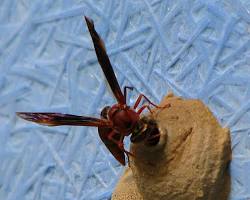
Zeta Wasps are a fascinating group of solitary potter wasps belonging to the genus Zeta within the family Vespidae. Native primarily to Central and South America, these insects are well known for constructing remarkable mud nests that resemble miniature clay pots, jars, or urns. Unlike social wasps such as yellowjackets and hornets, Zeta Wasps live alone and do not form colonies. Their solitary nature, combined with their beneficial role as predators of garden pests, makes them among the most harmless and ecologically valuable wasps found in residential landscapes.
Although their mud nests may occasionally be viewed as an aesthetic nuisance when attached to buildings, fences, porches, and outdoor structures, Zeta Wasps pose very little risk to humans. They are non-aggressive, rarely sting, and spend most of their lives collecting prey and constructing nests for their offspring.
Because they prey upon caterpillars, spiders, and other small arthropods, Zeta Wasps provide natural biological control services that help maintain ecological balance in gardens and natural environments.
Taxonomy and Classification
Zeta Wasps belong to the potter wasp group, which includes numerous solitary nest-building species.
- Kingdom: Animalia
- Phylum: Arthropoda
- Class: Insecta
- Order: Hymenoptera
- Family: Vespidae
- Subfamily: Eumeninae
- Genus: Zeta
The subfamily Eumeninae contains thousands of solitary wasp species commonly known as potter wasps or mason wasps due to their habit of constructing nests from mud.
Identification
Zeta Wasps possess a distinctive appearance that separates them from most social wasps.
Adults
- Length: 15–25 mm.
- Body Shape: Slender and elongated.
- Color: Black with yellow, orange, or reddish markings.
- Waist: Extremely narrow and elongated petiole connecting the thorax and abdomen.
- Wings: Clear to smoky brown.
- Legs: Long and adapted for carrying mud and prey.
The long, thread-like waist is one of the most recognizable features of Zeta Wasps.
Nest Identification
- Constructed from mud.
- Resembles miniature pottery vessels.
- Round or urn-shaped chambers.
- Often attached to sheltered surfaces.
- Built singly or in small clusters.
The unique nest architecture is often easier to identify than the wasp itself.
Distribution and Habitat
Zeta Wasps are primarily native to tropical and subtropical regions of the Americas.
Common habitats include:
- Forests
- Woodland edges
- Gardens
- Parks
- Agricultural areas
- Residential landscapes
- Porches and patios
- Building eaves
- Outdoor structures
They prefer locations where suitable mud, prey, and protected nesting sites are readily available.
Life Cycle
Zeta Wasps undergo complete metamorphosis.
- Egg Stage: A single egg is deposited inside a completed mud chamber.
- Larval Stage: The developing larva feeds on paralyzed prey stored within the nest.
- Pupal Stage: The larva pupates within the sealed chamber.
- Adult Stage: The adult emerges and begins searching for mates and nesting sites.
Each nest cell typically supports only one developing offspring.
Nest Construction
Nest building is one of the most remarkable behaviors exhibited by Zeta Wasps.
The female:
- Collects small balls of wet mud.
- Shapes the mud into a pot-like chamber.
- Allows the structure to dry.
- Stocks the chamber with prey.
- Lays an egg inside.
- Seals the opening with additional mud.
The finished nest resembles a tiny clay vase attached to a wall, branch, or structure.
Feeding Habits
Adult Diet
Adult Zeta Wasps feed primarily on:
- Nectar
- Plant juices
- Honeydew
- Floral resources
They may occasionally visit flowers and contribute to pollination.
Larval Diet
The developing larvae consume prey collected by the female.
Common prey includes:
- Caterpillars
- Spiders
- Small beetle larvae
- Leaf-feeding insects
- Other soft-bodied arthropods
The prey is paralyzed but remains alive, ensuring fresh food for the developing larva.
Benefits to Humans
Zeta Wasps provide several valuable ecological services.
Natural Pest Control
- Reduce caterpillar populations.
- Control leaf-feeding insects.
- Capture nuisance spiders.
- Help suppress garden pests.
Many of the insects they hunt are considered pests in ornamental and agricultural settings.
Environmental Benefits
- Reduce reliance on pesticides.
- Support biodiversity.
- Contribute to healthy ecosystems.
Their role as predators makes them valuable components of integrated pest management programs.
Human Interaction
Zeta Wasps are among the least aggressive wasps encountered around homes.
- Do not form colonies.
- Do not defend communal nests.
- Rarely sting.
- Avoid confrontation.
- Focus on hunting and nesting activities.
Most stings occur only if a wasp is trapped, handled, or accidentally crushed.
Nuisance Issues
The primary complaint associated with Zeta Wasps involves their nests.
- Mud nests on walls.
- Nests beneath eaves.
- Structures attached to porches.
- Accumulation on decorative surfaces.
These issues are largely cosmetic and do not result in structural damage.
Signs of Activity
Indicators of Zeta Wasp presence include:
- Pot-shaped mud nests.
- Solitary wasps carrying mud.
- Wasps transporting caterpillars or spiders.
- Repeated visits to sheltered structures.
The distinctive mud nests are the most obvious sign of activity.
Behavior and Conflict
The relationship between humans and Zeta Wasps is generally positive.
- Solitary Lifestyle: No colony defense behavior.
- Beneficial Predation: Natural control of pests.
- Low Sting Risk: Extremely non-aggressive.
- Aesthetic Concerns: Mud nests may be unwanted on structures.
- Minimal Property Impact: No structural damage.
The benefits they provide generally outweigh any minor inconvenience caused by nest construction.
Management and Prevention
Management is rarely necessary and typically focuses on nest placement.
Toleration
- Allow nests to remain when possible.
- Benefit from natural pest control.
- Protect beneficial insect populations.
Toleration is the preferred management strategy.
Physical Removal
- Scrape unwanted nests from surfaces.
- Use a putty knife or scraper.
- Dispose of abandoned nests.
Nest removal is most effective before new nests become established.
Discouragement
- Wash nesting surfaces.
- Remove fresh mud deposits.
- Reduce access to preferred nesting sites.
Repeated cleaning often encourages females to select alternative locations.
Conservation and Research
Research on Zeta Wasps focuses on nest-building behavior, prey selection, larval development, and biological control potential. Scientists continue studying how females locate suitable prey, construct complex mud nests, and contribute to natural regulation of insect populations.
Although occasionally viewed as a nuisance because of their mud nests, Zeta Wasps are highly beneficial insects that provide valuable pest control while posing virtually no danger to people. Their remarkable nesting behavior and ecological importance make them some of the most fascinating solitary wasps found in tropical and subtropical environments.