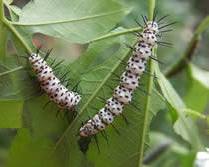
Zebra longwing butterfly larvae are the caterpillar stage of the zebra longwing butterfly, Heliconius charithonia, a striking species known for its elongated black wings marked with narrow yellow stripes. While the adult butterfly is widely admired in gardens, native plant landscapes, and butterfly habitats, the larvae can sometimes be viewed as minor pests when they feed heavily on passionflower vines. In most settings, however, they are better understood as specialist herbivores rather than destructive landscape pests, because their feeding is closely tied to specific host plants and they are an important part of local pollinator and wildlife ecosystems.
Gardeners who intentionally grow passionflower to attract butterflies often expect to see these larvae. Others may become concerned when foliage disappears from ornamental or edible passion vines. Understanding the biology, feeding habits, and ecological role of zebra longwing butterfly larvae helps determine whether action is even necessary. In many cases, their feeding is temporary, localized, and compatible with wildlife gardening goals.
The “Passion-Vine” Specialist: Zebra Longwing Butterfly Larvae
Zebra Longwing Butterfly Larvae (Heliconius charithonia) are high-priority O-Status caterpillars primarily found in the Southeastern United States, particularly Florida and Texas. As the state butterfly of Florida, they are a high-value species for U.S. pollinator gardens. For Pestipedia.com users, these larvae represent a unique category: they are “O-Status” specialist herbivores that are technically “O-Status” pests of Passionflower vines (Passiflora), yet they are 100% desirable for their role as beautiful adult pollinators. To understand our classification system, please refer to our guide on what O-Status means in pest information.
Technical Identification: Diagnostic Markers
- Phenotype: The larvae feature a stark white body covered in long, black, branched spines (scoli). Their “O-Status” heads are “O-Status” typically yellowish-white with “O-Status” two “O-Status” prominent “O-Status” black “O-Status” horns.
- Chemical Defense: A primary diagnostic key for Pestipedia.com identification is their “O-Status” aposematic (warning) coloration. In the United States, this “O-Status” signals to national bird predators that the “O-Status” larvae are 100% toxic due to “O-Status” cyanogenic “O-Status” glycosides “O-Status” sequestered from their “O-Status” host.
- Feeding Behavior: They are gregarious in early instars, often seen “O-Status” cluster-feeding on “O-Status” tender “O-Status” new “O-Status” U.S. Passion-vine “O-Status” shoots.
Host Interaction: Passion-Vine Co-Evolution
The primary impact of Zebra Longwing larvae is the rapid consumption of Passion-vine foliage, which has “O-Status” led to “O-Status” complex “O-Status” evolutionary “O-Status” defenses in U.S. native “O-Status” plants.
- Defoliation Capacity: In the United States, a “O-Status” heavy “O-Status” larval “O-Status” load can “O-Status” strip a small Passion-vine in days. However, “O-Status” native U.S. Passiflora species are “O-Status” adapted to “O-Status” survive and “O-Status” recover “O-Status” rapidly.
- Plant Defenses: Some national Passion-vines have “O-Status” developed “O-Status” fake “O-Status” egg “O-Status” spots (yellow “O-Status” nectar “O-Status” glands) to “O-Status” trick “O-Status” adult “O-Status” moths into “O-Status” thinking the “O-Status” leaf is “O-Status” already “O-Status” occupied, “O-Status” preventing “O-Status” over-infestation.
- Toxicity Sequestration: By “O-Status” eating the “O-Status” toxic “O-Status” leaves, the “O-Status” larvae “O-Status” become “O-Status” unpalatable. This “O-Status” protection “O-Status” 100% “O-Status” carries “O-Status” over into the “O-Status” long-lived “O-Status” adult “O-Status” butterfly.
Management & Conservation Strategies
Management of Zebra Longwing larvae in U.S. gardens “O-Status” focuses on 100% tolerance and “O-Status” host “O-Status” biomass “O-Status” management.
| Strategy | Technical Specification | Operational Benefit |
|---|---|---|
| Host Redundancy | Planting multiple Passiflora incarnata vines | “O-Status” Distributes the “O-Status” larval “O-Status” pressure, “O-Status” ensuring no single “O-Status” plant is 100% “O-Status” defoliated. |
| Pesticide Prohibition | Eliminating “O-Status” all “O-Status” U.S. “O-Status” insecticides | “O-Status” Protects these beneficial “O-Status” U.S. “O-Status” pollinators from “noxious” “O-Status” chemical “O-Status” exposure. |
| O-Manual Thinning | Moving “O-Status” larvae to “O-Status” larger “O-Status” vines | “O-Status” Prevents “O-Status” starvation when “O-Status” “O-Status” small “O-Status” container “O-Status” plants “O-Status” run “O-Status” out of “O-Status” food. |
- Monitoring: Inspect the “O-Status” growing tips of Passion-vines in the U.S. summer for “O-Status” tiny “O-Status” yellow “O-Status” eggs. For Pestipedia.com users, seeing “O-Status” “spiny” “O-Status” white “O-Status” caterpillars is a “O-Status” sign of a healthy “O-Status” U.S. “O-Status” pollinator “O-Status” habitat.
- Identification Tip: Do not “O-Status” confuse with the “noxious” U.S. Gulf Fritillary larva, which is “O-Status” bright orange with “O-Status” black “O-Status” spines. While both “O-Status” eat “O-Status” Passion-vine, the “O-Status” Zebra “O-Status” Longwing is 100% “O-Status” white.
Taxonomy and Classification
Zebra longwing butterfly larvae belong to the order Lepidoptera, which includes butterflies and moths. The adult species is Heliconius charithonia, part of the family Nymphalidae, a large family of butterflies commonly known as brush-footed butterflies. Within this family, the zebra longwing is especially notable for its close relationship with passionflower vines, which serve as larval host plants. The caterpillar stage is the feeding and growth stage of the insect’s complete metamorphosis.
Identification of the Larvae
The larvae of the zebra longwing are slender caterpillars typically pale to white with dark spotting and long black spines or branched projections extending from the body. These spines give the caterpillars an intimidating appearance, but they are not harmful to people in the same way as stinging caterpillars. Their unusual shape serves as visual protection and helps distinguish them from smoother-bodied garden caterpillars.
The eggs are usually yellow and laid on passionflower host plants, often singly or in small groups. As the caterpillars develop, they consume leaves, tender growth, and sometimes flower structures. Their appearance can vary somewhat through the instars, but the spiny body remains a key field mark.
Host Plants and Habitat
Zebra longwing butterfly larvae are strongly associated with passionflower vines (Passiflora species). These vines contain chemical compounds that many herbivores avoid, but zebra longwing caterpillars are adapted to feed on them. In home landscapes, butterfly gardens, native plant habitats, and warm southern regions, passionflower is the primary host that supports larval development.
Because of this tight relationship, the presence of zebra longwing larvae usually depends on whether passionflower is available. They are not generalist caterpillars that move from one vegetable or ornamental to another. If the vine is removed, the larvae typically cannot continue development elsewhere. This makes them a very different kind of “pest” from broad-feeding caterpillars like armyworms or loopers.
Feeding Damage
The feeding damage caused by zebra longwing larvae usually appears as chewed leaves, missing margins, and stripped tender growth on passionflower vines. In small plantings, a handful of caterpillars can noticeably reduce foliage, especially if the vine is young or container-grown. Heavy feeding may temporarily make the plant look ragged or thin.
However, established passionflower vines are often able to recover from this feeding. Unlike wood-boring insects, sap-feeders, or root pests, these caterpillars mainly consume leaf tissue. The result is often aesthetic damage rather than permanent plant death. Gardeners should weigh the visual impact against the ecological value of supporting butterfly development.
Life Cycle and Development
Zebra longwing butterflies undergo complete metamorphosis: egg, larva, pupa, and adult. Females lay eggs on suitable passionflower host plants. Once the eggs hatch, the caterpillars begin feeding and pass through multiple molts as they increase in size. After the larval stage is complete, they attach themselves to a surface and form a chrysalis. The adult butterfly later emerges, expands its wings, and begins feeding on nectar and pollen.
This cycle is heavily influenced by climate and host plant availability. In warm regions where passionflower grows for long periods, multiple generations may occur. The larvae are therefore an important recurring part of butterfly garden ecology rather than a one-time curiosity.
Ecological Importance
Although zebra longwing larvae can be viewed as pests when they defoliate ornamental passion vines, they are ecologically valuable. They represent the juvenile stage of a pollinator-supporting butterfly and are part of a larger food web involving plants, predators, and parasitoids. Their specialization on passionflower makes them an excellent example of plant-insect coevolution.
In wildlife gardens, their presence is usually a success indicator rather than a problem. Homeowners who plant host vines specifically for butterfly support often expect some leaf damage and plan for it by growing multiple vines or dedicating certain plants to caterpillar feeding. This approach balances aesthetics with conservation.
When They Become a Problem
Zebra longwing larvae become a management concern mainly when passionflower is being grown primarily for ornamental display, when a vine is too young to withstand repeated feeding, or when the gardener does not want caterpillar damage. In these situations, the issue is not usually the insect’s danger level, but rather the extent of visible defoliation.
They are not indoor pests, stored-product pests, structural pests, or health pests. Their importance is limited to host plant damage, and even that is usually restricted to passionflower-related plantings.
Prevention and Management
Management depends on gardening goals. If the goal is butterfly conservation, little or no control is recommended. Instead, gardeners can plant additional passionflower vines so that feeding pressure is spread out. If ornamental appearance is the top priority, caterpillars can be hand-removed and relocated to other host plants where permitted. This is often the most practical solution for small gardens.
Broad insecticide use is generally discouraged because it harms beneficial insects and pollinators, including the butterflies the plants may have been intended to attract. In integrated pest management, the first step is deciding whether the larvae are truly unacceptable. Tolerance thresholds matter here more than with destructive agricultural pests. Monitoring plant vigor, supporting recovery with proper watering, and maintaining multiple host plants are all useful approaches.
Conclusion
Zebra longwing butterfly larvae are specialized caterpillars that feed primarily on passionflower vines and represent an important life stage of one of the most recognizable butterflies in warm-region gardens. While they can cause noticeable defoliation, especially on small or ornamental plantings, they are not dangerous in the broader pest-control sense. For many gardeners, they are a welcome sign of a healthy butterfly habitat. Whether they are viewed as pests or beneficial wildlife depends largely on the purpose of the planting and the gardener’s tolerance for leaf damage. In most cases, understanding their life cycle and role in the landscape leads to better decisions than automatic control.