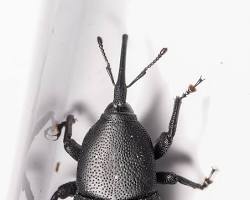
Yucca Weevils (Scyphophorus yuccae) are among the most destructive pests of yucca and agave plants throughout the southwestern United States and northern Mexico. These large snout beetles are notorious for attacking the crown, stem, and flowering stalks of desert plants, causing extensive internal damage that often leads to complete plant collapse and death. Because yuccas and agaves are highly valued in xeriscaping and desert landscapes, infestations can result in significant ornamental and financial losses.
The greatest threat posed by Yucca Weevils comes from their larvae. After eggs are deposited into plant tissue, the developing grubs tunnel deep within the crown and stem, feeding on the plant’s soft internal tissues. This feeding destroys the plant’s growing point and creates entry points for bacteria and fungi that accelerate decay. Unfortunately, most of the damage occurs out of sight, and symptoms may not become visible until the infestation is already advanced.
Due to their hidden feeding habits and ability to rapidly destroy valuable desert plants, Yucca Weevils are considered one of the most serious pests affecting ornamental yucca and agave species.
Taxonomy and Classification
Yucca Weevils belong to a group of beetles commonly known as snout beetles or billbugs.
- Kingdom: Animalia
- Phylum: Arthropoda
- Class: Insecta
- Order: Coleoptera
- Family: Dryophthoridae
- Genus: Scyphophorus
- Species: Scyphophorus yuccae
Members of the Dryophthoridae family are known for their elongated snouts and their tendency to infest palms, agaves, yuccas, and other large monocot plants.
Identification
Yucca Weevils are relatively large insects that are easier to identify than many other landscape pests.
Adult Weevils
- Length: 15–20 mm.
- Color: Uniformly black.
- Body: Robust and cylindrical.
- Surface: Smooth and shiny.
- Snout: Long, curved rostrum used for boring into plant tissue.
The distinctive snout is one of the easiest features for identification.
Larvae
- Color: Creamy white.
- Head: Brown.
- Body: Legless and grub-like.
- Habitat: Hidden inside plant crowns and stems.
The larvae are responsible for nearly all of the serious damage associated with infestations.
Distribution and Habitat
Yucca Weevils are native to arid and semi-arid regions of North America.
They are commonly found in:
- Arizona
- New Mexico
- Texas
- Nevada
- Northern Mexico
- Desert landscapes
- Xeriscape gardens
- Natural desert habitats
They thrive in warm climates where yucca and agave plants are abundant.
Host Plants
Yucca Weevils specialize in attacking plants within the agave and yucca groups.
Common hosts include:
- Yucca species
- Agave species
- Century plants
- Soap tree yucca
- Banana yucca
- Spanish dagger yucca
- Various ornamental agaves
Large, mature plants are often the most attractive hosts.
Life Cycle
Yucca Weevils undergo complete metamorphosis.
- Egg Stage: Females bore into plant tissue and deposit eggs.
- Larval Stage: Grubs tunnel through crowns, stems, and flower stalks.
- Pupal Stage: Pupation occurs within the plant tissue.
- Adult Stage: New adults emerge and seek additional host plants.
Development times vary depending on temperature and host quality.
Feeding Behavior
The feeding habits of Yucca Weevils are highly destructive because they target critical plant tissues.
Adult Feeding
- Bore into stems.
- Create egg-laying sites.
- Cause minor external damage.
Although adults contribute to injury, their feeding is usually not the primary cause of plant death.
Larval Feeding
- Tunnel through crowns.
- Destroy growing points.
- Consume soft internal tissues.
- Create extensive galleries.
Larval feeding can completely hollow out portions of the plant interior.
Damage and Economic Importance
Yucca Weevils are capable of killing even large, established plants.
Early Symptoms
- Yellowing leaves.
- Reduced vigor.
- Wilting foliage.
- Stunted growth.
Early symptoms are often mistaken for drought stress or disease.
Advanced Symptoms
- Sudden crown collapse.
- Drooping central leaves.
- Plant instability.
- Stem weakening.
By the time these symptoms appear, internal damage is usually severe.
Internal Damage
- Tunnels throughout the crown.
- Destroyed growth points.
- Rotting tissues.
- Structural collapse.
The destruction of the crown often prevents recovery.
Secondary Infections
- Bacterial soft rot.
- Fungal infections.
- Rapid tissue decay.
- Foul odors.
Secondary pathogens frequently accelerate plant death.
Behavior and Conflict
Several characteristics make Yucca Weevils particularly difficult to manage.
- Hidden Feeding: Larvae remain concealed inside plants.
- Crown Destruction: Attack the plant’s growing point.
- Disease Introduction: Tunneling promotes infections.
- Delayed Detection: Symptoms often appear late.
- Rapid Collapse: Plants may deteriorate quickly once damage becomes visible.
These traits often allow infestations to progress unnoticed.
Monitoring and Detection
Regular inspection is critical for protecting valuable landscape plants.
- Inspect plant bases.
- Check flower stalks.
- Look for bore holes.
- Monitor leaf color changes.
- Watch for soft or collapsing tissue.
Early detection offers the best opportunity for successful intervention.
Management and Prevention
Integrated Pest Management (IPM) focuses heavily on prevention and sanitation.
Sanitation
- Remove infested plants immediately.
- Destroy infected plant material.
- Dispose of infested crowns properly.
- Prevent adult emergence.
Sanitation is one of the most effective management tools.
Cultural Controls
- Maintain plant health.
- Avoid unnecessary wounds.
- Reduce plant stress.
- Monitor valuable specimens frequently.
Healthy plants may be better able to tolerate minor infestations.
Chemical Control
- Preventative treatments around plant bases.
- Systemic insecticides for high-value specimens.
- Timed applications targeting adult activity.
Chemical treatments are generally most effective before larvae enter the plant.
Biological Control
- Beneficial nematodes.
- Entomopathogenic fungi.
- Natural predators.
Researchers continue evaluating biological options for long-term suppression.
Natural Enemies
Several organisms may naturally attack Yucca Weevils.
- Predatory beetles.
- Parasitic insects.
- Beneficial nematodes.
- Entomopathogenic fungi.
While natural enemies exist, they rarely provide complete control during severe infestations.
Conservation and Research
Research involving Yucca Weevils focuses on biological control agents, improved monitoring techniques, pheromone-based detection systems, and sustainable management methods for ornamental landscapes. Scientists are particularly interested in beneficial nematodes and fungi that can target larvae hidden deep within plant crowns.
As yucca and agave plants continue to grow in popularity for xeriscaping and water-efficient landscapes, effective management of Yucca Weevils remains an important concern. Early detection, sanitation, and preventative treatments are essential for protecting valuable desert plants from this destructive pest.