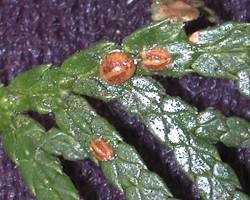
Yew Scale
Yew Scale (Parthenolecanium fletcheri) is a common soft scale insect that attacks yews, arborvitae, and several other ornamental evergreen shrubs. Although small and often overlooked, these insects can cause significant plant stress by feeding on sap and producing large amounts of sticky honeydew. Heavy infestations may weaken plants, reduce vigor, cause needle discoloration, and create unsightly accumulations of black sooty mold on foliage and nearby surfaces.
Unlike many chewing insects that visibly damage leaves, Yew Scale insects feed discreetly on plant sap. Their hidden lifestyle allows infestations to develop unnoticed until symptoms become severe. While a healthy plant can tolerate small populations, large infestations may result in extensive aesthetic damage and long-term decline.
Yew Scale is considered one of the more important scale pests affecting ornamental evergreens in residential landscapes, parks, nurseries, and commercial properties.
Taxonomy and Classification
Yew Scale belongs to the group commonly known as soft scales.
- Kingdom: Animalia
- Phylum: Arthropoda
- Class: Insecta
- Order: Hemiptera
- Family: Coccidae
- Species: Parthenolecanium fletcheri
Soft scales differ from armored scales because their protective covering is part of the insect’s body rather than a separate shell. They are also known for producing large quantities of honeydew.
Identification
Yew Scale insects are small but can become noticeable when populations are high.
Adult Females
- Size: 3–6 mm in diameter.
- Shape: Rounded, dome-shaped, or turtle-like.
- Color: Brownish-yellow to tan.
- Surface: Smooth and shiny.
- Location: Attached to stems and twigs.
Adult females are stationary and remain attached to the plant while feeding.
Crawlers
- Very small and difficult to see.
- Yellowish in color.
- Highly mobile.
- Responsible for spreading infestations.
The crawler stage is the most vulnerable period in the insect’s life cycle and the easiest stage to control.
Host Plants
Yew Scale primarily attacks evergreen ornamental plants.
Common hosts include:
- Yew (Taxus species)
- Arborvitae (Thuja species)
- Juniper species
- Cedar species
- Other ornamental conifers
Dense evergreen plantings often provide ideal conditions for population growth.
Distribution and Habitat
Yew Scale is widely distributed throughout temperate regions where ornamental evergreens are commonly grown.
Typical habitats include:
- Residential landscapes
- Commercial properties
- Parks
- Botanical gardens
- Plant nurseries
- Hedges and privacy screens
Plants growing in sheltered locations with limited air circulation may be particularly susceptible.
Life Cycle
Yew Scale typically produces one generation each year.
- Egg Stage: Eggs develop beneath the female scale.
- Crawler Stage: Newly hatched crawlers move to suitable feeding sites.
- Nymph Stage: Young scales settle and begin feeding.
- Adult Stage: Females mature and continue feeding while producing eggs.
The crawler stage usually occurs during summer and represents the primary dispersal period.
Feeding Behavior
Yew Scale insects feed by inserting specialized mouthparts into plant tissue and extracting phloem sap.
This feeding causes:
- Loss of plant nutrients.
- Reduced vigor.
- Plant stress.
- Declining growth.
Continuous feeding over multiple seasons can significantly weaken susceptible plants.
Damage and Economic Importance
The damage caused by Yew Scale is often more aesthetic than immediately life-threatening, but severe infestations can lead to long-term decline.
Needle Yellowing
- Discoloration of foliage.
- Patchy yellowing.
- Loss of healthy green color.
This symptom is often one of the first visible indicators of infestation.
Needle Drop
- Premature shedding of needles.
- Thin appearance.
- Reduced plant density.
Heavy infestations may noticeably reduce the ornamental value of the plant.
Honeydew Production
- Sticky coating on foliage.
- Residue on patios and vehicles.
- Attraction of nuisance insects.
Honeydew is often the most common complaint from homeowners.
Sooty Mold
- Black fungal growth.
- Coating on needles and branches.
- Reduced visual appeal.
The mold itself does not directly damage the plant but can interfere with photosynthesis when severe.
Ant Activity
- Ants are attracted to honeydew.
- Increased insect activity around plants.
- Protection of scales from natural enemies.
Ants often help scale populations survive by defending them from predators.
Behavior and Conflict
Several characteristics make Yew Scale a persistent ornamental pest.
- Hidden Development: Populations often build unnoticed.
- Honeydew Production: Creates significant nuisance issues.
- Ant Attraction: Encourages secondary pest activity.
- Protected Feeding Sites: Scales are often concealed on inner branches.
- Long-Term Stress: Continuous sap feeding weakens plants over time.
These factors allow infestations to persist for multiple seasons if left unmanaged.
Monitoring and Detection
Regular inspections are important for early detection.
- Inspect twigs and stems.
- Look for dome-shaped scales.
- Check for sticky honeydew.
- Watch for black sooty mold.
- Monitor ant activity around plants.
Early intervention is significantly easier than treating a mature infestation.
Management and Prevention
Integrated Pest Management (IPM) provides the most effective approach for controlling Yew Scale.
Biological Control
- Lady beetles.
- Lacewings.
- Parasitic wasps.
- Predatory insects.
Protecting beneficial insects can naturally suppress scale populations.
Dormant Oil Treatments
- Applied during late winter.
- Smothers overwintering scales.
- Reduces spring populations.
Dormant oil applications are among the most effective preventive measures.
Crawler Control
- Horticultural oils.
- Insecticidal soaps.
- Targeted summer treatments.
Treatments are most successful when timed to coincide with crawler emergence.
Cultural Practices
- Improve plant health.
- Reduce plant stress.
- Provide proper watering.
- Avoid excessive nitrogen fertilization.
Healthy plants are generally better able to tolerate low-level infestations.
Natural Enemies
Several beneficial organisms help regulate Yew Scale populations.
- Lady beetles.
- Lacewing larvae.
- Predatory midges.
- Parasitic wasps.
- Spiders.
These natural enemies often provide substantial control when broad-spectrum insecticides are avoided.
Conservation and Research
Research involving Yew Scale focuses on improving Integrated Pest Management programs, refining crawler monitoring techniques, and optimizing the use of horticultural oils while minimizing potential damage to evergreen foliage. Scientists continue studying interactions between scale insects, beneficial predators, and environmental conditions to improve long-term management strategies.
Although Yew Scale rarely kills established plants outright, heavy infestations can cause significant ornamental damage and chronic plant stress. Regular monitoring, preservation of natural enemies, and properly timed treatments remain the most effective methods for managing this common evergreen pest.