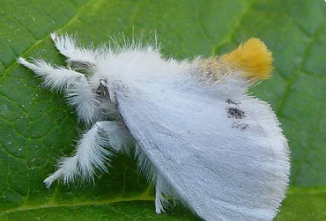
Yellowtail Moths (Euproctis similis) are distinctive moths known for their striking white appearance, bright yellow tail tuft, and highly irritating caterpillars. While the adult moth is harmless and short-lived, the larval stage can become a significant pest of deciduous trees and shrubs. These caterpillars feed voraciously on foliage and possess specialized urticating hairs that can cause skin irritation, rashes, eye irritation, and respiratory problems in humans.
Found throughout Europe, North Africa, and parts of Asia, Yellowtail Moths are commonly associated with hedgerows, orchards, parks, gardens, and woodland edges. Their caterpillars feed on a wide variety of host plants, including willow, hawthorn, blackthorn, apple, plum, pear, oak, and other deciduous species. During outbreak years, large populations can strip significant amounts of foliage from trees and shrubs, reducing plant vigor and ornamental value.
In addition to their impact on vegetation, Yellowtail Moth caterpillars are important public health pests due to their irritating hairs. Contact with these hairs can result in dermatitis, allergic reactions, and respiratory discomfort, making infestations particularly problematic in residential and recreational areas.
Taxonomy and Classification
Yellowtail Moths belong to a group of moths commonly known as tussock moths.
- Kingdom: Animalia
- Phylum: Arthropoda
- Class: Insecta
- Order: Lepidoptera
- Family: Erebidae
- Subfamily: Lymantriinae
- Genus: Euproctis
- Species: Euproctis similis
The species is closely related to several other hairy caterpillar species that are known for causing both defoliation and human health concerns.
Identification
Yellowtail Moths are relatively easy to identify in both their adult and caterpillar stages.
Adult Moths
- Wingspan: 35–45 mm.
- Color: Pure white wings.
- Body: White and fuzzy.
- Tail Tuft: Bright yellow-orange tuft at the end of the abdomen.
- Activity: Nocturnal and attracted to lights.
The yellow tail tuft is the most distinctive feature and gives the species its common name.
Caterpillars
- Length: 25–35 mm.
- Color: Dark brown to black.
- Markings: White side stripes and reddish-brown dorsal markings.
- Hairs: Dense covering of long, irritating hairs.
- Behavior: Often feed in groups when young.
The hairy appearance of the caterpillar serves both as a defense mechanism and an important identification feature.
Egg Masses
- Deposited on leaves or branches.
- Covered with yellow hairs from the female.
- Often found in clusters.
Distribution and Habitat
Yellowtail Moths are widely distributed across temperate regions.
They are commonly found in:
- Europe
- North Africa
- Western Asia
- Temperate regions of Eurasia
Preferred habitats include:
- Hedgerows
- Woodland edges
- Gardens
- Parks
- Orchards
- Roadside vegetation
- Urban green spaces
Areas containing abundant deciduous host plants are particularly susceptible to infestations.
Host Plants
Yellowtail caterpillars feed on numerous deciduous trees and shrubs.
Common hosts include:
- Willow
- Hawthorn
- Blackthorn
- Apple
- Pear
- Plum
- Cherry
- Oak
- Birch
- Rose species
Their broad host range allows populations to thrive in both natural and cultivated environments.
Life Cycle
Yellowtail Moths undergo complete metamorphosis.
- Egg Stage: Females lay clusters of eggs covered with yellow hairs.
- Larval Stage: Caterpillars hatch and begin feeding on foliage.
- Overwintering Stage: Caterpillars construct communal silk nests and overwinter on host plants.
- Pupal Stage: Mature larvae pupate within silken cocoons.
- Adult Stage: White moths emerge during summer and reproduce.
One generation is typically produced per year.
Feeding Behavior
The caterpillars are the destructive stage of the life cycle.
Young larvae often feed collectively, while older caterpillars spread throughout the host plant.
Feeding damage includes:
- Leaf skeletonization.
- Chewed foliage.
- Partial defoliation.
- Complete defoliation during severe outbreaks.
Heavy feeding can significantly reduce a tree’s ability to photosynthesize and recover from environmental stress.
Damage and Economic Importance
Yellowtail Moths create both plant damage and public health concerns.
Plant Damage
- Defoliation.
- Reduced tree vigor.
- Slower growth.
- Stress on young trees.
- Reduced fruit production.
Repeated defoliation can weaken susceptible plants over time.
Ornamental Damage
- Unsightly foliage loss.
- Visible nests.
- Reduced landscape value.
Infestations are particularly noticeable in parks and residential gardens.
Public Health Concerns
The greatest concern associated with Yellowtail Moths is the caterpillar’s urticating hairs.
These hairs:
- Break off easily.
- Become airborne.
- Remain irritating long after being shed.
- Cause reactions upon contact.
Symptoms of Exposure
- Skin rashes.
- Itching.
- Redness.
- Dermatitis.
- Eye irritation.
- Respiratory discomfort.
- Asthma-like symptoms.
Sensitive individuals may experience severe allergic reactions following exposure.
Behavior and Conflict
Several biological characteristics contribute to their pest status.
- Hair Defense: Urticating hairs discourage predators.
- Communal Nesting: Caterpillars overwinter together.
- Wide Host Range: Numerous deciduous plants are attacked.
- Defoliation Potential: Large populations consume substantial foliage.
- Public Exposure: Hairs may affect people far from the infestation site.
The persistence of detached hairs makes management especially important in populated areas.
Monitoring and Detection
Early detection can prevent severe infestations.
- Inspect host trees during winter.
- Look for communal silk nests.
- Monitor leaves for feeding damage.
- Check for hairy caterpillars in spring.
- Watch for defoliation.
Winter inspections are particularly effective because the nests are easy to spot when leaves are absent.
Management and Prevention
Integrated Pest Management (IPM) combines monitoring, sanitation, and biological controls.
Mechanical Control
- Remove winter nests.
- Prune infested branches.
- Destroy collected material.
Protective clothing, gloves, and eye protection should always be worn when handling infested material.
Biological Control
- Encourage birds.
- Promote beneficial insects.
- Apply biological insecticides when larvae are young.
Biological treatments are most effective against early larval stages.
Cultural Controls
- Maintain healthy trees.
- Reduce stress factors.
- Monitor susceptible host plants regularly.
Chemical Control
- Treat severe infestations.
- Target young caterpillars.
- Avoid unnecessary broad-spectrum applications.
Chemical treatments are generally reserved for situations where significant defoliation or public health concerns exist.
Natural Enemies
Several predators and parasitoids naturally suppress Yellowtail Moth populations.
- Birds.
- Parasitic wasps.
- Predatory beetles.
- Spiders.
- Pathogenic fungi.
These natural enemies help regulate populations in healthy ecosystems.
Conservation and Research
Research on Yellowtail Moths focuses on understanding the chemistry of their urticating hairs, improving biological control methods, and developing safer management practices in public spaces. Scientists continue investigating the environmental conditions that contribute to outbreaks and the health impacts associated with airborne caterpillar hairs.
Although adult Yellowtail Moths are harmless and visually attractive, their caterpillars can become significant pests due to their ability to defoliate trees and cause human health issues. Proper monitoring, nest removal, and integrated management strategies are essential for reducing both plant damage and public exposure to irritating hairs.