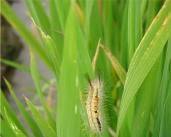
Yellow Rice Caterpillars
Yellow Rice Caterpillars are among the most destructive pests of rice production throughout Asia and other rice-growing regions of the world. The name most commonly refers to the larval stage of the Yellow Stem Borer (Scirpophaga incertulas), a moth species capable of causing severe economic losses in rice fields. These caterpillars attack rice plants by boring into stems and feeding internally, destroying critical plant tissues responsible for water and nutrient transport.
Rice is one of the world’s most important food crops, feeding billions of people annually. Because Yellow Rice Caterpillars attack the plant from the inside, infestations often go unnoticed until significant damage has already occurred. Heavy infestations can reduce grain production dramatically and, in severe cases, destroy entire sections of a rice field.
The characteristic symptoms known as “dead hearts” and “white heads” are among the most recognizable signs of stem borer damage and can result in substantial reductions in crop yield and profitability.
Taxonomy and Classification
Yellow Rice Caterpillars belong to a group of moths known as stem borers.
- Kingdom: Animalia
- Phylum: Arthropoda
- Class: Insecta
- Order: Lepidoptera
- Family: Crambidae
- Species: Scirpophaga incertulas
Several related stem-boring moth species may also be referred to as Yellow Rice Caterpillars depending on the region, but the Yellow Stem Borer remains the most economically important.
Identification
Proper identification is essential for successful management.
Adult Moths
- Length: Approximately 10–15 mm.
- Color: Pale yellow or straw-colored.
- Wings: Narrow and lightly scaled.
- Markings: Females often possess a small black spot on each forewing.
- Activity: Primarily nocturnal.
Adults are relatively inconspicuous and are most active during evening hours.
Larvae
- Length: 15–25 mm.
- Color: Creamy white to pale yellow.
- Head: Brown or yellowish-brown.
- Body: Smooth and cylindrical.
- Habitat: Hidden inside rice stems.
The larval stage is responsible for all economically significant damage.
Distribution and Habitat
Yellow Rice Caterpillars are widespread throughout major rice-growing regions.
They are commonly found in:
- India
- China
- Bangladesh
- Thailand
- Vietnam
- Indonesia
- Philippines
- Pakistan
- Sri Lanka
Their preferred habitat includes flooded rice paddies, irrigation systems, and nearby grassy vegetation that can serve as alternative hosts.
Host Plants
Rice is the primary host plant, although some related grasses may support populations.
Common hosts include:
- Cultivated rice
- Wild rice species
- Aquatic grasses
- Volunteer rice plants
Rice plants are vulnerable throughout much of their growing cycle.
Life Cycle
Yellow Rice Caterpillars undergo complete metamorphosis.
- Egg Stage: Females deposit egg masses on rice leaves.
- Larval Stage: Newly hatched caterpillars bore into stems and begin feeding.
- Pupal Stage: Pupation occurs inside the rice stem.
- Adult Stage: Moths emerge and begin reproduction.
Multiple generations may occur annually depending on climate and cropping schedules.
Feeding Behavior
The destructive nature of Yellow Rice Caterpillars comes from their internal feeding habits.
After hatching, larvae:
- Bore directly into the stem.
- Feed on internal tissues.
- Destroy vascular structures.
- Remain concealed from predators and sprays.
This hidden feeding behavior makes infestations difficult to detect and control.
Damage and Economic Importance
Yellow Rice Caterpillars are considered one of the most damaging rice pests worldwide.
Dead Hearts
Damage occurring during vegetative growth produces symptoms known as dead hearts.
- Central shoots wilt.
- Young tillers die.
- Plants stop developing normally.
- Yield potential is reduced.
Dead hearts are among the earliest visible signs of infestation.
White Heads
Damage occurring during reproductive growth results in white heads.
- Panicles turn white.
- Grain development fails.
- Heads remain empty.
- Harvest losses increase.
White heads represent direct yield loss because affected panicles produce little or no grain.
Stem Damage
- Internal tunneling.
- Structural weakening.
- Reduced nutrient movement.
- Plant stress.
Extensive stem injury reduces overall plant health.
Yield Losses
- Reduced grain production.
- Lower grain quality.
- Uneven crop maturity.
- Economic losses.
Severe infestations can cause substantial reductions in farm profitability.
Behavior and Conflict
Several biological characteristics contribute to the pest status of Yellow Rice Caterpillars.
- Hidden Feeding: Protected inside stems.
- Multiple Generations: Continuous reinfestation.
- Rapid Population Growth: Large outbreaks can develop quickly.
- Crop Specialization: Highly adapted to rice production systems.
- Difficult Detection: Damage often appears after feeding is advanced.
These factors make stem borers challenging pests to manage.
Monitoring and Detection
Regular scouting is critical for early detection.
Growers should monitor for:
- Dead hearts.
- White heads.
- Egg masses on leaves.
- Stem entry holes.
- Adult moth activity.
Early detection improves management success and reduces crop losses.
Management and Prevention
Integrated Pest Management (IPM) provides the most effective long-term strategy.
Cultural Controls
- Field sanitation.
- Removal of crop residues.
- Destruction of volunteer rice plants.
- Synchronized planting schedules.
These practices help reduce pest survival between seasons.
Water Management
- Periodic field drainage.
- Improved water control.
- Reduced larval survival.
Proper water management can significantly suppress populations.
Biological Control
- Parasitic wasps.
- Predatory insects.
- Beneficial spiders.
- Natural pathogens.
Numerous natural enemies contribute to stem borer suppression.
Chemical Control
- Systemic insecticides.
- Granular formulations.
- Targeted applications.
- Threshold-based treatments.
Chemical treatments are often most effective when applied before larvae enter stems.
Host Plant Resistance
- Stem-borer-resistant rice varieties.
- Improved stem hardness.
- Enhanced plant defenses.
Resistant cultivars remain one of the most sustainable management options.
Natural Enemies
Several beneficial organisms attack Yellow Rice Caterpillars.
- Egg parasitoid wasps.
- Larval parasitoids.
- Predatory beetles.
- Spiders.
- Entomopathogenic fungi.
Conservation of natural enemies is a key component of IPM programs.
Conservation and Research
Yellow Rice Caterpillars remain one of the highest research priorities in rice entomology. Scientists continue investigating resistant rice varieties, improved biological control programs, pheromone monitoring systems, and environmentally sustainable management strategies. Research also focuses on reducing pesticide dependence while maintaining profitable rice production.
Because they attack rice stems internally and can cause severe yield losses, Yellow Rice Caterpillars continue to be among the most economically important agricultural pests in Asia. Effective monitoring, resistant varieties, biological control, and integrated management practices remain essential for protecting one of the world’s most important food crops.