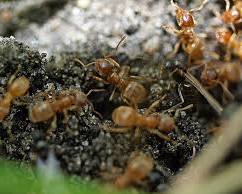
Yellow Meadow Ants
Yellow Meadow Ants (Lasius flavus) are small, yellow-colored ants commonly found in grasslands, meadows, lawns, parks, golf courses, and other turf environments throughout temperate regions of the world. Unlike many ant species that frequently enter homes in search of food, Yellow Meadow Ants spend almost their entire lives underground. They are best known for constructing large soil mounds and maintaining an unusual relationship with root-feeding aphids, which they “farm” for sugary honeydew.
Although Yellow Meadow Ants rarely become indoor pests and do not damage structures, their nesting activities can create significant problems in managed turf. Their excavated soil forms dome-shaped mounds that disrupt lawn appearance, interfere with mowing equipment, create uneven playing surfaces on sports fields and golf courses, and reduce the aesthetic quality of ornamental landscapes.
Despite these concerns, Yellow Meadow Ants also provide ecological benefits through soil aeration, nutrient cycling, and their role in supporting healthy grassland ecosystems.
Taxonomy and Classification
Yellow Meadow Ants belong to one of the most widespread groups of social insects.
- Kingdom: Animalia
- Phylum: Arthropoda
- Class: Insecta
- Order: Hymenoptera
- Family: Formicidae
- Genus: Lasius
- Species: Lasius flavus
The genus Lasius includes numerous ant species found throughout Europe, Asia, and North America. Yellow Meadow Ants are among the most specialized subterranean members of the group.
Identification
Yellow Meadow Ants are relatively small and often remain hidden beneath the soil surface.
Workers
- Length: 2–4 mm.
- Color: Uniform yellow, yellow-orange, or yellowish-brown.
- Body: Smooth and slightly glossy.
- Antennae: Elbowed, typical of ants.
- Waist: Single-node petiole.
Workers are rarely seen above ground except during nest maintenance or colony disturbances.
Queens
- Significantly larger than workers.
- Darker yellow to brown coloration.
- Long-lived reproductive individuals.
Winged Reproductives
- Appear during mating flights.
- Possess transparent wings.
- Often emerge in large numbers.
Nest Identification
The easiest way to identify Yellow Meadow Ants is by their nests.
- Large dome-shaped soil mounds.
- Fine, loose excavated soil.
- Grass growing through portions of the mound.
- Minimal visible ant activity.
- Persistent mound growth over time.
Some colonies create mounds exceeding several feet in diameter after years of expansion.
Distribution and Habitat
Yellow Meadow Ants are widespread throughout temperate regions.
Common habitats include:
- Meadows
- Pastures
- Grasslands
- Lawns
- Parks
- Golf courses
- Sports fields
- Roadside verges
- Garden borders
They prefer well-drained soils that support both their colonies and the root aphids they depend upon.
Life Cycle
Yellow Meadow Ants undergo complete metamorphosis.
- Egg Stage: The queen lays eggs within protected underground chambers.
- Larval Stage: Larvae are fed and cared for by workers.
- Pupal Stage: Development continues within the nest.
- Adult Stage: Workers emerge and begin colony duties.
Colonies may persist for decades under favorable conditions.
A mature colony contains:
- A queen.
- Thousands of workers.
- Brood chambers.
- Root aphid populations.
Relationship with Root Aphids
One of the most remarkable aspects of Yellow Meadow Ant biology is their relationship with root aphids.
The ants:
- Protect root aphids from predators.
- Move aphids to healthy plant roots.
- Care for aphid eggs during winter.
- Transport aphids throughout the colony.
In return, the aphids produce sugary honeydew that serves as the ants’ primary food source.
This mutualistic relationship is often compared to livestock farming.
Feeding Habits
Unlike many ants that forage widely above ground, Yellow Meadow Ants rely heavily on honeydew.
Primary food sources include:
- Root aphid honeydew.
- Plant-derived sugars.
- Occasional small insects.
- Organic matter.
Because their food source exists underground, workers spend little time foraging on the soil surface.
Damage and Economic Importance
The primary concern associated with Yellow Meadow Ants is turf disruption.
Turf Surface Damage
- Uneven mowing surfaces.
- Raised soil mounds.
- Disrupted grass growth.
- Poor lawn appearance.
Large mounds can significantly reduce the quality of ornamental turf.
Golf Course Problems
- Interference with putting greens.
- Uneven fairway surfaces.
- Aesthetic concerns.
- Maintenance challenges.
Golf course managers often consider these ants significant turf pests.
Landscape Issues
- Visible soil piles.
- Unsightly anthills.
- Disturbed flower beds.
- Reduced visual appeal.
The damage is primarily cosmetic rather than destructive.
Benefits of Yellow Meadow Ants
Despite their turf impacts, Yellow Meadow Ants provide important ecological services.
- Improve soil aeration.
- Increase water infiltration.
- Enhance nutrient cycling.
- Mix organic matter into soil.
- Support grassland biodiversity.
Many natural ecosystems benefit from their extensive tunneling activities.
Behavior and Conflict
Several characteristics contribute to their status as turf pests.
- Subterranean Lifestyle: Colonies remain hidden underground.
- Mound Construction: Soil is continuously excavated.
- Aphid Farming: Root aphids support colony growth.
- Long Colony Life: Mounds increase in size over many years.
- Minimal Indoor Activity: Rarely invade structures.
The conflict arises almost entirely from mound formation rather than direct interaction with people.
Signs of Infestation
Common indicators include:
- Dome-shaped anthills.
- Fine loose soil on turf.
- Yellow ants beneath stones.
- Increased mound size after rainfall.
- Multiple mounds across a lawn.
Most colonies are identified through their soil mounds rather than visible worker activity.
Management and Prevention
Management depends on the severity of turf disruption.
Physical Control
- Rake or brush mounds regularly.
- Level soil deposits.
- Break up developing anthills.
- Maintain smooth turf surfaces.
Regular disturbance helps reduce mound accumulation.
Cultural Controls
- Maintain healthy turf.
- Reduce excessive thatch.
- Improve drainage where necessary.
- Monitor mound development.
Chemical Control
- Targeted ant treatments.
- Direct nest applications.
- Localized treatments around problem mounds.
Chemical control is generally reserved for high-value turf areas.
Conservation and Research
Research involving Yellow Meadow Ants focuses on their sophisticated communication systems, aphid-farming behavior, soil ecology, and their influence on grassland biodiversity. Scientists continue studying the chemical signals used between ants and root aphids, as well as the role these ants play in shaping soil structure and nutrient dynamics.
Although they can create challenges in lawns and golf courses, Yellow Meadow Ants remain ecologically important insects whose tunneling activities contribute significantly to healthy soils. Their remarkable underground lifestyle and aphid-farming behavior make them one of the most interesting ant species found in temperate grassland environments.