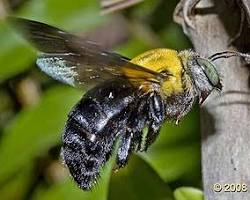
Xylocopa Carpenter Bees (Xylocopa spp.) are large solitary bees known for their ability to tunnel into wood to create nesting galleries. These bees are commonly mistaken for bumblebees, but Carpenter Bees can usually be identified by their distinctive shiny, black, hairless abdomen. Although they are important native pollinators, they are also considered structural nuisance pests because females excavate tunnels in untreated wood such as decks, railings, siding, fascia boards, fences, and porch supports.
Unlike termites, Carpenter Bees do not consume wood for food. Instead, they bore into wood to construct nests for their offspring. A single tunnel generally causes only minor cosmetic damage, but repeated tunneling over many years can weaken wooden structures and contribute to moisture intrusion, decay, and costly repairs.
These bees are widespread throughout warm and temperate regions worldwide and are particularly common around homes with exposed or weathered wood. Despite their reputation as pests, Carpenter Bees play an important ecological role as highly effective pollinators of flowers, fruits, and vegetables.
Quick Facts
- Scientific Name: Xylocopa spp.
- Family: Apidae
- Order: Hymenoptera
- Main Conflict: Structural wood tunneling
- Habitat: Wooden structures, forests, gardens
- Diet: Nectar and pollen
- Status: Beneficial pollinator and nuisance wood pest
- Nest Type: Solitary wood galleries
Taxonomy and Classification
Carpenter Bees belong to the order Hymenoptera, the same insect order that includes bees, ants, and wasps. They are classified within the family Apidae, which also contains honey bees and bumblebees.
The genus Xylocopa contains more than 500 species worldwide. In North America, the most common species is the Eastern Carpenter Bee (Xylocopa virginica).
Unlike honey bees, Carpenter Bees are solitary bees. They do not form large colonies with queens and workers. Instead, each female independently constructs and provisions her own nest tunnels. However, multiple females may nest near each other in favorable wood structures.
Carpenter Bees undergo complete metamorphosis consisting of:
- Egg
- Larva
- Pupa
- Adult
Physical Description
Adult Carpenter Bees are large, robust insects measuring approximately 20–25 mm long.
Female Carpenter Bees
Females are:
- Large and heavy-bodied
- Black with shiny hairless abdomens
- Capable of stinging
- Responsible for boring tunnels into wood
Female bees create nearly perfect circular entrance holes about 1/2 inch in diameter.
Male Carpenter Bees
Males are often slightly smaller and may possess:
- White or yellow facial markings
- Territorial hovering behavior
- No stinger
Although males aggressively buzz near people, they are harmless because they cannot sting.
Damage Signs
Common signs of Carpenter Bee activity include:
- Perfectly round entrance holes
- Piles of coarse sawdust (frass)
- Yellowish-brown staining beneath holes
- Buzzing or drilling sounds
- Hovering bees near wooden structures
Over time, tunnels may extend several feet within the wood.
Distribution and Habitat
Carpenter Bees occur worldwide in warm and temperate climates. They are especially common in North America, Europe, Asia, and tropical regions.
Preferred nesting sites include:
- Decking
- Porch railings
- Fascia boards
- Eaves
- Wood siding
- Outdoor furniture
- Fences
- Sheds and barns
They strongly prefer:
- Untreated wood
- Weathered wood
- Softwoods such as pine, cedar, cypress, and redwood
Painted or pressure-treated wood is generally less attractive.
Behavior and Conflict
The primary conflict associated with Carpenter Bees is their wood-boring nesting behavior.
Tunnel Construction
Females chew directly into wood using powerful mandibles. After boring perpendicular to the surface for about an inch, the tunnel typically turns and follows the wood grain.
Inside the tunnel, the female creates a series of brood chambers separated by partitions of chewed wood pulp.
Structural Damage
A single tunnel rarely causes serious structural damage. However:
- Repeated reuse of tunnels
- Multiple generations nesting in the same wood
- Numerous bees tunneling together
can eventually weaken structural wood and contribute to decay.
Woodpeckers frequently worsen damage by tearing open wood while feeding on Carpenter Bee larvae.
Acoustic Nuisance
Many homeowners first notice Carpenter Bees because of the loud buzzing and drilling sounds produced while females excavate tunnels.
Pollination Benefits
Despite their structural damage potential, Carpenter Bees are highly valuable pollinators. They pollinate:
- Tomatoes
- Eggplants
- Blueberries
- Sunflowers
- Coneflowers
- Native wildflowers
Some species perform buzz pollination, vibrating flowers to release pollen efficiently.
Life Cycle
Egg Stage
Females lay eggs individually inside brood chambers within the wooden tunnel.
Larval Stage
Larvae feed on stored pollen and nectar provisions placed in each chamber.
Pupal Stage
Pupation occurs safely within the wooden gallery.
Adult Emergence
New adults emerge later in the season and may overwinter inside old tunnels before becoming active the following spring.
Management and Prevention
Management focuses on prevention, exclusion, and selective treatment while preserving pollinator benefits whenever possible.
Prevention
The most effective preventive measure is protecting wood surfaces.
- Paint exterior wood
- Apply thick stain or varnish
- Use hardwood materials where possible
- Repair weathered wood promptly
Carpenter Bees strongly prefer bare or weathered wood surfaces.
Targeted Treatment
Active nest holes may be treated by:
- Applying insecticidal dust into the tunnel
- Waiting 24–48 hours
- Sealing holes with caulk or wood filler
Sealing untreated active tunnels immediately may trap live bees inside or encourage excavation of new tunnels nearby.
Alternative Nesting Sites
Some conservation-focused approaches encourage providing alternative untreated wood blocks away from structures to preserve Carpenter Bee pollination benefits.
Natural Deterrents
Homeowners sometimes use:
- Citrus sprays
- Almond oil
- Wind chimes
- Bee traps
with varying effectiveness.
Interesting Facts About Carpenter Bees
- Male Carpenter Bees cannot sting.
- Females create nearly perfect circular entrance holes.
- Some tunnels may extend over 10 feet in total length.
- They are among the most important native pollinators.
- Old tunnels may be reused for multiple generations.
Conservation and Research
Modern research increasingly focuses on balancing structural protection with pollinator conservation. Scientists are studying:
- Non-lethal repellents
- Protective wood coatings
- Alternative nesting systems
- Pollination ecology
- Wood-resistant construction materials
Because Carpenter Bees are valuable native pollinators, many researchers advocate prevention and exclusion rather than widespread extermination.