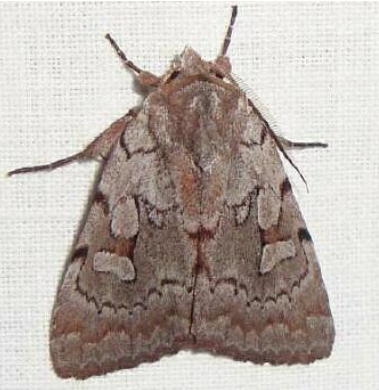
Xestia moths are medium-sized nocturnal moths belonging to the family Noctuidae. The genus includes numerous species known as dart moths, clay moths, and cutworm moths. They occur in forests, grasslands, gardens, agricultural fields, tundra, and other habitats across North America, Europe, Asia, and portions of the Southern Hemisphere.
Adult Xestia moths do not damage plants. Their caterpillars feed on leaves, stems, buds, seedlings, grasses, and low-growing vegetation. Some species are minor or occasional crop pests, while others live primarily on native plants and rarely cause noticeable damage.
Taxonomy and Classification
- Order: Lepidoptera
- Family: Noctuidae
- Subfamily: Noctuinae
- Genus: Xestia
- Common names: Dart moths, clay moths, cutworm moths, and Xestia moths
- Damaging stage: Caterpillar
The genus contains a diverse collection of species adapted to temperate, boreal, alpine, and Arctic environments. Some Xestia species are widely distributed, while others occupy relatively restricted mountain, forest, or tundra habitats.
Common Xestia Species
Examples of Xestia moths found in North America include:
- Spotted cutworm or lesser black-letter dart (Xestia c-nigrum): A widespread species whose larvae feed on numerous herbaceous plants and crops.
- Greater black-letter dart (Xestia dolosa): A brownish moth found across portions of eastern North America.
- Smith’s dart (Xestia smithii): A woodland and open-habitat species occurring across much of North America.
- Norman’s dart (Xestia normaniana): A North American species associated with wooded and mixed habitats.
- Setaceous Hebrew character (Xestia c-nigrum): Another common name used for the spotted cutworm moth because of the dark, letter-like marking on its forewing.
Many members of the genus look remarkably similar. Photographs may provide a preliminary identification, but separating certain species requires examination of wing patterns, geographic range, flight season, or anatomical characteristics.
Adult Moth Identification
Adult Xestia moths usually have stout, hairy bodies and a wingspan of approximately 1 to 2 inches. Their forewings are generally gray, tan, reddish-brown, or dark brown. These subdued colors provide camouflage when the moths rest on soil, tree bark, dead leaves, or weathered wood.
The forewings commonly display wavy crosslines and two traditional noctuid markings: a rounded orbicular spot and a kidney-shaped reniform spot. Some species also have dark wedges, pale bands, or black markings resembling letters or symbols.
The hindwings are typically lighter and less heavily patterned. At rest, the moth folds its forewings over its body, concealing most of the hindwings. Adults have threadlike antennae and a coiled proboscis used to drink liquids.
Caterpillar Identification
Xestia caterpillars generally have smooth, thick bodies with relatively few noticeable hairs. Their colors may include gray, green, brown, tan, or nearly black. Many have faint longitudinal stripes, dark spots, or mottled patterns that help them blend with soil and vegetation.
Mature larvae commonly reach 1 to 2 inches long, depending on the species. Like many cutworms, they frequently curl into a tight C-shape when disturbed. They may be found beneath soil clods, mulch, stones, boards, plant debris, or around the bases of damaged plants.
Distribution and Habitat
Xestia moths are distributed across much of the world, with particularly high diversity in northern temperate and boreal regions. North American species occur from the Arctic to the southern United States, although each has its own range.
Habitats include deciduous and coniferous forests, meadows, prairies, wetlands, gardens, vineyards, crop fields, alpine slopes, and tundra. Adults may be observed resting on vegetation during the day or flying around porch lights at night.
Life Cycle
Xestia moths undergo complete metamorphosis through egg, larval, pupal, and adult stages. Females deposit eggs on host plants, plant debris, stems, or nearby surfaces. Newly hatched caterpillars begin feeding on suitable vegetation.
Most caterpillars feed after sunset and hide near the soil during daylight. Some remain close to the ground and cut through young stems. Others climb plants at night to consume leaves, buds, flowers, fruit surfaces, or tender shoots.
Overwintering behavior varies among species. Some survive winter as eggs, while others overwinter as partially grown caterpillars. Larvae in especially cold northern environments may require more than one growing season to finish developing.
Fully developed caterpillars generally pupate in shallow soil chambers or beneath surface debris. Most temperate species produce one generation per year, but generation length varies with species, latitude, elevation, and climate.
Host Plants and Diet
Collectively, Xestia caterpillars feed on a wide variety of plants. Potential hosts include:
- Grasses and cereal crops
- Alfalfa and clover
- Vegetable seedlings
- Grapevines
- Low-growing weeds
- Wildflowers
- Deciduous shrubs and trees
- Conifer seedlings
- Boreal and tundra vegetation
Host range varies greatly between species. The spotted cutworm is a broad feeder that may damage crops and garden plants. Other Xestia caterpillars have narrower ecological associations and rarely appear in managed landscapes.
Plant Damage
Damage depends on the species and its feeding behavior. Ground-level cutworms may sever seedlings at or slightly below the soil surface. Climbing cutworms crawl up plants at night and feed on foliage, buds, flowers, or developing shoots.
Possible signs of Xestia caterpillar activity include:
- Seedlings cut off near the soil line
- Wilted plants with damaged stems
- Irregular holes along leaf edges
- Missing or damaged buds
- Chewed grapevine shoots during bud break
- Defoliated patches in gardens or fields
- Dark caterpillar droppings on foliage
- Caterpillars hiding in soil during the day
Most Xestia moths occur at levels too low to cause economically important injury. Damage becomes significant when favorable weather, abundant weeds, or other environmental conditions allow unusually large larval populations to develop.
Adult Behavior
Adult Xestia moths are primarily nocturnal. Many visit flowers to drink nectar and may contribute to nighttime pollination. They may also feed on tree sap, overripe fruit, or other sugary liquids.
Adults are attracted to porch lights, illuminated windows, and other artificial light sources. A moth found indoors has usually entered accidentally and is not evidence of an infestation. Xestia moths do not feed on clothing, stored food, carpeting, or structural wood.
Monitoring
Inspect susceptible plants for fresh chewing, clipped stems, and missing buds. Because larvae feed mainly at night, examine plants with a flashlight after sunset. During the day, gently disturb the upper 1 to 2 inches of soil near damaged plants and inspect beneath mulch or debris.
Light traps and species-specific pheromone traps may be used to monitor adult moth activity in agricultural settings. Adult captures indicate that a species is present, but crop treatment should be based on larval numbers and actual plant damage.
Management and Control
Correct identification is essential because many harmless noctuid caterpillars resemble damaging cutworms. Small numbers can usually be managed without insecticides.
- Remove caterpillars: Search plants and surrounding soil at night and place collected larvae in soapy water.
- Control weeds: Remove excessive weeds before planting because they may provide egg-laying sites and food for young larvae.
- Clear plant debris: Reduce heavy accumulations of residue where caterpillars can hide, while preserving beneficial habitat elsewhere.
- Protect seedlings: Place cardboard or plastic collars around vulnerable transplants, extending the barrier slightly into the soil.
- Cultivate exposed soil: Light cultivation before planting may expose hidden larvae and pupae to predators and weather.
- Encourage natural enemies: Ground beetles, birds, parasitic wasps, tachinid flies, pathogens, and predatory insects help suppress cutworms.
Btk may control small, actively feeding caterpillars, but it becomes less dependable as cutworms mature. Spinosad and other products labeled for cutworms may be available for particular plants or crops. Treatments are most effective when directed at young larvae during evening feeding activity.
Do not apply insecticides simply because adult moths are gathering around a light. Always confirm that larvae are causing unacceptable damage and follow the product label for the specific crop or treatment site.
Are Xestia Moths Dangerous?
Xestia moths do not bite, sting, or pose a medical threat to people or pets. Their caterpillars are not generally known for medically significant stinging hairs. The main concern is occasional feeding damage to seedlings, crops, gardens, or developing grapevine buds.
Conclusion
Xestia moths are a diverse group of nocturnal moths whose larvae include cutworms and climbing cutworms. Although certain species can damage seedlings, foliage, and crop buds, most remain inconspicuous parts of natural ecosystems. Nighttime inspection, weed management, physical barriers, protection of natural enemies, and targeted treatment of young larvae provide effective control when intervention is necessary.