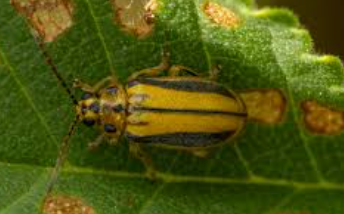
Xanthoura Leaf Beetles are herbivorous insects belonging to the family Chrysomelidae, one of the largest and most economically important beetle families in the world. These colorful beetles are known for their bright yellow, orange, or metallic coloration and their ability to cause significant feeding damage to a variety of trees, shrubs, and ornamental plants. Both adults and larvae feed on foliage, making them particularly destructive during periods of high population growth.
While most infestations remain localized, favorable weather conditions can allow populations to increase rapidly. During outbreak years, Xanthoura Leaf Beetles may severely defoliate host plants, reduce plant vigor, and leave ornamental landscapes looking damaged and unattractive.
Because both life stages feed on leaves, these beetles are considered important defoliating pests in gardens, nurseries, parks, and natural ecosystems.
Taxonomy and Classification
- Kingdom: Animalia
- Phylum: Arthropoda
- Class: Insecta
- Order: Coleoptera
- Family: Chrysomelidae
- Genus: Xanthoura
The family Chrysomelidae contains thousands of species commonly referred to as leaf beetles. Most members are plant feeders and many are considered significant agricultural or ornamental pests. Xanthoura species fit this pattern, feeding extensively on foliage throughout their development.
Identification
Xanthoura Leaf Beetles are typically small to medium-sized beetles with a rounded, convex appearance.
- Size: Usually 5 mm to 8 mm long.
- Color: Bright yellow, orange, green, or metallic hues.
- Shape: Oval and strongly convex.
- Legs: Well-developed, with enlarged hind legs in some species.
- Wings: Hard wing covers protecting the abdomen.
The larvae differ significantly from adults and are often described as slug-like or grub-like.
- Soft-bodied appearance.
- Dark, yellow, or mottled coloration.
- Black tubercles or markings.
- Frequently found feeding in groups.
Adults create chewing damage, while larvae often skeletonize leaves by consuming soft tissues between veins. :contentReference[oaicite:2]{index=2}
Distribution and Habitat
Xanthoura Leaf Beetles are found throughout many regions of North America, particularly where host plants are abundant.
Common habitats include:
- Riparian corridors
- Ornamental landscapes
- Home gardens
- Tree nurseries
- Parks
- Forest edges
- Urban plantings
They are especially common in warm climates and are most active during late spring and summer when foliage growth is abundant.
Host Plants
Xanthoura Leaf Beetles feed on a variety of woody and herbaceous plants.
Common hosts include:
- Willows
- Alders
- Roses
- Fruit trees
- Members of the Rosaceae family
- Various ornamental shrubs
Although some species show preferences for particular plants, many can feed on multiple hosts when populations become large.
Life Cycle
Xanthoura Leaf Beetles undergo complete metamorphosis.
- Egg Stage: Eggs are deposited on the undersides of leaves.
- Larval Stage: Larvae hatch and begin feeding immediately.
- Pupal Stage: Pupation occurs in soil, leaf litter, or plant debris.
- Adult Stage: Adults emerge, feed, mate, and continue the cycle.
Several generations may develop annually in warm regions, allowing populations to build rapidly during the growing season.
Damage and Economic Importance
Both adults and larvae contribute to plant damage.
Adult Feeding
- Irregular chewing holes.
- Shot-hole appearance.
- Reduced leaf surface area.
Larval Feeding
- Leaf skeletonization.
- Removal of soft tissue.
- Retention of leaf veins.
Plant Stress
Repeated feeding reduces photosynthetic capacity.
- Reduced vigor.
- Slower growth.
- Premature leaf drop.
- Increased susceptibility to secondary pests.
Severe infestations may weaken trees and shrubs by preventing adequate carbohydrate storage in roots and stems. Repeated annual defoliation can contribute to branch dieback and long-term decline.
Nursery Impact
Commercial nurseries often experience economic losses due to:
- Defoliated stock.
- Reduced plant quality.
- Larval frass contamination.
- Unsellable ornamental plants.
Signs of Infestation
Common indicators include:
- Irregular holes in leaves.
- Skeletonized foliage.
- Clusters of larvae on leaf undersides.
- Visible adult beetles.
- Accumulations of frass.
- Defoliated branches.
Early detection is important because damage can increase rapidly when both larvae and adults are feeding simultaneously.
Behavior and Conflict
The primary conflict associated with Xanthoura Leaf Beetles is their ability to rapidly consume foliage.
- Dual Feeding: Adults and larvae feed simultaneously.
- Aggregation: Larvae often feed in groups.
- Rapid Defoliation: Large populations remove significant leaf tissue.
- Multiple Generations: Population growth can accelerate during summer.
The combined feeding activity can quickly transform healthy foliage into skeletonized remains, particularly on susceptible ornamental plants.
Management and Prevention
Integrated Pest Management (IPM) is the preferred control strategy.
Monitoring
- Inspect foliage regularly.
- Check leaf undersides.
- Monitor for adult activity.
- Track larval populations.
Mechanical Control
- Hand-remove larvae when practical.
- Use strong water sprays to dislodge larvae.
- Prune heavily infested branches.
Biological Control
- Encourage lady beetles.
- Protect lacewings.
- Preserve predatory insects.
- Support natural enemy populations.
Organic Treatments
- Spinosad applications.
- Neem oil treatments.
- Targeted biological products.
Dormant Season Management
- Apply horticultural oils where appropriate.
- Reduce overwintering adults.
- Remove plant debris.
Cultural Practices
- Maintain healthy plants.
- Provide proper irrigation.
- Reduce plant stress.
- Promote vigorous growth.
Conservation and Research
Researchers continue studying Xanthoura Leaf Beetles to better understand host preferences, population dynamics, and biological control opportunities. Current research focuses on reducing pesticide reliance through improved monitoring techniques and conservation of natural predators.
Although Xanthoura Leaf Beetles are not always major economic pests, outbreaks can cause substantial defoliation and aesthetic damage. Early detection, conservation of beneficial insects, and integrated pest management remain the most effective approaches for maintaining healthy landscapes and preventing serious infestations.