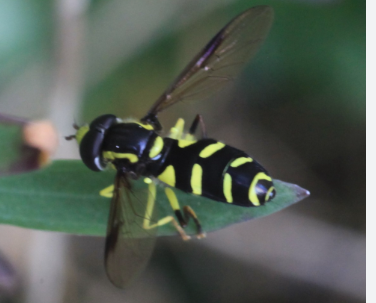
Xanthogramma Hoverflies are beneficial insects belonging to the family Syrphidae. These remarkable flies are famous for their bright yellow-and-black coloration, which closely resembles that of wasps. Despite their appearance, they are completely harmless to humans and cannot sting. Their resemblance to stinging insects is a defensive adaptation that helps protect them from predators.
Hoverflies in the genus Xanthogramma are highly valued in gardens, agricultural landscapes, and natural ecosystems because they provide two critical ecological services. Adults function as pollinators, visiting flowers to feed on nectar and pollen, while their larvae help suppress populations of aphids and other plant pests. This dual role makes them among the most important beneficial insects in integrated pest management programs. :contentReference[oaicite:1]{index=1}
Taxonomy and Classification
- Kingdom: Animalia
- Phylum: Arthropoda
- Class: Insecta
- Order: Diptera
- Family: Syrphidae
- Genus: Xanthogramma
Hoverflies belong to the order Diptera, meaning they possess a single pair of wings. Unlike bees and wasps, which have four wings, hoverflies have only two functional wings and a pair of balancing organs called halteres.
Species such as Xanthogramma flavipes are among the best-known representatives of this genus and are widely recognized for their wasp-like appearance and beneficial ecological role. :contentReference[oaicite:2]{index=2}
Identification
Xanthogramma Hoverflies can often be mistaken for yellowjackets or other stinging wasps at first glance.
- Size: Typically 5 mm to 10 mm long.
- Coloration: Bright yellow and black markings.
- Body Shape: Flattened abdomen with distinct banding.
- Eyes: Large compound eyes covering much of the head.
- Wings: One pair of transparent wings.
- Flight: Capable of hovering motionless in mid-air.
Their ability to remain suspended while flying is one of the easiest ways to distinguish them from wasps. Hoverflies frequently pause in the air before darting rapidly to another flower or perch. :contentReference[oaicite:3]{index=3}
Distribution and Habitat
Xanthogramma Hoverflies are found throughout Europe and parts of North America. They thrive wherever flowering plants provide abundant nectar and pollen resources.
Common habitats include:
- Home gardens
- Wildflower meadows
- Agricultural fields
- Orchards
- Parks
- Roadside vegetation
- Natural grasslands
Many species prefer sunny locations with diverse flowering plants. Larvae are often found in soil, leaf litter, or areas where aphid populations are abundant. :contentReference[oaicite:4]{index=4}
Life Cycle
Xanthogramma Hoverflies undergo complete metamorphosis consisting of four stages:
- Egg
- Larva
- Pupa
- Adult
Females carefully deposit eggs near aphid colonies or suitable feeding sites.
After hatching, larvae immediately begin feeding. The immature stage is often translucent green, yellow, or brown and resembles a small slug or maggot.
During development, a single larva may consume hundreds of aphids and other soft-bodied insects.
After completing larval growth, pupation occurs in protected locations. Adults eventually emerge and begin feeding on flower nectar and pollen.
Several generations may develop annually under favorable conditions. :contentReference[oaicite:5]{index=5}
Behavior and Ecological Importance
Xanthogramma Hoverflies are among the most valuable beneficial insects found in landscapes and agricultural systems.
Pollination
Adults regularly visit flowers to feed on nectar and pollen.
- Transfer pollen between flowers.
- Support wildflower reproduction.
- Assist fruit production.
- Enhance biodiversity.
Biological Control
Larvae are important natural predators.
- Aphids
- Root aphids
- Small soft-bodied insects
- Other pest larvae
Their feeding activity helps suppress pest populations naturally, reducing reliance on chemical insecticides. :contentReference[oaicite:6]{index=6}
Mimicry
The yellow-and-black coloration serves as a form of protective mimicry.
Predators often mistake hoverflies for stinging insects and avoid attacking them, even though hoverflies lack stingers entirely.
Relationship with Ants
Some Xanthogramma species exhibit fascinating ecological relationships with ants.
Certain larvae are considered myrmecophilous, meaning they live near or within ant colonies. These larvae may feed on root aphids that ants actively protect and farm for honeydew.
This specialized behavior highlights the complexity of hoverfly ecology and contributes to their effectiveness as biological control agents. :contentReference[oaicite:7]{index=7}
Benefits to Agriculture
Xanthogramma Hoverflies provide numerous benefits to farmers and gardeners.
- Natural aphid suppression.
- Improved crop pollination.
- Reduced pesticide dependence.
- Enhanced ecosystem health.
- Support for sustainable agriculture.
Fields with strong hoverfly populations often experience lower aphid pressure and improved biological balance.
Management and Conservation
Because Xanthogramma Hoverflies are beneficial insects, management focuses on conservation rather than control.
Plant Nectar Sources
Provide flowers that offer easy nectar access.
- Dill
- Fennel
- Cilantro
- Alyssum
- Yarrow
- Queen Anne’s Lace
Avoid Broad-Spectrum Insecticides
Many insecticides that kill pests also harm hoverflies and their larvae.
- Use targeted treatments only when necessary.
- Preserve beneficial insect populations.
- Practice integrated pest management.
Maintain Habitat Diversity
- Leave areas of natural vegetation.
- Retain leaf litter and mulch.
- Provide flowering plants throughout the season.
- Create pollinator-friendly landscapes.
Provide Water Sources
Shallow water stations with stones can help adult hoverflies survive during hot, dry weather.
Conservation and Research
Scientists continue studying Xanthogramma Hoverflies to better understand their role in biological control and pollination. Research focuses on habitat requirements, larval feeding behavior, interactions with ants, and methods for increasing hoverfly populations in agricultural environments.
As interest in sustainable agriculture grows, hoverflies are becoming increasingly important as natural allies in reducing pest populations while supporting pollination services.
Xanthogramma Hoverflies are outstanding examples of beneficial insects. Their combination of effective aphid predation, valuable pollination services, and harmless nature makes them an important component of healthy gardens, farms, and natural ecosystems. Encouraging their presence can significantly improve biological pest control while promoting long-term environmental sustainability. :contentReference[oaicite:8]{index=8}