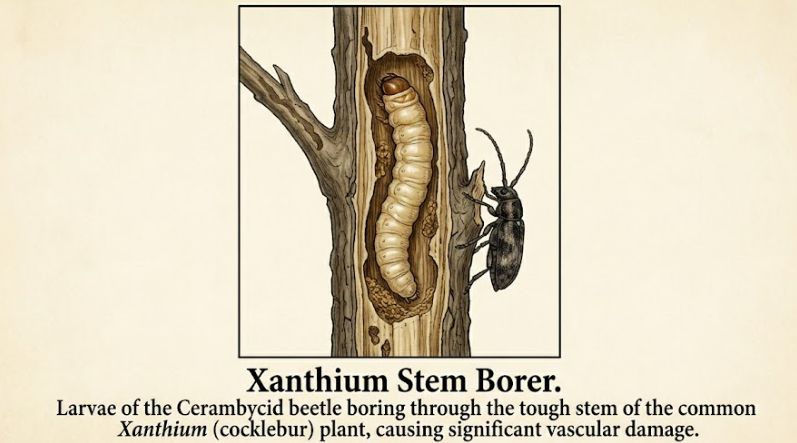
Xanthium Stem Borers are specialized insects whose larvae develop inside the stems of plants belonging to the genus Xanthium, commonly known as cockleburs. These insects are often associated with certain longhorned beetles and stem-boring moths that use cocklebur plants as hosts for reproduction and larval development.
Unlike leaf-feeding insects that cause visible damage on plant surfaces, stem borers feed internally, making infestations difficult to detect until significant injury has occurred. Their tunneling activity disrupts the movement of water and nutrients throughout the plant, weakens structural integrity, and frequently causes stems to break or collapse.
Although stem borers can be considered pests when they attack desirable plants, species associated with cockleburs are often viewed as beneficial biological control agents. By reducing plant vigor and seed production, they help suppress invasive cocklebur populations in agricultural and natural ecosystems.
Taxonomy and Classification
- Kingdom: Animalia
- Phylum: Arthropoda
- Class: Insecta
- Order: Coleoptera or Lepidoptera
- Family: Various stem-boring beetle and moth families
- Common Name: Xanthium Stem Borers
Stem borers include a wide variety of insects that share a common feeding strategy. Their larvae develop within plant stems, where they are protected from many predators and environmental hazards.
Identification
Adult appearance varies depending on the species involved.
- Size: Generally 8 mm to 15 mm long.
- Body Shape: Slender and elongated.
- Color: Gray, brown, black, or bluish-gray.
- Antennae: Often long and conspicuous in beetle species.
- Movement: Active flyers during warm months.
Adults are commonly observed resting on host plants during the summer growing season.
Larvae
The larval stage is responsible for nearly all plant damage.
- Creamy white coloration.
- Legless body.
- Cylindrical shape.
- Brown head capsule.
- Internal stem feeder.
Larvae spend most of their development concealed within plant stems where they feed on internal tissues.
Distribution and Habitat
Xanthium Stem Borers occur wherever cocklebur plants grow.
Common habitats include:
- Agricultural fields
- Pastures
- Roadsides
- Field margins
- Disturbed soils
- Riverbanks
- Grasslands
- Open rangelands
Because cockleburs thrive in disturbed environments, stem borers are frequently encountered in agricultural landscapes and grazing areas.
Life Cycle
Xanthium Stem Borers undergo complete metamorphosis.
- Egg Stage: Females deposit eggs on stems or foliage.
- Larval Stage: Newly hatched larvae bore into stems and begin feeding internally.
- Pupal Stage: Pupation occurs inside the stem or within nearby soil.
- Adult Stage: Adults emerge and seek mates and host plants.
Most species complete one generation annually, although warmer climates may support additional generations.
Host Plants
Stem borers associated with cockleburs primarily attack species within the genus Xanthium.
- Xanthium strumarium (Common Cocklebur)
- Xanthium spinosum (Spiny Cocklebur)
- Other regional cocklebur species
Some stem-boring species may also utilize related host plants depending on environmental conditions.
Damage and Economic Importance
The primary impact of Xanthium Stem Borers results from internal feeding.
Stem Tunneling
Larvae excavate galleries throughout the plant stem.
- Disrupted water transport.
- Disrupted nutrient movement.
- Internal tissue destruction.
- Reduced plant vigor.
Damage often remains hidden until plants begin showing external symptoms.
Wilting and Stunting
Infested plants commonly exhibit stress symptoms.
- Wilted foliage.
- Reduced growth.
- Smaller leaves.
- Poor overall health.
These symptoms result from impaired vascular function caused by internal tunneling.
Stem Breakage and Lodging
One of the most recognizable effects is structural failure.
- Weak stems.
- Stem collapse.
- Lodging near the base.
- Reduced seed production.
As larvae hollow out the stem, the plant becomes increasingly vulnerable to wind and environmental stress.
Reduced Reproduction
Stem damage directly affects reproductive success.
- Fewer flowers.
- Reduced bur production.
- Lower seed viability.
- Decreased weed spread.
This reduction in reproductive output contributes significantly to biological weed suppression.
Signs of Infestation
Several indicators can help identify infestations.
- Small entry holes.
- Sawdust-like frass.
- Wilting stems.
- Broken plants.
- Hollow stem interiors.
- Visible larvae inside stems.
Cutting stems lengthwise often reveals internal tunnels and feeding galleries.
Behavior and Ecology
Xanthium Stem Borers are highly adapted to life inside plant stems.
- Protected internal development.
- Reduced exposure to predators.
- Efficient nutrient access.
- Host-specific feeding habits.
The concealed nature of larval development makes these insects effective long-term suppressors of invasive cocklebur populations.
Management and Conservation
Because many Xanthium Stem Borers provide biological control benefits, conservation is often preferred.
Protect Beneficial Populations
- Monitor population levels.
- Preserve established colonies.
- Support natural weed control.
- Reduce unnecessary interventions.
Avoid Broad-Spectrum Insecticides
Non-selective insecticides can eliminate beneficial stem borers.
- Use selective treatments when needed.
- Protect biological control agents.
- Minimize ecosystem disruption.
Integrated Weed Management
- Combine biological control with mowing.
- Use targeted herbicide treatments.
- Monitor invasive weed populations.
- Encourage multiple control agents.
Integrating several approaches often provides the most effective long-term suppression of invasive cockleburs.
Research and Biological Control Applications
Researchers continue studying Xanthium Stem Borers because of their effectiveness in suppressing invasive weed populations. Current research focuses on host specificity, establishment success, life cycle biology, and interactions with other biological control organisms.
Scientists are also evaluating how stem borers can be integrated into sustainable weed management programs while minimizing impacts on non-target species.
Conclusion
Xanthium Stem Borers are specialized insects that attack cocklebur plants from the inside out. Their larvae tunnel through stems, disrupt nutrient transport, weaken structural integrity, and reduce seed production. While hidden from view for much of their life cycle, their impact on invasive cocklebur populations can be substantial, making them valuable biological control agents in agricultural and natural ecosystems.