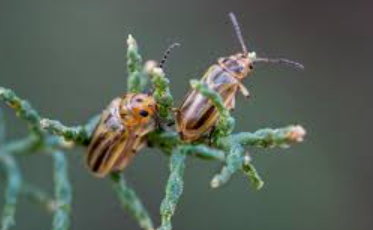
Xanthium Leaf Beetles are herbivorous insects belonging to the family Chrysomelidae that specialize in feeding on plants in the genus Xanthium, commonly known as cockleburs. These beetles consume leaf tissue throughout both their larval and adult stages, often causing significant defoliation when populations become abundant.
Unlike many agricultural pests, Xanthium Leaf Beetles can serve an important beneficial role. Because cockleburs are considered invasive weeds in many regions, these beetles are frequently recognized as valuable biological control agents. Their feeding activity weakens plants, reduces seed production, and limits the spread of invasive populations without the use of herbicides.
In areas where cockleburs threaten crops, livestock pastures, or native vegetation, Xanthium Leaf Beetles can provide substantial natural suppression and are often encouraged as part of integrated weed management programs.
Taxonomy and Classification
- Kingdom: Animalia
- Phylum: Arthropoda
- Class: Insecta
- Order: Coleoptera
- Family: Chrysomelidae
- Common Name: Xanthium Leaf Beetles
Leaf beetles are among the most diverse groups of plant-feeding beetles. Many species are agricultural pests, while others provide beneficial services by targeting invasive or undesirable plants.
Identification
Xanthium Leaf Beetles are small to medium-sized beetles with a characteristic oval shape.
- Size: Typically 4 mm to 6 mm long.
- Body Shape: Oval and compact.
- Color: Yellow, tan, brown, or striped depending on species.
- Wing Covers: Hardened elytra often displaying dark longitudinal markings.
- Movement: Active crawlers that readily move between leaves.
Adults are commonly observed feeding on the upper surfaces of cocklebur leaves during the growing season.
Larvae
The larval stage is equally destructive.
- Yellowish-white body.
- Soft-bodied appearance.
- Dark spots or tubercles along the sides.
- Frequently feed in groups.
Larvae often cluster together on leaves, consuming large amounts of foliage in a short period of time.
Eggs
Egg masses are typically deposited on leaf undersides.
- Bright yellow or orange coloration.
- Grouped clusters.
- Protected placement beneath foliage.
Distribution and Habitat
Xanthium Leaf Beetles are found wherever suitable Xanthium host plants occur.
Common habitats include:
- Agricultural field margins
- Pastures
- Roadsides
- Disturbed soils
- Riverbanks
- Open grasslands
- Weedy lots
- Naturalized areas
Their populations are closely tied to the abundance of cocklebur plants and related hosts.
Life Cycle
Xanthium Leaf Beetles undergo complete metamorphosis.
- Egg Stage: Females deposit clusters of eggs on host plant leaves.
- Larval Stage: Larvae hatch and begin feeding immediately.
- Pupal Stage: Pupation typically occurs in soil or plant debris.
- Adult Stage: Adults emerge and continue feeding and reproduction.
Depending on climate and environmental conditions, several generations may occur each year.
Host Plants
These beetles are highly associated with cocklebur species.
- Xanthium strumarium (Common Cocklebur)
- Xanthium spinosum (Spiny Cocklebur)
- Related weed species in the sunflower family
Their preference for these invasive weeds makes them particularly valuable in biological control programs.
Damage and Economic Importance
Xanthium Leaf Beetles cause damage through direct feeding on foliage.
Leaf Feeding
Both larvae and adults consume leaf tissue.
- Small feeding holes.
- Chewed leaf margins.
- Reduced leaf area.
- Visible feeding scars.
Skeletonization
Heavy infestations can result in skeletonized leaves.
- Leaf tissue removed between veins.
- Lacy appearance.
- Reduced photosynthesis.
- Severe plant stress.
Entire patches of cocklebur plants may become heavily defoliated when beetle populations are high.
Reduced Flowering and Seed Production
Defoliation significantly affects plant reproduction.
- Fewer flowers.
- Reduced bur production.
- Lower seed viability.
- Reduced weed spread.
By limiting seed production, the beetles help reduce future generations of invasive cockleburs.
Agricultural Benefits
Cockleburs compete with crops and pasture vegetation.
- Reduce forage quality.
- Compete for nutrients.
- Compete for water.
- Interfere with harvesting operations.
The feeding activity of Xanthium Leaf Beetles helps suppress these unwanted weeds naturally.
Signs of Infestation
- Chewed leaves.
- Skeletonized foliage.
- Adult beetles on leaves.
- Larval clusters feeding together.
- Yellow-orange egg masses.
- Reduced plant vigor.
Severe infestations are often highly visible because of extensive foliage loss.
Behavior and Ecology
Xanthium Leaf Beetles are active herbivores that spend most of their lives on host plants.
- Adults feed openly on leaves.
- Larvae often feed in groups.
- Multiple generations may develop annually.
- Population growth can be rapid.
When conditions are favorable, populations can expand quickly and provide substantial suppression of cocklebur infestations.
Management and Conservation
Management strategies generally focus on conserving beneficial populations rather than eliminating them.
Biological Control Programs
- Protect existing populations.
- Monitor establishment success.
- Evaluate weed suppression.
- Reduce herbicide dependence.
Avoid Broad-Spectrum Insecticides
Non-selective insecticides can eliminate beneficial beetles.
- Use selective treatments when necessary.
- Protect biological control agents.
- Maintain natural suppression.
Integrated Weed Management
- Combine biological control with mowing.
- Use targeted herbicide applications.
- Monitor invasive weed populations.
- Preserve beneficial insect habitat.
Combining multiple management strategies often produces the best long-term results.
Research and Biological Control Applications
Researchers continue studying Xanthium Leaf Beetles because of their effectiveness against invasive weeds. Current research focuses on population dynamics, host specificity, establishment success, and integration with other weed management strategies.
Scientists are also evaluating how these beetles interact with native ecosystems and how they can be used most effectively in sustainable land management programs.
Conclusion
Xanthium Leaf Beetles are important herbivorous insects that can function as highly effective biological control agents against invasive cocklebur species. Their feeding reduces plant vigor, limits seed production, and suppresses weed populations naturally. For land managers, farmers, and conservation professionals, these beetles represent a valuable tool for environmentally responsible weed management.