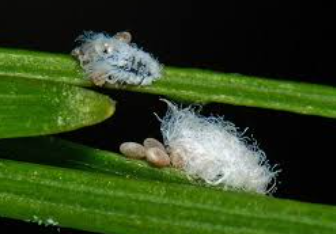
Woolly Larch Adelgids
Woolly larch adelgids (Adelges laricis) are small sap-feeding insects that attack larch and spruce trees. Closely related to aphids, these insects are best known for producing distinctive white, cotton-like wax that covers their bodies and colonies. Their complex life cycle alternates between spruce and larch hosts, where they cause different types of damage. On spruce trees they induce the formation of cone-like galls, while on larch trees they feed directly on needles and shoots.
Although woolly larch adelgids rarely kill mature trees, repeated infestations can reduce growth, weaken trees, and diminish the ornamental value of landscape plantings. Heavy populations may lead to needle yellowing, premature needle drop, branch thinning, and increased susceptibility to environmental stress and secondary pests.
Taxonomy and Classification
- Kingdom: Animalia
- Phylum: Arthropoda
- Class: Insecta
- Order: Hemiptera
- Family: Adelgidae
- Genus: Adelges
- Species: Adelges laricis
Adelgids are closely related to aphids but differ in their host preferences, wax production, and often highly complex life cycles involving multiple tree species.
Physical Description
Adult Adelgids
Adult woolly larch adelgids are extremely small and difficult to see without magnification.
- Length: Approximately 1–2 millimeters.
- Body Color: Dark brown to black.
- Covering: Dense white waxy filaments.
- Appearance: Cotton-like clusters on needles and shoots.
- Mobility: Limited after settling to feed.
The waxy covering protects the insects from predators, weather, and some insecticide applications.
Nymphs
Immature adelgids resemble adults but are smaller and less heavily covered with wax. They develop through several stages before reaching maturity.
Distribution and Habitat
Woolly larch adelgids occur throughout regions where both spruce and larch trees are present.
In North America they are commonly found in:
- Northeastern United States.
- Great Lakes region.
- Upper Midwest.
- Canadian forests.
- Landscape plantings.
- Nurseries and arboretums.
Their distribution closely follows the availability of suitable host trees.
Host Plants
This species requires two hosts to complete its traditional life cycle.
Primary Hosts
- Larch (Larix species).
- Tamarack.
- European larch.
- Japanese larch.
Secondary Hosts
- Spruce (Picea species).
- Norway spruce.
- White spruce.
- Black spruce.
Damage differs depending on which host tree is being attacked.
Life Cycle
Woolly larch adelgids have one of the more complex life cycles among sap-feeding insects.
Gall Formation on Spruce
The cycle often begins on spruce trees.
Females feed on developing buds and stimulate the formation of cone-shaped galls that resemble miniature pineapples.
- Galls protect developing adelgids.
- Nymphs develop safely inside.
- Winged forms later emerge.
Migration to Larch
Winged adults leave spruce and migrate to nearby larch trees.
Once on larch, they settle on needles and shoots, where multiple generations may occur.
Summer Feeding
Colonies expand throughout the growing season.
The insects extract sap from needles and young tissues while producing characteristic white waxy secretions.
Return to Spruce
Later generations may return to spruce hosts to continue the cycle and produce new galls.
Signs of Infestation
Common symptoms include:
- White cottony masses on needles.
- Clusters of wax-covered insects.
- Yellowing needles.
- Needle curling or distortion.
- Premature needle drop.
- Reduced shoot growth.
- Cone-shaped galls on spruce.
- Branch thinning.
Spruce galls are often the most recognizable sign of infestation.
Damage and Economic Importance
Larch Damage
On larch trees, feeding affects needles and young growth.
- Needle yellowing.
- Reduced photosynthesis.
- Premature needle drop.
- Growth reduction.
- Thinning canopies.
Repeated infestations can gradually weaken trees over time.
Spruce Damage
On spruce trees, gall formation can interfere with normal growth.
- Distorted shoots.
- Killed terminal buds.
- Branch deformities.
- Reduced aesthetic value.
- Stunted growth.
Ornamental Impact
Landscape specimens may lose much of their visual appeal when covered with white woolly masses or deformed by gall production.
Tree Stress
Although mature trees generally survive infestations, repeated attacks can increase susceptibility to:
- Drought stress.
- Winter injury.
- Bark beetles.
- Secondary diseases.
- Other conifer pests.
Natural Enemies
Several beneficial organisms help suppress adelgid populations.
- Lady beetles.
- Lacewing larvae.
- Predatory flies.
- Minute pirate bugs.
- Parasitic insects.
- Spiders.
Healthy predator populations often keep infestations below damaging levels.
Management and Control
Monitoring
Regular inspection is the foundation of management.
- Check larch needles in spring.
- Inspect spruce tips for galls.
- Look for white waxy masses.
- Monitor tree vigor annually.
Pruning
Removing spruce galls before adults emerge can significantly reduce future populations.
- Prune infested shoots.
- Destroy removed material.
- Remove galls before midsummer emergence.
Water Sprays
Strong water sprays can physically remove adelgids from small ornamental trees.
This approach is most effective when populations are discovered early.
Dormant Oils
Horticultural oils applied before bud break may suppress overwintering populations.
Coverage is critical for successful control.
Systemic Treatments
For severe infestations on valuable landscape specimens, systemic insecticides may provide season-long protection.
Treatments are generally most effective when applied before populations become heavily established.
Host Separation
Where practical, avoiding the close planting of spruce and larch trees can disrupt the insect’s life cycle and reduce infestation pressure.
Prevention
- Maintain tree vigor through proper watering.
- Avoid unnecessary stress.
- Inspect nursery stock before planting.
- Monitor annually for galls.
- Encourage beneficial insects.
- Prune infested growth promptly.
- Maintain proper tree spacing.
Conclusion
Woolly larch adelgids are specialized sap-feeding pests that alternate between spruce and larch trees. Their distinctive white waxy colonies and gall-forming behavior make them relatively easy to identify, although their complex life cycle can complicate management. While rarely fatal, repeated infestations can reduce growth, cause needle loss, deform shoots, and diminish landscape value. Through regular monitoring, gall removal, biological control conservation, and targeted treatments when necessary, homeowners and arborists can successfully manage woolly larch adelgid populations and maintain healthy conifer trees.