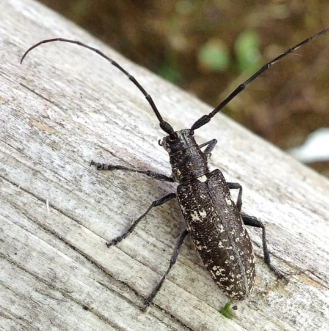
White-spotted sawyer beetles (Monochamus scutellatus) are large wood-boring beetles commonly found throughout the coniferous forests of North America. These insects are members of the longhorn beetle family and are easily recognized by their exceptionally long antennae and distinctive white spot located near the center of their wing covers. While they play an important ecological role in breaking down dead and dying trees, they are also considered significant forestry pests because their larvae tunnel through wood and adults can transmit organisms associated with tree diseases.
White-spotted sawyers primarily attack weakened, recently dead, storm-damaged, or fire-injured conifer trees. However, their presence can greatly reduce timber quality and create pathways for fungal infections and other wood-degrading organisms. Their association with pinewood nematodes has also made them important subjects in forest health monitoring programs across North America.
Taxonomy and Classification
- Kingdom: Animalia
- Phylum: Arthropoda
- Class: Insecta
- Order: Coleoptera
- Family: Cerambycidae
- Subfamily: Lamiinae
- Genus: Monochamus
- Species: Monochamus scutellatus
White-spotted sawyers belong to the longhorn beetle family, a group known for their elongated antennae and wood-boring larvae. The genus Monochamus includes several species commonly referred to as pine sawyers.
Physical Description
Adult Beetles
Adult White-spotted Sawyer Beetles are among the largest longhorn beetles found in North America.
- Length: 15–30 millimeters.
- Color: Dark brown to black.
- Body Shape: Cylindrical and elongated.
- Distinctive Marking: Single white spot at the base of the wing covers.
- Antennae: Often longer than the body, especially in males.
The white scutellum, located between the wing covers, gives the species its common name and serves as one of the easiest identification features.
Larvae
The larvae are commonly called roundheaded borers.
- Creamy white coloration.
- Legless body.
- Brown head capsule.
- Can reach 50 millimeters or more in length.
- Strong jaws adapted for boring through wood.
Larvae spend most of their lives concealed within trees and logs.
Distribution and Habitat
White-spotted sawyer beetles are widespread throughout North America.
They are commonly found in:
- Canada
- Alaska
- Northeastern United States
- Great Lakes region
- Pacific Northwest
- Rocky Mountain forests
The species is strongly associated with coniferous forests.
Preferred host trees include:
- Spruce
- Fir
- Pine
- Hemlock
- Larch
Adults are frequently encountered on freshly cut logs, dead trees, logging sites, and fire-damaged forests.
Life Cycle
Egg Stage
Female beetles deposit eggs individually beneath bark crevices or within small notches chewed into the bark.
Egg laying typically occurs on weakened or recently dead conifers.
Larval Stage
After hatching, larvae initially feed beneath the bark before tunneling deeper into the wood.
As they grow, they excavate large galleries that may extend several inches into the heartwood.
This stage causes most of the economic damage associated with the species.
Pupal Stage
When mature, larvae create pupal chambers within the wood.
Pupation occurs inside these chambers and may last several weeks.
Adult Emergence
Adults chew perfectly round exit holes through the bark when emerging.
Development generally requires one to two years depending on climate, host condition, and environmental factors.
Behavior and Ecology
Wood Decomposition
White-spotted sawyers play an important ecological role by helping decompose dead trees.
Their tunneling activity accelerates:
- Nutrient recycling.
- Wood breakdown.
- Fungal colonization.
- Habitat creation for other organisms.
Strong Flying Ability
Adults are powerful fliers capable of traveling considerable distances in search of suitable host trees.
This mobility contributes to their importance as vectors of tree pathogens.
Audible Feeding
Large larvae feeding within logs sometimes produce audible chewing sounds.
People working around infested timber occasionally hear scraping or gnawing noises from inside the wood.
Pinewood Nematode Association
One of the most important aspects of White-spotted Sawyer biology is its association with pinewood nematodes.
These microscopic roundworms can be transported by adult beetles as they emerge from infested wood.
When adults feed on healthy trees, nematodes may be introduced into new hosts.
Pinewood nematodes are responsible for pine wilt disease, a serious tree disease that can cause rapid mortality in susceptible pine species.
Although pine wilt is more common in some regions than others, the role of sawyer beetles as vectors has made them a major focus of forestry research and quarantine efforts.
Damage and Economic Importance
Timber Damage
The most significant damage results from larval tunneling.
- Reduces lumber quality.
- Creates structural defects.
- Produces unsightly holes.
- Increases wood waste.
- Lowers market value.
Even when wood remains structurally usable, extensive galleries often reduce its commercial value.
Forest Health Concerns
Although White-spotted Sawyer Beetles usually attack stressed trees rather than healthy ones, large populations can accelerate forest decline following:
- Drought.
- Wildfires.
- Storm damage.
- Logging activities.
- Disease outbreaks.
Disease Transmission
The ability to transport pinewood nematodes significantly increases the economic importance of this species.
Forestry agencies often monitor sawyer populations as part of broader forest health programs.
Signs of Infestation
Common indicators include:
- Round adult exit holes.
- Sawdust-like frass.
- Loose bark.
- Tunnels beneath bark.
- Large galleries within wood.
- Woodpecker activity.
- Declining conifer trees.
Freshly cut logs often show signs of infestation within weeks of beetle colonization.
Management and Control
Sanitation Practices
Proper management begins with removing attractive breeding material.
- Promptly remove storm-damaged trees.
- Process harvested timber quickly.
- Reduce slash accumulation.
- Dispose of infested wood.
Debarking Logs
Removing bark from harvested logs prevents females from laying eggs and reduces larval survival.
Heat Treatment
Kiln drying and heat treatment effectively eliminate larvae, pupae, and adults.
This approach is widely used in commercial lumber production.
Firewood Management
Transporting infested firewood is one of the primary ways wood-boring insects spread.
Homeowners should:
- Buy local firewood.
- Burn firewood where purchased.
- Avoid moving untreated logs long distances.
- Inspect stored wood regularly.
Forest Management
Maintaining healthy forests reduces vulnerability to infestation.
- Selective thinning.
- Drought stress reduction.
- Prompt salvage logging.
- Disease monitoring.
- Wildfire management.
Interesting Facts
- Male antennae can exceed twice the length of their bodies.
- Larvae may remain hidden inside wood for more than a year.
- Adults can produce squeaking sounds when handled.
- The species helps recycle nutrients in forest ecosystems.
- White-spotted sawyers are among the most commonly encountered longhorn beetles in northern forests.
Conclusion
White-spotted Sawyer Beetles are important insects in North American forest ecosystems. While they contribute to the natural decomposition of dead wood, their larval tunneling can significantly reduce timber value, and their role as vectors of pinewood nematodes increases their importance to forestry and forest health programs. Early detection, proper wood management, and sound forestry practices remain the most effective strategies for minimizing economic losses while maintaining healthy forest ecosystems.