White-marked Tussock Moths
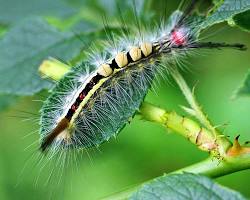
White-marked Tussock Moths (Orgyia leucostigma) are distinctive native moths found throughout eastern North America. They are best known for their striking caterpillars, which possess colorful tufts of hair and unique brush-like structures along their backs. Although the adult moths cause no damage, the caterpillars are important defoliators of shade trees, ornamental trees, fruit trees, and shrubs.
White-marked Tussock Moth caterpillars feed on hundreds of plant species and can occasionally reach outbreak levels that result in significant defoliation. In addition to plant damage, these caterpillars are known for their irritating hairs, which may cause skin rashes, itching, and allergic reactions in sensitive individuals. Because of their unusual appearance and broad host range, they are among the most recognizable caterpillar pests in North America.
While healthy trees often recover from moderate feeding, repeated defoliation can weaken plants and increase their susceptibility to drought, disease, and other insect pests.
Taxonomy and Classification
- Kingdom: Animalia
- Phylum: Arthropoda
- Class: Insecta
- Order: Lepidoptera
- Family: Erebidae
- Genus: Orgyia
- Species: Orgyia leucostigma
White-marked Tussock Moths belong to a group commonly known as tussock moths, named for the dense tufts of hair found on their caterpillars.
Identification
Caterpillar
The larval stage is the most recognizable and damaging stage.
- Length: 30 mm to 40 mm.
- Color: Black, yellow, red, white, and gray.
- Body: Covered with long hairs.
- Head: Bright red or orange.
Key Identification Features
- Four prominent white or yellow brush-like tussocks on the back.
- Two long black hair pencils extending forward near the head.
- One long hair pencil extending from the rear.
- Brightly colored red head capsule.
These features make the caterpillar one of the easiest tree-feeding larvae to identify.
Adult Male
- Gray-brown wings.
- White spot on each forewing.
- Feathery antennae.
- Strong flyer.
Adult Female
- Wingless.
- Gray and fuzzy appearance.
- Remains near the cocoon after emergence.
- Lays eggs directly on the cocoon.
The wingless female is highly unusual among moth species.
Distribution and Habitat
White-marked Tussock Moths occur throughout much of eastern North America.
Common habitats include:
- Urban landscapes.
- Parks.
- Residential yards.
- Orchards.
- Woodlands.
- Forest edges.
- Street tree plantings.
The species thrives wherever suitable host trees are available.
Host Plants
White-marked Tussock Moths have an exceptionally broad host range.
- Oak.
- Elm.
- Maple.
- Apple.
- Birch.
- Willow.
- Poplar.
- Rose.
- Basswood.
- Hawthorn.
This flexibility allows them to survive in a wide variety of habitats.
Life Cycle
White-marked Tussock Moths undergo complete metamorphosis.
- Egg Stage: Eggs overwinter in masses attached to the female’s cocoon.
- Larval Stage: Caterpillars emerge in spring and begin feeding.
- Pupal Stage: Mature larvae spin cocoons and pupate.
- Adult Stage: Males emerge and locate wingless females for mating.
Depending on climate, one or more generations may occur each year.
Damage and Economic Importance
Defoliation
The caterpillars feed aggressively on leaves.
- Chewed foliage.
- Skeletonized leaves.
- Partial defoliation.
- Complete defoliation during outbreaks.
Heavy infestations can leave trees with little remaining foliage.
Tree Stress
Repeated feeding weakens host plants.
- Reduced growth.
- Lower vigor.
- Increased drought susceptibility.
- Greater vulnerability to disease.
Young trees and stressed trees are most vulnerable.
Human Irritation
The caterpillar’s hairs can cause skin reactions.
- Itching.
- Redness.
- Rashes.
- Localized irritation.
Sensitive individuals may experience stronger allergic responses.
Behavior and Conflict
Defensive Hairs
White-marked Tussock Moth caterpillars are protected by numerous specialized hairs.
- Deter predators.
- Cause irritation when touched.
- Remain irritating after shedding.
Direct handling should always be avoided.
Wide Host Range
Their ability to feed on many plant species increases their pest potential.
- Readily move between hosts.
- Adapt to urban environments.
- Utilize both native and ornamental plants.
Signs of Infestation
- Visible hairy caterpillars.
- Chewed leaves.
- Defoliated branches.
- Silken cocoons attached to bark.
- White egg masses on old cocoons.
Infestations are often noticed because of the caterpillar’s unusual appearance.
Management and Prevention
Integrated Pest Management (IPM) is the preferred approach.
Mechanical Control
- Remove visible egg masses.
- Scrape cocoons from trunks.
- Prune heavily infested branches.
Protective gloves should always be worn during removal.
Biological Control
- Bacillus thuringiensis (Bt).
- Parasitic wasps.
- Predatory insects.
- Naturally occurring pathogens.
Bt treatments are most effective against young caterpillars.
Cultural Control
- Maintain healthy trees.
- Reduce environmental stress.
- Provide adequate irrigation.
- Monitor susceptible hosts regularly.
Healthy trees are more resilient to defoliation.
Chemical Control
Severe infestations may require treatment.
- Target young larvae.
- Apply according to label directions.
- Use selective products whenever possible.
Treatment becomes less effective as caterpillars mature.
Research and Future Management
Scientists continue studying the allergens found in White-marked Tussock Moth hairs and the role of naturally occurring diseases in regulating populations. Research also focuses on biological control agents and environmentally responsible management techniques that protect beneficial insects.
Understanding population cycles helps foresters and arborists predict outbreaks and minimize tree damage.
Conclusion
White-marked Tussock Moths are distinctive native insects whose caterpillars can cause significant defoliation of shade trees, fruit trees, and ornamentals. Their colorful appearance, irritating hairs, and broad host range make them both a landscape pest and a public health concern. Effective management relies on monitoring, mechanical removal, biological controls, and maintaining healthy trees capable of tolerating occasional feeding damage.