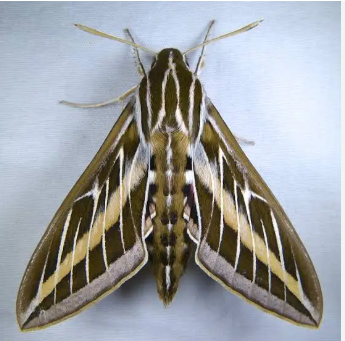
White-lined sphinx moths (Hyles lineata) are among the most recognizable and widespread sphinx moths in North America. Famous for their rapid, hovering flight, these insects are often mistaken for hummingbirds as they dart from flower to flower collecting nectar. Their ability to hover while feeding, combined with their large size and daytime or twilight activity, makes them one of the most frequently observed moth species in the United States.
Although adult White-lined Sphinx Moths are valuable pollinators, their caterpillars—commonly known as hornworms—can occasionally become significant defoliators of agricultural crops, ornamental plants, and native vegetation. During outbreak years, thousands of caterpillars may appear in fields, gardens, and even urban landscapes, creating noticeable feeding damage and attracting public attention.
Taxonomy and Classification
- Kingdom: Animalia
- Phylum: Arthropoda
- Class: Insecta
- Order: Lepidoptera
- Family: Sphingidae
- Genus: Hyles
- Species: Hyles lineata
White-lined Sphinx Moths belong to the family Sphingidae, commonly known as hawk moths or sphinx moths. This family contains some of the strongest and fastest flying moths in the world.
Physical Description
Adult Moths
Adult White-lined Sphinx Moths are large and streamlined, perfectly adapted for fast flight.
- Wingspan: 5–9 centimeters (2–4 inches).
- Body Color: Olive-brown, gray, and black.
- Forewings: Marked with several distinctive white stripes.
- Hindwings: Bright pink with black bands.
- Proboscis: Long feeding tube used to reach nectar deep within flowers.
Their aerodynamic body and powerful flight muscles allow them to hover in front of flowers much like hummingbirds.
Caterpillars (Hornworms)
The larval stage is highly variable in appearance.
- Length up to 8.5 centimeters.
- Smooth-bodied appearance.
- Distinct horn on the rear end.
- Color forms range from green and yellow to black.
- Rows of orange, yellow, or white spots along the sides.
The rear horn is harmless but serves as a useful identification feature.
Distribution and Habitat
White-lined Sphinx Moths are among the most widely distributed moths in the Americas.
They occur throughout:
- United States
- Canada
- Mexico
- Central America
- South America
In the United States they can be found in virtually every state.
Common habitats include:
- Deserts
- Grasslands
- Agricultural fields
- Gardens
- Urban landscapes
- Roadside vegetation
- Prairies
- Shrublands
The species is particularly abundant throughout the western and southwestern United States.
Life Cycle
Egg Stage
Females lay individual eggs on host plants.
Eggs are typically deposited on:
- Evening primrose
- Grapevines
- Tomatoes
- Purslane
- Four-o’clocks
- Desert wildflowers
Eggs hatch within several days under favorable temperatures.
Larval Stage
Newly hatched caterpillars begin feeding immediately.
As they grow, they consume increasingly large amounts of foliage.
During outbreak years, large numbers of larvae may gather and migrate across roads, sidewalks, and fields while searching for food.
Pupal Stage
When fully mature, caterpillars burrow into loose soil.
There they create underground chambers and transform into pupae.
The pupal stage may last several weeks or, in colder regions, through the winter.
Adult Stage
Adults emerge and quickly begin feeding on nectar.
Unlike many moths, White-lined Sphinx Moths are often active at dawn, dusk, and even during daylight hours.
Host Plants
White-lined Sphinx caterpillars utilize an extensive range of host plants.
Common hosts include:
- Evening primrose
- Tomatoes
- Grapevines
- Purslane
- Apple species
- Four-o’clocks
- Desert wildflowers
- Various weeds
- Ornamental flowers
This broad host range contributes to their success across diverse environments.
Behavior and Ecology
Hummingbird Mimicry
The hovering behavior of White-lined Sphinx Moths often causes observers to mistake them for hummingbirds.
Key similarities include:
- Rapid wingbeats.
- Hovering flight.
- Nectar feeding.
- Flower visitation.
- Fast directional changes.
Migration
In some regions, White-lined Sphinx Moths undertake seasonal migrations.
Large numbers may suddenly appear after favorable weather conditions, especially following periods of heavy rainfall.
Pollination
Adults are important pollinators.
They visit numerous flowering plants and transfer pollen between blossoms while feeding.
Many native wildflowers depend partially on sphinx moth pollination.
Damage and Economic Importance
Larval Feeding Damage
The caterpillar stage can cause significant foliage loss.
Symptoms include:
- Chewed leaves.
- Defoliation.
- Reduced plant vigor.
- Damaged flowers.
- Occasional fruit feeding.
Young plants are especially vulnerable during heavy infestations.
Agricultural Impact
Commercial damage is generally sporadic but can become severe during outbreak years.
Crops occasionally affected include:
- Tomatoes
- Grapes
- Beans
- Various vegetable crops
Large caterpillars consume substantial amounts of plant material in a short period.
Landscape Impact
Home gardeners often notice:
- Sudden leaf loss.
- Large caterpillars on ornamentals.
- Accumulations of frass.
- Migrating larvae crossing sidewalks.
Despite their size, most infestations remain temporary and rarely kill healthy plants.
Beneficial Contributions
White-lined Sphinx Moths provide important ecological benefits.
- Pollination of native plants.
- Support for biodiversity.
- Food source for birds.
- Food source for bats.
- Support for beneficial parasitoids.
Because adults contribute significantly to pollination, broad-spectrum control is generally discouraged unless caterpillar populations become excessive.
Management and Control
Monitoring
Regular inspection helps identify developing infestations.
- Check foliage for chewing damage.
- Look for hornworms at dusk.
- Inspect for frass beneath host plants.
- Monitor susceptible crops.
Hand Removal
Large caterpillars are easy to locate and remove.
Manual collection is often the most effective solution in home gardens.
Biological Control
Numerous natural enemies attack White-lined Sphinx caterpillars.
- Parasitic wasps.
- Tachinid flies.
- Birds.
- Roadrunners.
- Predatory insects.
These natural enemies often prevent severe outbreaks.
Bacillus thuringiensis (Bt)
Young caterpillars are susceptible to Bt-based biological insecticides.
Applications are most effective when larvae are small and actively feeding.
Cultural Control
- Remove weeds near crops.
- Till soil where practical.
- Encourage bird activity.
- Maintain healthy plants.
- Monitor after rainy seasons.
Interesting Facts
- White-lined Sphinx Moths are among the most commonly mistaken insects in North America.
- Adults can hover almost perfectly motionless while feeding.
- Large migrations have covered roads and sidewalks with thousands of caterpillars.
- The species is an important pollinator in desert ecosystems.
- The caterpillar’s horn is completely harmless.
Conclusion
White-lined Sphinx Moths are fascinating insects that serve dual roles in the environment. Their caterpillars can occasionally become significant defoliators of crops, ornamentals, and native vegetation, while the adults function as valuable pollinators that support ecosystems across North America. Understanding their life cycle, recognizing their distinctive appearance, and applying balanced integrated pest management strategies allows homeowners, gardeners, and growers to minimize damage while preserving the ecological benefits these remarkable moths provide.