White Grubs
White Grubs are the larval stage of several species of scarab beetles, including Japanese Beetles (Popillia japonica), European Chafers (Rhizotrogus majalis), and various May and June Beetles (Phyllophaga spp.). These soil-dwelling larvae are among the most destructive turfgrass pests in North America and are also significant agricultural pests in many parts of the world.
White grubs feed primarily on the roots of grasses and other plants beneath the soil surface. Their feeding weakens turf, reduces water uptake, and eventually kills large sections of lawn. Severe infestations can leave turf so weakened that it can be rolled back like a carpet. In agricultural settings, white grubs can damage corn, vegetables, root crops, and ornamental plants, resulting in substantial economic losses.
Beyond their direct damage, white grubs attract predators such as skunks, raccoons, moles, crows, and armadillos, which may dig up large sections of turf while searching for food. As a result, infestations often cause both primary and secondary damage to landscapes.
Taxonomy and Classification
- Kingdom: Animalia
- Phylum: Arthropoda
- Class: Insecta
- Order: Coleoptera
- Family: Scarabaeidae
Several scarab beetle species produce white grub larvae, including:
- Japanese Beetle (Popillia japonica)
- European Chafer (Rhizotrogus majalis)
- Masked Chafers (Cyclocephala spp.)
- May Beetles (Phyllophaga spp.)
- Oriental Beetles (Anomala orientalis)
Depending on the species, the life cycle may take one to three years to complete.
Identification
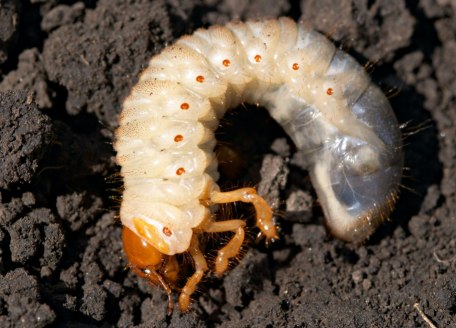
White grubs have a distinctive appearance that makes them relatively easy to identify.
- Length: 20 mm to 40 mm.
- Color: Creamy white body with a brown head.
- Shape: Characteristic “C-shaped” posture when disturbed.
- Legs: Three pairs of legs near the head.
- Body: Soft and plump.
Key Identification Features
- Curled into a distinct C-shape.
- Brown head capsule.
- Visible legs near the front of the body.
- Found feeding beneath turf or crop roots.
Different species can often be distinguished by examining the raster pattern on the underside of the abdomen near the tail.
Distribution and Habitat
White grubs occur throughout North America and many other parts of the world.
Common habitats include:
- Lawns
- Golf courses
- Athletic fields
- Parks
- Pastures
- Corn fields
- Vegetable gardens
- Ornamental landscapes
They thrive in well-watered turf and soils rich in organic matter.
Life Cycle
White grubs undergo complete metamorphosis.
- Egg Stage: Adult beetles lay eggs in soil during summer.
- Larval Stage: Grubs hatch and feed on roots.
- Pupal Stage: Mature larvae pupate underground.
- Adult Stage: Beetles emerge, mate, and begin the cycle again.
Most turf damage occurs during the larval stage when root feeding is most intense.
Feeding Behavior
White grubs feed beneath the soil surface.
- Grass roots.
- Corn roots.
- Vegetable roots.
- Root crops.
- Ornamental plant roots.
Their feeding disrupts water and nutrient uptake, causing plants to decline rapidly during hot or dry weather.
Damage and Economic Importance
Turf Damage
The most common damage occurs in lawns and turfgrass.
- Brown patches.
- Thinning grass.
- Wilted turf.
- Spongy lawn surface.
- Loose sod that lifts easily.
Severe infestations can completely destroy large sections of turf.
Agricultural Damage
White grubs are important pests of numerous crops.
- Corn.
- Potatoes.
- Carrots.
- Strawberries.
- Soybeans.
Root injury reduces plant vigor and can significantly decrease yields.
Secondary Damage
Predators often cause additional destruction while feeding on grubs.
- Skunks.
- Raccoons.
- Moles.
- Crows.
- Armadillos.
These animals may tear up extensive areas of turf while searching for larvae.
Signs of Infestation
- Brown, dead turf patches.
- Turf lifting easily from soil.
- Increased animal digging activity.
- Poor plant growth.
- Visible grubs beneath the sod.
A common diagnostic method involves cutting and lifting a section of turf to inspect the root zone for grubs.
Behavior and Conflict
Seasonal Movement
White grubs move vertically within the soil profile.
- Near the surface during spring.
- Feed heavily in late summer and fall.
- Move deeper during winter.
- Return upward as soils warm.
This movement influences treatment timing and effectiveness.
High Feeding Capacity
Large populations can consume significant amounts of root tissue.
- Rapid turf decline.
- Reduced drought tolerance.
- Increased susceptibility to stress.
Damage often becomes most visible during hot summer weather.
Management and Prevention
Integrated Pest Management (IPM) offers the most effective approach for long-term control.
Monitoring
- Inspect turf regularly.
- Sample soil for grub populations.
- Identify species present.
- Determine economic thresholds.
Not all grub populations require treatment.
Biological Control
- Entomopathogenic nematodes.
- Milky Spore disease (Paenibacillus popilliae).
- Beneficial soil organisms.
Biological controls can provide environmentally friendly suppression.
Cultural Control
- Maintain healthy turf.
- Improve soil drainage.
- Reduce excessive irrigation.
- Promote deep root growth.
Healthy turf can better tolerate moderate grub feeding.
Chemical Control
- Preventative soil insecticides.
- Curative grub treatments.
- Targeted applications timed to young larvae.
Treatment timing is critical because younger grubs are easier to control than mature larvae.
Research and Future Management
Researchers continue investigating improved biological controls, reduced-risk insecticides, and resistant turfgrass varieties. Significant attention is also focused on optimizing beneficial nematode applications and developing more sustainable approaches to grub management.
Advances in integrated pest management are helping reduce pesticide use while maintaining effective control of these damaging soil pests.
Conclusion
White grubs are among the most destructive root-feeding pests of lawns, turfgrass, and agricultural crops. Their feeding damages plant root systems, weakens turf, and attracts vertebrate predators that often cause additional destruction. Effective management depends on proper identification, monitoring, biological controls, and timely treatments that target vulnerable life stages.