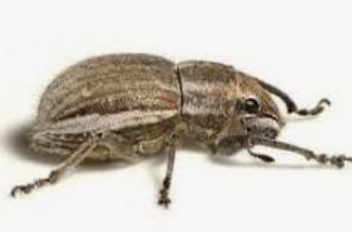
White-fringed beetles (Naupactus leucoloma) are invasive agricultural pests known for their broad host range and destructive root-feeding larvae. Originally native to South America, these beetles have spread to several regions worldwide, including the United States, Australia, New Zealand, and South Africa. Their ability to attack hundreds of plant species makes them one of the most adaptable and economically important invasive weevils in agricultural systems.
While adult beetles primarily feed on foliage, the greatest damage is caused by the underground larval stage. The grubs feed on roots, root crowns, and underground stems, reducing a plant’s ability to absorb water and nutrients. Severe infestations can result in stunted growth, reduced yields, plant death, and significant economic losses in field crops, orchards, nurseries, and ornamental landscapes.
Taxonomy and Classification
- Kingdom: Animalia
- Phylum: Arthropoda
- Class: Insecta
- Order: Coleoptera
- Family: Curculionidae
- Genus: Naupactus
- Species: Naupactus leucoloma
White-fringed beetles belong to the weevil family, a group characterized by elongated snouts and plant-feeding habits. They are closely related to other root-feeding agricultural weevils that attack crops and ornamental plants worldwide.
Physical Description
Adult Beetles
Adult White-fringed Beetles are medium-sized, robust weevils measuring approximately 8 to 12 millimeters in length.
- Color: Gray, brown, or dark charcoal.
- Distinctive Marking: White fringe along the edges of the wing covers.
- Head: Short, broad snout typical of weevils.
- Body Shape: Oval and heavily armored.
- Movement: Flightless but strong crawlers.
The fused wing covers prevent flight, making local movement dependent on crawling. Despite this limitation, the species spreads efficiently through human transportation of soil, nursery stock, and farm equipment.
Larvae
The larval stage is responsible for nearly all serious economic damage.
- Creamy-white coloration.
- Legless body.
- C-shaped appearance.
- Brown head capsule.
- Typically 10–13 millimeters long when mature.
Larvae remain hidden underground throughout development.
Distribution and Habitat
White-fringed Beetles are established throughout portions of the southeastern United States and other warm agricultural regions.
In North America they are most commonly found in:
- Virginia
- North Carolina
- South Carolina
- Georgia
- Florida
- Alabama
- Mississippi
- Louisiana
- Texas
Preferred habitats include:
- Agricultural fields
- Pastures
- Nurseries
- Orchards
- Vegetable farms
- Landscape plantings
- Roadsides
- Weedy field margins
Host Plants
One of the most remarkable characteristics of White-fringed Beetles is their enormous host range.
More than 380 plant species have been recorded as hosts, including:
- Peanuts
- Soybeans
- Cotton
- Alfalfa
- Clover
- Beans
- Potatoes
- Sweet potatoes
- Corn
- Strawberries
- Citrus trees
- Fruit trees
- Ornamental shrubs
- Nursery stock
This broad host range makes eradication extremely difficult once populations become established.
Life Cycle
Parthenogenetic Reproduction
White-fringed Beetles are unusual because populations consist almost entirely of females.
They reproduce through parthenogenesis, meaning:
- No males are required.
- Females lay fertile eggs without mating.
- A single beetle can establish a new infestation.
This reproductive strategy contributes significantly to their invasive success.
Egg Stage
Females lay clusters of eggs in protected locations.
- Under plant debris.
- Near soil surfaces.
- On stems and leaves.
- Within cracks and crevices.
Egg masses may contain 15 to 60 eggs.
Larval Stage
After hatching, larvae move into the soil and begin feeding on roots.
- Root hairs consumed first.
- Larger roots attacked later.
- Development may last many months.
- Some larvae remain underground for over a year.
This hidden stage makes infestations difficult to detect and manage.
Pupal Stage
Pupation occurs within earthen chambers in the soil.
The pupal stage generally lasts several weeks before adult emergence.
Adult Stage
Adults emerge during warmer months and begin feeding on foliage.
Although they cannot fly, they readily disperse through crawling and human-assisted movement.
Damage and Economic Importance
Root Feeding
The most severe damage occurs below ground.
Larvae feed on:
- Root crowns
- Taproots
- Lateral roots
- Underground stems
Damaged roots lose their ability to efficiently absorb water and nutrients.
Plant Symptoms
Infested plants commonly exhibit:
- Wilting
- Yellowing foliage
- Stunted growth
- Poor vigor
- Reduced yields
- Premature death
Because symptoms resemble drought stress or nutrient deficiencies, infestations may initially go unnoticed.
Crop Losses
White-fringed Beetles can cause substantial losses in agricultural systems.
- Reduced peanut production.
- Poor soybean establishment.
- Cotton stand loss.
- Lower forage yields.
- Vegetable crop damage.
Young plants are especially vulnerable because their root systems are less developed.
Adult Feeding
Adult beetles feed along leaf margins.
Characteristic symptoms include:
- Notched leaf edges.
- Scalloped feeding patterns.
- Minor defoliation.
Although adult feeding rarely causes severe injury, it serves as an important indicator of larval populations below ground.
Behavior and Conflict
Slow Expansion
Because adults cannot fly, infestations often spread gradually from a central source.
This creates:
- Circular infestation zones.
- Patchy crop damage.
- Localized hot spots.
Human-Assisted Spread
Long-distance movement occurs through:
- Infested nursery plants.
- Contaminated soil.
- Farm equipment.
- Construction machinery.
- Transport vehicles.
Strict sanitation measures are often necessary to prevent spread.
Management and Control
Field Monitoring
Regular scouting improves early detection.
- Inspect foliage for notching.
- Monitor field edges.
- Examine roots of stressed plants.
- Track historical infestation areas.
Equipment Sanitation
Cleaning equipment is one of the most effective preventive measures.
- Remove soil from machinery.
- Clean harvest equipment.
- Inspect nursery stock.
- Avoid moving contaminated materials.
Crop Rotation
Rotation can reduce larval survival.
Less favorable crops include:
- Corn
- Wheat
- Sorghum
- Certain grasses
Rotation reduces pressure on susceptible legumes and broadleaf crops.
Biological Control
Natural enemies contribute to suppression.
- Predatory beetles.
- Parasitic nematodes.
- Soil fungi.
- Predatory ants.
Research continues into biological control options that target soil-dwelling larvae.
Chemical Control
Where infestations are severe, insecticides may be used.
- In-furrow applications.
- Soil treatments.
- Targeted pyrethroid products.
- Preventive treatments in high-risk fields.
Control is most effective when directed against larvae before significant root injury occurs.
Prevention Strategies
- Use certified pest-free nursery stock.
- Inspect incoming plant materials.
- Practice crop rotation.
- Maintain equipment sanitation.
- Monitor fields regularly.
- Manage weeds around field borders.
- Address infestations early.
Conclusion
White-fringed Beetles are invasive root-feeding weevils capable of causing severe economic damage across a wide range of crops and ornamental plants. Their hidden larval stage, broad host range, and unusual ability to reproduce without males make them particularly difficult to manage. Early detection, sanitation practices, crop rotation, and integrated pest management strategies remain the most effective tools for limiting damage and preventing the spread of this destructive agricultural pest.