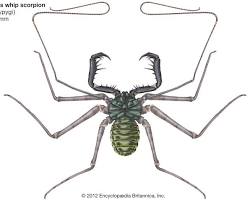
Whipscorpions, commonly known as Vinegaroons, are large arachnids belonging to the order Thelyphonida. Despite their intimidating appearance, these fascinating creatures are completely harmless to humans. They are named for their distinctive whip-like tail and their unique defensive ability to spray a vinegar-smelling liquid when threatened.
Whipscorpions are often mistaken for true scorpions because of their large pincers and intimidating body shape. However, unlike scorpions, they lack a venomous stinger and cannot inject venom. Instead, they rely on powerful pedipalps for capturing prey and a defensive spray containing acetic acid that deters predators.
These nocturnal hunters play an important ecological role by feeding on insects, cockroaches, termites, crickets, and other arthropods. In many areas they are considered beneficial predators that naturally reduce pest populations.
Taxonomy and Classification
- Kingdom: Animalia
- Phylum: Arthropoda
- Class: Arachnida
- Order: Thelyphonida
Whipscorpions are closely related to spiders, scorpions, and whip spiders, but they represent a unique arachnid group with specialized adaptations.
Common species found in North America include:
- Mastigoproctus giganteus (Giant Vinegaroon)
- Mastigoproctus tohono
Identification
Whipscorpions are among the largest terrestrial arachnids in many desert and tropical ecosystems.
- Body Length: 25 mm to 85 mm.
- Color: Dark brown, reddish-brown, or black.
- Body Shape: Flattened and heavily armored.
- Tail: Long, flexible, whip-like flagellum.
Key Identification Features
- Large pincer-like pedipalps.
- Long whip-like tail.
- Eight legs.
- Flattened body.
- No venomous stinger.
The long tail is often mistaken for a stinger, but it is actually a sensory structure that cannot sting or inject venom.
Distribution and Habitat
Whipscorpions occur throughout tropical, subtropical, and arid regions of the world.
In North America, they are most common in:
- Arizona.
- New Mexico.
- Texas.
- Northern Mexico.
- Southwestern deserts.
Preferred habitats include:
- Desert scrublands.
- Grasslands.
- Woodlands.
- Caves.
- Under rocks.
- Under logs.
- Crawl spaces.
- Garages.
They require sheltered locations with moderate humidity and protection from extreme temperatures.
Life Cycle
Whipscorpions undergo simple metamorphosis and develop gradually through a series of molts.
- Egg Stage: Eggs are deposited within a protected underground chamber.
- Juvenile Stage: Young whipscorpions hatch and remain with the female for a period of time.
- Molting Stage: Juveniles molt several times as they grow.
- Adult Stage: Mature individuals become active predators and reproduce.
Females display remarkable parental care, carrying egg sacs and protecting young offspring after hatching.
Feeding Habits
Whipscorpions are active predators that feed on a variety of small animals.
- Cockroaches.
- Crickets.
- Termites.
- Beetles.
- Millipedes.
- Spiders.
- Other arthropods.
They use their powerful pedipalps to seize prey before crushing and consuming it.
Ecological Importance
Natural Pest Control
Whipscorpions help regulate insect populations.
- Reduce cockroach numbers.
- Consume termites.
- Control crickets.
- Limit other arthropod pests.
Their role as predators makes them beneficial components of many ecosystems.
Food Web Contributions
Whipscorpions are both predators and prey.
- Support biodiversity.
- Provide food for reptiles.
- Serve as prey for birds and mammals.
They contribute to balanced ecosystem function.
Behavior and Conflict
Nocturnal Lifestyle
Whipscorpions are almost entirely nocturnal.
- Hide during the day.
- Hunt after dark.
- Avoid direct sunlight.
This behavior helps them conserve moisture and avoid predators.
Defensive Spray
Their most famous defense mechanism is the production of a vinegar-like spray.
- Contains acetic acid.
- Produces a strong vinegar odor.
- Deters predators.
- Causes mild irritation if contacted.
The spray is harmless to humans but may be unpleasant if released nearby.
Fear-Based Conflict
The primary conflict involving whipscorpions is human misunderstanding.
- Large size causes alarm.
- Mistaken for dangerous scorpions.
- Frequently killed unnecessarily.
Despite their frightening appearance, they pose virtually no threat to people.
Signs of Presence
- Sightings under rocks or logs.
- Individuals in garages or basements.
- Nocturnal activity around structures.
- Occasional vinegar odor when disturbed.
They are usually encountered accidentally while moving debris or exploring dark areas.
Management and Prevention
Control is rarely necessary because whipscorpions are beneficial predators.
Exclusion
- Seal foundation cracks.
- Install door sweeps.
- Repair damaged screens.
- Reduce entry points.
These measures help prevent accidental indoor entry.
Habitat Modification
- Remove excess debris.
- Reduce clutter.
- Store firewood away from buildings.
- Limit outdoor hiding places.
Reducing shelter sites decreases encounters near structures.
Toleration and Relocation
- Capture gently.
- Relocate outdoors.
- Avoid unnecessary pesticide use.
Because they are harmless and beneficial, relocation is preferred over extermination.
Research and Future Studies
Scientists continue studying the chemistry of whipscorpion defensive sprays, their sensory biology, and their ecological role as predators. Research has revealed that their acetic acid spray is remarkably effective at deterring predators while remaining relatively harmless.
Additional studies focus on their unique reproductive behavior, parental care, and adaptations to desert environments.
Conclusion
Whipscorpions, or vinegaroons, are remarkable arachnids that combine an intimidating appearance with a surprisingly harmless nature. Their distinctive whip-like tail, vinegar-smelling defensive spray, and beneficial predatory habits make them one of the most fascinating arthropods in desert and tropical ecosystems. While they may startle homeowners and outdoor enthusiasts, these creatures provide valuable natural pest control and should generally be left undisturbed or relocated when encountered.