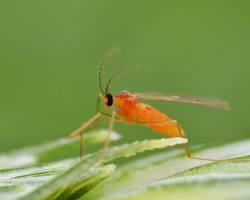
Wheat Midge (Sitodiplosis mosellana) is one of the most economically significant insect pests affecting wheat production in temperate agricultural regions. Although the adult insect is tiny and often overlooked, its larvae can cause substantial damage by feeding directly on developing wheat kernels during the critical flowering and grain-filling stages.
Wheat Midge infestations can reduce grain yield, lower kernel weight, and significantly impact grain quality. Because larvae feed within the wheat head, damage is often hidden until harvest, when growers discover shriveled kernels, reduced test weights, and lower market grades. In severe outbreaks, economic losses can be substantial, particularly in regions where environmental conditions favor midge development.
The pest is especially important throughout the Northern Great Plains, Great Lakes region, and other major wheat-producing areas where cool winters and moist spring conditions support annual population growth.
Taxonomy and Classification
- Kingdom: Animalia
- Phylum: Arthropoda
- Class: Insecta
- Order: Diptera
- Family: Cecidomyiidae
- Genus: Sitodiplosis
- Species: Sitodiplosis mosellana
Wheat Midge belongs to the gall midge family, a group of small flies known for their plant-feeding larvae. Many members of this family are important agricultural pests because of their ability to damage crops during critical growth stages.
Physical Description
Adult Wheat Midge
Adult Wheat Midges are extremely small and delicate flies measuring approximately 2 to 3 millimeters in length.
- Bright orange to reddish-orange body.
- Long, slender legs.
- Transparent wings with fine hairs.
- Mosquito-like appearance.
- Short adult lifespan.
Adults are weak fliers and are most active during calm, warm evenings.
Larvae
The larval stage is responsible for all economic damage.
- Tiny orange maggots.
- Initially translucent white after hatching.
- Turn bright orange as they mature.
- Legless body.
- Found between kernels and glumes.
Mature larvae typically reach 2 to 3 millimeters in length before leaving the wheat head.
Distribution and Habitat
Wheat Midge is widely distributed throughout major wheat-growing regions of North America, Europe, and Asia.
In North America, significant populations occur in:
- North Dakota
- South Dakota
- Minnesota
- Montana
- Saskatchewan
- Manitoba
- Alberta
- Great Lakes wheat regions
The insect is most problematic where cool, moist soil conditions support successful overwintering and adult emergence.
Life Cycle
Wheat Midge completes one generation per year.
Overwintering Stage
Larvae spend the winter in the soil.
- Form protective cocoons.
- Remain dormant throughout winter.
- Require specific moisture conditions for survival.
Pupation and Adult Emergence
In late spring and early summer, larvae pupate in the soil.
- Emergence is strongly influenced by rainfall.
- Warm temperatures accelerate development.
- Adults emerge during wheat heading.
Timing is critical because adults must synchronize emergence with suitable wheat growth stages.
Egg Laying
Female midges lay eggs on developing wheat heads.
- Most activity occurs during evening hours.
- Eggs are deposited between flowering spikelets.
- One female may lay dozens of eggs.
Larval Feeding
After hatching, larvae feed directly on developing kernels.
- Consume nutrient-rich grain tissues.
- Interfere with kernel development.
- Remain protected within the wheat head.
Feeding continues for several weeks before larvae drop to the soil.
Damage and Economic Importance
Kernel Damage
The primary impact of Wheat Midge is damage to developing kernels.
- Shriveled grain.
- Reduced kernel weight.
- Cracked grain.
- Poor grain filling.
- Empty kernels.
Multiple larvae feeding on a single kernel can completely prevent grain development.
Yield Reduction
Significant infestations can reduce overall yield.
- Fewer marketable kernels.
- Lower grain volume.
- Reduced harvest weight.
Yield losses of 15–40% may occur during severe outbreaks.
Quality Loss
Even when yield losses are moderate, quality reductions can be substantial.
- Lower test weight.
- Poor milling performance.
- Reduced baking quality.
- Market grade reductions.
These quality issues often result in price discounts at grain elevators.
Economic Impact
Wheat Midge outbreaks have caused millions of dollars in agricultural losses across North America.
Costs include:
- Reduced grain sales.
- Additional monitoring expenses.
- Control measures.
- Reduced profitability.
Signs of Infestation
Detecting Wheat Midge requires careful field scouting.
- Orange adult flies at dusk.
- Larvae inside wheat heads.
- Shriveled kernels.
- Poor grain fill.
- Reduced test weights.
Adults are most easily observed during calm evenings when they fly around flowering wheat heads.
Behavior and Conflict
Timing Synchronization
One of the most remarkable aspects of Wheat Midge biology is its synchronization with wheat flowering.
Adults emerge only when suitable host plants are available, maximizing larval survival.
Hidden Feeding
Larvae remain concealed within wheat heads.
- Protected from predators.
- Difficult to detect.
- Shielded from some treatments.
Weather Dependence
Population levels fluctuate significantly based on weather conditions.
- Moist soils favor emergence.
- Warm evenings encourage activity.
- Drought can suppress populations.
Management and Prevention
Integrated Pest Management (IPM) provides the best long-term control.
Field Scouting
Regular monitoring is essential.
- Inspect fields during heading.
- Scout during evening hours.
- Count adult flies on wheat heads.
- Track local forecasts.
Economic thresholds help determine when treatment is justified.
Resistant Varieties
Planting resistant wheat cultivars is among the most effective management strategies.
- Reduces larval survival.
- Protects grain quality.
- Minimizes insecticide dependence.
Modern midge-tolerant wheat varieties often contain genetic resistance that suppresses larval feeding.
Biological Control
Natural enemies contribute significantly to population suppression.
- Parasitic wasps such as Macroglenes penetrans.
- Predatory insects.
- Beneficial soil organisms.
Conserving natural enemies is an important component of sustainable management.
Insecticide Applications
When thresholds are exceeded, insecticides may be necessary.
- Applications must be precisely timed.
- Target adult flies before egg laying.
- Evening applications are often most effective.
Improper timing greatly reduces treatment effectiveness.
Crop Rotation
Crop rotation may help reduce local populations.
- Disrupts pest development.
- Improves field diversity.
- Supports long-term management.
Research and Future Outlook
Ongoing research focuses on improving resistant wheat varieties, refining forecasting systems, and enhancing biological control programs. Scientists continue developing predictive models based on weather and soil conditions to help growers better anticipate outbreaks.
Advances in integrated pest management have significantly improved the ability of producers to manage Wheat Midge while reducing reliance on broad-spectrum insecticides.
Conclusion
Wheat Midge remains one of the most important insect pests of wheat production in many temperate agricultural regions. Despite its small size, this orange fly can cause significant yield reductions and quality losses through larval feeding on developing kernels. Because damage occurs during a critical stage of crop development, effective management requires careful monitoring, resistant varieties, biological control conservation, and precisely timed interventions. Understanding the life cycle and behavior of Wheat Midge is essential for protecting wheat yields and maintaining profitable grain production.