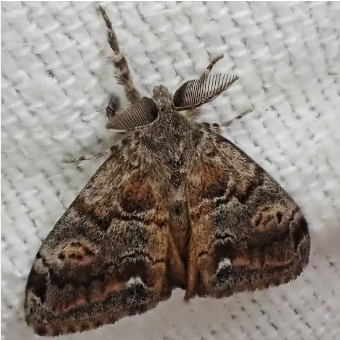
Western Tussock Moths (Orgyia vetusta and related species) are distinctive defoliating insects found throughout western North America. These moths are best known for their colorful, tufted caterpillars covered with dense clusters of hairs that resemble tiny brushes. While the adult moths are relatively inconspicuous, the larvae can attract significant attention due to their unusual appearance, feeding damage, and potential to cause skin irritation.
Western Tussock Moths are common inhabitants of forests, chaparral habitats, orchards, gardens, and ornamental landscapes. Their larvae feed on a wide variety of trees and shrubs, including oak, willow, apple, cherry, plum, and numerous ornamental plants. During outbreak years, large populations can strip foliage from host plants, weakening vegetation and reducing aesthetic value.
Although most infestations are naturally controlled by predators, parasites, and disease, localized outbreaks occasionally occur and may require management to prevent significant defoliation.
Taxonomy and Classification
- Kingdom: Animalia
- Phylum: Arthropoda
- Class: Insecta
- Order: Lepidoptera
- Family: Erebidae
- Subfamily: Lymantriinae
- Genus: Orgyia
- Species: Orgyia vetusta
Western Tussock Moths belong to the same group as several other tussock moth species known for their hairy caterpillars and periodic outbreaks. Many members of this group have wingless females and highly mobile males.
Physical Description
Larvae
The caterpillar stage is the most recognizable life stage.
- Length: Up to 30 mm.
- Dark gray to black body.
- Four dense white or yellow “toothbrush” tufts on the back.
- Long black hair pencils extending from the front and rear.
- Bright red or orange bumps along the body.
- Covered in irritating hairs.
The elaborate arrangement of tufts and hair pencils makes Western Tussock Moth caterpillars among the most distinctive caterpillars in North America.
Adult Males
- Wingspan: 15 mm to 30 mm.
- Brown to gray coloration.
- White spot near the outer edge of each forewing.
- Strong fliers.
- Active during daylight and dusk.
Males actively search for females using highly sensitive antennae capable of detecting pheromones from long distances.
Adult Females
Females are dramatically different from males.
- Wingless.
- Plump and grub-like appearance.
- Remain near their cocoon.
- Rarely travel more than a few inches during adulthood.
After emerging, females release pheromones to attract males and typically lay eggs directly on or near their cocoon.
Distribution and Habitat
Western Tussock Moths occur primarily along the western coast of North America.
Their range includes:
- California
- Oregon
- Washington
- British Columbia
- Coastal regions of the Pacific Northwest
They are especially common in:
- Chaparral habitats.
- Oak woodlands.
- Coastal shrublands.
- Urban landscapes.
- Orchards.
- Residential gardens.
Host plants vary widely depending on location and available vegetation.
Life Cycle
Western Tussock Moths typically complete one generation per year.
Egg Stage
Eggs overwinter and hatch in spring.
- Deposited on female cocoons.
- Protected by hair and silk.
- Capable of surviving harsh weather conditions.
Larval Stage
Young caterpillars emerge during spring.
- Feed on developing leaves.
- Pass through multiple growth stages.
- Cause the majority of plant damage.
Larvae remain active for several weeks before pupation.
Pupal Stage
Mature caterpillars spin hairy cocoons.
- Located on bark, fences, buildings, and vegetation.
- Protected by incorporated body hairs.
- Pupal development lasts several weeks.
Adult Stage
Adult emergence occurs during summer.
- Males fly in search of females.
- Females remain stationary.
- Mating occurs shortly after emergence.
- Eggs are laid for the next generation.
Damage and Economic Importance
Western Tussock Moths are primarily important as defoliators and nuisance pests.
Defoliation
Larvae consume large amounts of foliage.
- Skeletonize leaves during early stages.
- Consume entire leaves as they mature.
- Reduce photosynthetic capacity.
Heavy infestations may leave host plants partially or completely defoliated.
Reduced Plant Vigor
Repeated defoliation weakens plants.
- Reduced growth.
- Lower energy reserves.
- Greater susceptibility to drought.
- Increased vulnerability to diseases.
Young trees and shrubs are particularly vulnerable.
Fruit Damage
When foliage becomes scarce, larvae may feed on fruit.
- Surface scarring.
- Reduced marketability.
- Lower fruit quality.
This can create economic concerns for orchard owners.
Human Health Concerns
The hairs of Western Tussock Moth caterpillars are one of their most significant nuisance features.
- Cause itchy skin rashes.
- May trigger allergic reactions.
- Can irritate eyes.
- Occasionally cause respiratory discomfort if inhaled.
People working near infested vegetation should avoid direct contact.
Behavior and Conflict
Localized Population Build-Up
Because females cannot fly, populations often remain concentrated in specific areas.
- High-density infestations develop locally.
- Hundreds of cocoons may occur on a single structure.
- Outbreaks can persist for several years.
Defensive Hairs
The dense hairs serve as protection from predators.
- Discourage birds and mammals.
- Reduce predation pressure.
- Create accidental contact issues for humans.
Outbreak Cycles
Populations naturally fluctuate.
- Predators suppress outbreaks.
- Parasites regulate numbers.
- Diseases frequently collapse populations.
Most outbreaks eventually decline without intervention.
Management and Prevention
Integrated Pest Management (IPM) provides effective long-term control.
Egg Mass and Cocoon Removal
Winter sanitation is highly effective.
- Inspect trees and structures.
- Locate hairy cocoons.
- Scrape cocoons into soapy water.
- Destroy egg masses before hatching.
This significantly reduces spring populations.
Protective Clothing
Always wear protection when handling caterpillars or cocoons.
- Gloves.
- Long sleeves.
- Eye protection.
- Dust mask when necessary.
Even old cocoons may contain irritating hairs.
Bacillus thuringiensis (Bt)
Bt remains one of the most effective biological controls.
- Targets young caterpillars.
- Safe for most beneficial insects.
- Suitable for ornamental landscapes.
Applications are most effective when larvae are small.
Sticky Barriers
Sticky bands placed around trunks can reduce movement.
- Intercept young caterpillars.
- Limit access to foliage.
- Reduce localized infestations.
Biological Control
Natural enemies play an important role.
- Tachinid flies.
- Parasitic wasps.
- Predatory beetles.
- Birds.
- Pathogenic fungi and viruses.
Conserving beneficial organisms helps maintain long-term control.
Natural Enemies
Western Tussock Moth populations are often controlled naturally.
- Parasitic wasps attack larvae and pupae.
- Tachinid flies parasitize caterpillars.
- Birds consume larvae.
- Fungal pathogens spread during humid conditions.
- Viral diseases frequently end outbreaks.
These biological controls help prevent permanent damage to ecosystems.
Research and Conservation
Researchers continue studying the ecological role of tussock moths, the chemistry of their defensive hairs, and the factors that trigger outbreak cycles. Scientists are also investigating biological control agents and environmentally friendly management methods that reduce pesticide dependence.
Although considered pests during outbreaks, Western Tussock Moths are native insects that contribute to food webs and biodiversity throughout western ecosystems.
Conclusion
Western Tussock Moths are distinctive native defoliators recognized by their colorful, tufted caterpillars and wingless females. While most populations remain at manageable levels, periodic outbreaks can cause significant defoliation of trees and shrubs. Their irritating hairs add an additional nuisance factor for homeowners and landscapers. Through early monitoring, cocoon removal, biological controls, and targeted Bt applications, infestations can be effectively managed while preserving the ecological balance of natural landscapes.