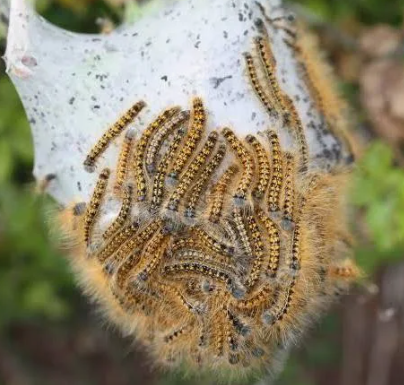
Western Tent Caterpillars
Western Tent Caterpillars (Malacosoma californicum) are native defoliating insects found throughout western North America. These caterpillars are famous for constructing large silk tents in the branches of trees, where they live communally and shelter between feeding periods. During outbreak years, Western Tent Caterpillars can defoliate thousands of acres of forest and ornamental trees, making them among the most visible springtime insect pests in western landscapes.
Although healthy trees can usually recover from a single season of defoliation, repeated infestations can weaken trees, reduce growth, and increase susceptibility to drought, disease, and secondary insect attacks. Their large silk nests and group-feeding behavior often alarm homeowners, even though the caterpillars rarely cause permanent damage to mature trees.
Western Tent Caterpillars primarily attack deciduous trees such as cherry, apple, willow, poplar, aspen, alder, and plum. Outbreak populations can develop rapidly and may persist for several years before naturally collapsing due to predators, parasites, diseases, and environmental factors.
Taxonomy and Classification
- Kingdom: Animalia
- Phylum: Arthropoda
- Class: Insecta
- Order: Lepidoptera
- Family: Lasiocampidae
- Genus: Malacosoma
- Species: Malacosoma californicum
Western Tent Caterpillars belong to the tent caterpillar group, which includes several species known for producing communal silk shelters. They are closely related to Eastern Tent Caterpillars and Forest Tent Caterpillars, although their appearance and nesting habits differ.
Physical Description
Western Tent Caterpillars are among the most colorful native caterpillars in western forests.
Larvae
- Length: Up to 50 mm.
- Dark brown to black body.
- Bright blue spots along the sides.
- Orange or yellow dashed markings down the back.
- Covered with reddish-brown hairs.
The combination of blue spots and orange markings helps distinguish them from other tent-building caterpillars.
Silk Tent
The silk tent is often the first sign of infestation.
- Dense, white silk structure.
- Built in branch forks and crotches.
- Expands as the colony grows.
- Provides shelter from predators and weather.
Unlike webworms, which feed within their webs, Western Tent Caterpillars leave the tent to feed and return afterward.
Adult Moths
- Cinnamon-brown coloration.
- Wingspan of 25 mm to 40 mm.
- Two darker diagonal lines across forewings.
- Nocturnal behavior.
Adult moths are relatively short-lived and are rarely noticed compared to the highly visible caterpillar stage.
Distribution and Habitat
Western Tent Caterpillars occur throughout western North America.
Their range includes:
- California
- Oregon
- Washington
- Idaho
- Montana
- Nevada
- Utah
- Arizona
- Colorado
- British Columbia
- Alberta
They thrive in areas where host trees are abundant.
Common habitats include:
- Forests.
- Riparian corridors.
- Orchards.
- Residential landscapes.
- Parks.
- Shelterbelts.
Life Cycle
Western Tent Caterpillars complete one generation per year.
Egg Stage
Adult females lay eggs during summer.
- Eggs are deposited in bands around twigs.
- Covered with a protective frothy coating.
- Overwinter on host trees.
The egg masses remain visible throughout winter.
Larval Stage
Larvae emerge in early spring as buds begin to open.
- Feed on newly emerging foliage.
- Construct communal silk tents.
- Feed in large groups.
- Pass through multiple molts.
This stage causes nearly all feeding damage.
Pupal Stage
After completing development, larvae leave the host tree.
- Spin protective cocoons.
- Pupate in sheltered locations.
- Transformation lasts several weeks.
Adult Stage
Adult moths emerge during summer.
- Mate shortly after emergence.
- Females lay egg masses.
- Adults do not feed extensively.
- Life span is relatively short.
Damage and Economic Importance
The primary damage caused by Western Tent Caterpillars is defoliation.
Leaf Consumption
Larvae consume large amounts of foliage.
- Feed on expanding leaves.
- Strip branches of foliage.
- Reduce photosynthesis.
Severe infestations may leave trees nearly leafless.
Growth Reduction
Defoliated trees must expend energy to replace lost leaves.
- Reduced annual growth.
- Lower energy reserves.
- Increased environmental stress.
Fruit Production Loss
Fruit trees may experience:
- Reduced fruit set.
- Smaller harvests.
- Poor fruit quality.
Repeated infestations can significantly impact orchard productivity.
Aesthetic Damage
Large silk tents create highly visible infestations.
- Unsightly branch structures.
- Defoliated canopies.
- Accumulated frass beneath trees.
This often prompts homeowners to seek control measures.
Behavior and Conflict
Communal Living
Western Tent Caterpillars are highly social.
- Live in colonies.
- Share silk shelters.
- Coordinate feeding activities.
The communal tent helps regulate temperature and provides protection.
Daily Feeding Patterns
Caterpillars leave the tent several times daily.
- Feed during favorable temperatures.
- Return to the tent to rest.
- Follow pheromone trails.
This behavior helps maximize feeding efficiency.
Natural Population Cycles
Populations naturally fluctuate.
- Outbreaks may last several years.
- Diseases often collapse populations.
- Predators and parasites provide regulation.
Large outbreaks are usually temporary.
Management and Prevention
Integrated Pest Management (IPM) focuses on monitoring and early intervention.
Winter Egg Mass Removal
One of the most effective preventive methods.
- Inspect trees during dormancy.
- Prune infested twigs.
- Destroy egg masses.
This prevents caterpillars from hatching in spring.
Tent Removal
Small infestations can be physically removed.
- Remove tents early.
- Wear gloves.
- Dispose of colonies properly.
Early morning or evening is ideal because most caterpillars are inside the tent.
Biological Control
Numerous natural enemies attack Western Tent Caterpillars.
- Parasitic flies.
- Parasitic wasps.
- Birds.
- Predatory insects.
Conserving beneficial organisms helps suppress outbreaks.
Bacillus thuringiensis (Bt)
Bt is highly effective against young caterpillars.
- Targets feeding larvae.
- Minimal impact on beneficial insects.
- Best applied early.
Bt remains one of the preferred treatments for ornamental trees.
Tree Health Management
- Provide adequate water.
- Avoid unnecessary stress.
- Maintain proper fertilization.
- Monitor for secondary pests.
Healthy trees recover more quickly from defoliation.
Natural Enemies
Several organisms help regulate Western Tent Caterpillar populations.
- Cuckoos.
- Orioles.
- Parasitic tachinid flies.
- Parasitic wasps.
- Predatory beetles.
- Viral pathogens.
- Fungal diseases.
These natural controls are often responsible for ending outbreak cycles.
Research and Conservation
Research continues to examine population dynamics, disease outbreaks, climate influences, and biological control agents. Scientists are particularly interested in understanding how weather patterns and environmental stress affect outbreak frequency and severity.
Although often viewed as pests, Western Tent Caterpillars are native insects that serve as food for numerous wildlife species and contribute to forest ecosystem processes.
Conclusion
Western Tent Caterpillars are highly visible native defoliators known for their communal silk tents and group-feeding behavior. While healthy trees usually recover from a single infestation, severe outbreaks can cause extensive defoliation and stress. Early detection, egg mass removal, biological controls, and Bt applications remain the most effective management strategies. Understanding their natural life cycle helps homeowners, orchard managers, and foresters reduce damage while maintaining healthy landscapes and forests.