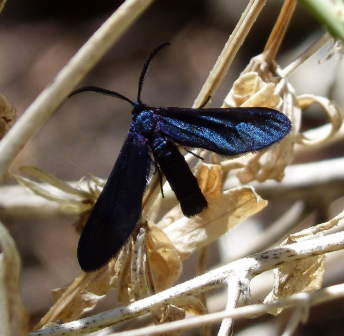
Western Grapeleaf Skeletonizers (Harrisina brillians) are destructive foliage-feeding pests that primarily attack grapevines and related plants. These insects are named for the distinctive feeding damage caused by their larvae, which consume leaf tissue between the veins and leave behind a delicate, lace-like skeleton of leaf veins. Heavy infestations can dramatically reduce photosynthesis, weaken vines, lower fruit production, and impact overall vineyard health.
Native to the southwestern United States and parts of Mexico, Western Grapeleaf Skeletonizers are particularly problematic in grape-growing regions of Arizona, California, Nevada, New Mexico, and Texas. Commercial vineyards, backyard grape plantings, and ornamental vines can all suffer significant damage when populations become established.
In addition to plant damage, the caterpillars possess irritating hairs that may cause skin irritation in people who handle infested foliage, making them both an agricultural and nuisance pest.
Taxonomy and Classification
- Kingdom: Animalia
- Phylum: Arthropoda
- Class: Insecta
- Order: Lepidoptera
- Family: Zygaenidae
- Genus: Harrisina
- Species: Harrisina brillians
Western Grapeleaf Skeletonizers belong to the burnet moth family (Zygaenidae), a group known for brightly colored adults and foliage-feeding larvae. Many members of this family possess defensive chemicals that make them unpalatable to predators.
Physical Description
The Western Grapeleaf Skeletonizer passes through complete metamorphosis, consisting of egg, larva, pupa, and adult stages.
Adult Moths
- Wingspan of approximately 20 mm to 25 mm.
- Metallic bluish-black coloration.
- Narrow wings and slender body.
- Day-flying behavior.
- Often mistaken for small wasps.
Adults are active during daylight hours and are commonly observed around grapevines during warm months.
Larvae
- Length of 12 mm to 18 mm when mature.
- Bright yellow body.
- Distinct black or purplish-black transverse bands.
- Covered with rows of short black hairs.
- Often feed in groups.
The larvae are the damaging stage responsible for skeletonizing grape leaves.
Eggs
- Small and yellow.
- Laid in clusters.
- Typically deposited on leaf undersides.
- May contain 20 to over 100 eggs per mass.
Pupae
Pupation occurs within small white or yellowish cocoons attached to vines, trellises, leaves, or nearby structures.
Distribution and Habitat
Western Grapeleaf Skeletonizers are primarily found throughout the southwestern United States and northern Mexico.
Common areas include:
- Arizona
- California
- Nevada
- New Mexico
- Texas
- Northern Mexico
Their preferred habitat consists of vineyards, backyard grape plantings, ornamental vines, and wild grape species. They thrive in warm climates that allow multiple generations to develop annually.
Life Cycle
Several generations may occur each year depending on temperature and local climate conditions.
Egg Stage
Females lay clusters of eggs on the undersides of grape leaves.
- Eggs hatch within several days.
- Larvae emerge simultaneously.
- Young larvae begin feeding immediately.
Larval Stage
The larval stage is responsible for virtually all plant damage.
- Feed in organized groups.
- Initially scrape leaf surfaces.
- Progressively consume larger portions of foliage.
- Pass through multiple growth stages.
Young larvae create “windowpane” damage where only a thin layer of leaf tissue remains. Older larvae leave only leaf veins behind.
Pupal Stage
Mature larvae spin cocoons and transform into pupae.
- Pupation lasts one to three weeks.
- Occurs on plants or nearby surfaces.
- Produces the next generation of moths.
Adult Stage
Adult moths emerge and quickly begin mating.
- Active during daylight hours.
- Feed minimally.
- Focus primarily on reproduction.
- Females lay new egg masses on grape foliage.
Damage and Economic Importance
Western Grapeleaf Skeletonizers are serious pests because they directly reduce a vine’s ability to produce energy through photosynthesis.
Leaf Skeletonization
The most recognizable symptom is skeletonized foliage.
- Leaf tissue consumed between veins.
- Lace-like leaf appearance.
- Reduced photosynthetic area.
- Premature leaf drop.
Defoliation
Heavy infestations can completely strip vines of leaves.
- Reduced vine vigor.
- Poor fruit development.
- Lower sugar production.
- Delayed ripening.
Repeated defoliation can weaken vines for multiple growing seasons.
Fruit Quality Reduction
Loss of foliage affects grape production.
- Smaller fruit clusters.
- Reduced sugar content.
- Poor color development.
- Lower overall yield.
Wine grape producers may experience significant impacts on fruit quality and harvest value.
Sunburn Damage
When leaves are removed, grape clusters become exposed to direct sunlight.
- Fruit sunscald.
- Berry shriveling.
- Reduced marketability.
- Increased water stress.
Behavior and Conflict
Group Feeding
Unlike many caterpillar pests, Western Grapeleaf Skeletonizer larvae feed communally.
- Move together in groups.
- Feed side-by-side.
- Create highly visible damage.
- Rapidly consume foliage.
Irritating Hairs
The caterpillars possess defensive hairs that may cause irritation.
- Skin rashes.
- Itching.
- Redness.
- Mild allergic reactions.
Protective clothing should be worn when handling infested vines.
Multiple Generations
Warm climates allow several generations each year.
- Rapid population growth.
- Extended damage period.
- Greater management challenges.
Signs of Infestation
- Skeletonized grape leaves.
- Windowpane feeding damage.
- Groups of yellow-and-black caterpillars.
- Egg masses on leaf undersides.
- White cocoons on vines or trellises.
- Premature defoliation.
- Metallic blue-black moths near vines.
Early detection is critical because young larvae are easier to control than mature caterpillars.
Management and Prevention
Integrated Pest Management (IPM) provides the most effective long-term control strategy.
Regular Monitoring
- Inspect leaf undersides.
- Look for egg masses.
- Monitor young caterpillars.
- Track seasonal activity.
Mechanical Removal
Small infestations can be managed manually.
- Remove egg clusters.
- Prune heavily infested leaves.
- Destroy larvae.
- Wear protective gloves.
Biological Control
Natural enemies help suppress populations.
- Parasitic wasps.
- Predatory insects.
- Birds.
- Naturally occurring pathogens.
Conserving beneficial insects can significantly reduce outbreaks.
Bacillus thuringiensis (Bt)
Bt remains one of the most effective treatments for young larvae.
- Targets caterpillars specifically.
- Safe for pollinators.
- Minimal environmental impact.
- Works best on early instars.
Insecticidal Treatments
Severe infestations may require insecticide applications.
- Apply according to label directions.
- Target young larvae.
- Ensure thorough coverage.
- Rotate products when appropriate.
Research and Future Studies
Current research focuses on improving biological control programs, understanding population dynamics, and developing vineyard management practices that reduce outbreak potential.
Scientists are also studying naturally occurring pathogens and parasitoids that may provide sustainable long-term suppression in commercial vineyards.
Conclusion
Western Grapeleaf Skeletonizers are important pests of grapevines throughout the southwestern United States. Their distinctive skeletonizing damage can reduce photosynthesis, weaken vines, lower yields, and affect fruit quality. Because multiple generations may occur annually, early detection and prompt intervention are essential. Through regular monitoring, conservation of natural enemies, biological controls such as Bt, and integrated management strategies, growers can effectively protect vineyards and ornamental grape plantings from serious damage.