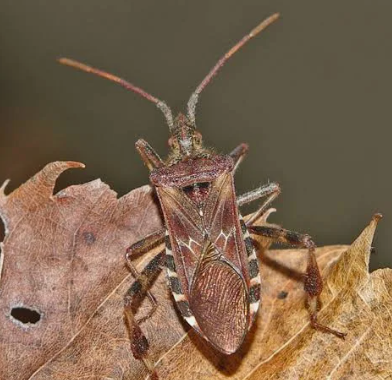
Western Conifer Seed Bugs (Leptoglossus occidentalis) are large leaf-footed bugs native to western North America that have become well-known both as forest pests and as nuisance invaders of homes. Originally confined to the western United States, this species has expanded its range across North America and has become established in Europe, Asia, and parts of South America.
In natural forest ecosystems, Western Conifer Seed Bugs feed on the developing seeds of pine, fir, spruce, and other conifer trees. Their feeding reduces seed viability and can negatively impact seed production in commercial forestry operations. While their impact on individual landscape trees is usually minimal, they can be significant pests in seed orchards and reforestation programs.
For homeowners, the primary concern is not plant damage but their habit of invading structures during autumn. As temperatures cool, large numbers of Western Conifer Seed Bugs gather on sunny walls and enter buildings through cracks and gaps. Once indoors, they become a nuisance by crawling on walls, ceilings, and windows. Although harmless to people and pets, they release a strong odor when disturbed or crushed.
Taxonomy and Classification
- Kingdom: Animalia
- Phylum: Arthropoda
- Class: Insecta
- Order: Hemiptera
- Family: Coreidae
- Genus: Leptoglossus
- Species: Leptoglossus occidentalis
Western Conifer Seed Bugs belong to the family Coreidae, commonly known as leaf-footed bugs because of the flattened, leaf-like expansions found on their hind legs.
Identification
Western Conifer Seed Bugs are among the largest true bugs commonly encountered around homes.
- Length: 15 mm to 20 mm.
- Color: Reddish-brown to dark brown.
- Shape: Elongated, flattened body.
- Antennae: Long and segmented.
- Wings: Fully developed and overlap when folded.
Key Identification Features
- Distinct flattened “leaf-like” expansions on the hind legs.
- Prominent white zigzag band across the wings.
- Long, piercing-sucking mouthparts.
- Noticeably larger than most stink bugs.
These characteristics make Western Conifer Seed Bugs relatively easy to distinguish from other household invaders.
Distribution and Habitat
Western Conifer Seed Bugs were originally native to western North America but have expanded dramatically over recent decades.
They are now found throughout:
- United States
- Canada
- Europe
- Japan
- China
- Korea
- Parts of South America
Their preferred habitat includes conifer forests, seed orchards, parks, residential landscapes, and urban environments containing pine, fir, spruce, cedar, and other coniferous trees.
Life Cycle
Western Conifer Seed Bugs undergo simple metamorphosis.
- Egg Stage: Eggs are laid in rows along pine needles or other host plant tissues.
- Nymph Stage: Nymphs pass through several developmental stages while feeding on developing seeds.
- Adult Stage: Winged adults emerge and continue feeding on conifer seeds.
Most populations complete one generation annually, although climate can influence development rates.
Feeding Behavior
Western Conifer Seed Bugs feed using specialized piercing-sucking mouthparts.
- Developing pine seeds.
- Fir seeds.
- Spruce seeds.
- Cedar seeds.
- Other conifer reproductive tissues.
The bug inserts its feeding stylets into developing seeds and removes nutrient-rich fluids.
Damage and Economic Importance
Forestry Damage
The primary economic impact occurs in seed-producing conifer trees.
- Reduced seed viability.
- Lower germination rates.
- Shriveled seeds.
- Reduced reforestation success.
Commercial seed orchards can experience significant losses when populations become high.
Landscape Impact
Most ornamental trees experience little permanent damage.
- Minor seed loss.
- Limited impact on tree health.
- Rarely causes noticeable foliage injury.
Healthy mature trees generally tolerate feeding without significant problems.
Structural Nuisance
The greatest concern for homeowners is their overwintering behavior.
- Large indoor aggregations.
- Activity on walls and windows.
- Seasonal invasions during autumn.
- Persistent indoor nuisance.
Behavior and Conflict
Western Conifer Seed Bugs become particularly noticeable during fall.
Overwintering Behavior
As temperatures decline, adults seek protected overwintering sites.
- Wall voids.
- Attics.
- Basements.
- Garages.
- Storage buildings.
They often congregate on sunlit walls before entering structures through tiny openings.
Defensive Odor
Like many true bugs, Western Conifer Seed Bugs produce defensive chemicals.
- Released when handled.
- Produced when crushed.
- Strong, unpleasant odor.
- Functions as predator deterrence.
This odor is one reason manual crushing is generally discouraged.
Signs of Infestation
- Bugs gathering on sunny exterior walls.
- Large insects around windows.
- Indoor sightings during fall and winter.
- Flying adults inside structures.
- Occasional odor when disturbed.
Most infestations become apparent shortly after the first cool weather of autumn.
Management and Prevention
Management focuses primarily on preventing indoor entry.
Exclusion
The most effective strategy is sealing entry points.
- Caulk cracks and gaps.
- Seal utility penetrations.
- Repair damaged screens.
- Install weather stripping.
- Screen attic vents.
Exclusion efforts should be completed before fall migration begins.
Mechanical Removal
- Vacuum visible bugs.
- Dispose of vacuum contents promptly.
- Avoid crushing insects.
Vacuuming is often the preferred method for removing indoor invaders.
Chemical Control
Chemical treatments are generally of limited value indoors.
- Exterior perimeter treatments may reduce entry.
- Residual insecticides can provide temporary suppression.
- Professional applications may be useful during severe invasions.
Research and Conservation
Current research focuses on understanding the invasive spread of Western Conifer Seed Bugs and their impact on forest regeneration programs. Scientists are also studying their overwintering behavior and developing improved exclusion techniques for structures.
In Europe, considerable attention has been directed toward evaluating their effects on native conifer species and commercial forestry operations.
Conclusion
Western Conifer Seed Bugs are distinctive leaf-footed insects that play a significant role as both forestry pests and household nuisance invaders. Although they rarely cause serious damage to ornamental trees or structures, their ability to reduce conifer seed production and invade homes in large numbers makes them a common concern throughout their expanding range. Effective management relies primarily on exclusion, monitoring, and mechanical removal rather than extensive pesticide use.