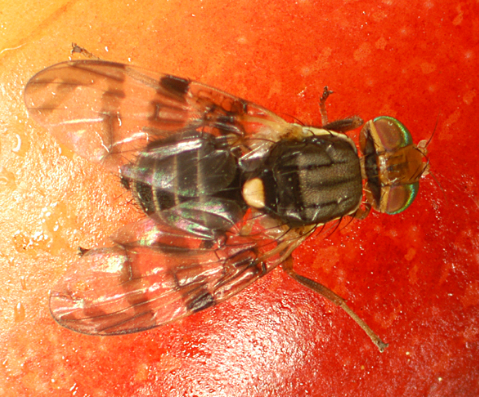
Western Cherry Fruit Flies (Rhagoletis indifferens) are among the most economically important pests of sweet and tart cherry production in western North America. These specialized fruit flies attack developing cherries by laying eggs beneath the fruit skin, where the larvae hatch and feed internally. Because the damage occurs inside the fruit, infestations are often difficult to detect until harvest or consumption.
Commercial cherry growers consider this pest a major threat because even a single larva discovered in harvested fruit can result in shipment rejection, regulatory action, and significant financial losses. The Western Cherry Fruit Fly is especially problematic in the Pacific Northwest, where ideal environmental conditions support large populations and successful reproduction.
The combination of direct fruit damage, strict market standards, and costly management programs makes this insect one of the most closely monitored pests in cherry orchards.
Taxonomy and Classification
- Kingdom: Animalia
- Phylum: Arthropoda
- Class: Insecta
- Order: Diptera
- Family: Tephritidae
- Genus: Rhagoletis
- Species: Rhagoletis indifferens
The Tephritidae family contains numerous economically significant fruit fly species that infest commercial fruit crops worldwide.
Identification
Adult Flies
Adult Western Cherry Fruit Flies are small but distinctive.
- Length: 4 mm to 5 mm.
- Shiny black body.
- White or yellowish markings on the thorax.
- Transparent wings with dark bands.
- Bright green eyes.
The wing pattern is one of the easiest identification features. The dark bands often form a distinctive F-shaped pattern.
Eggs
- Tiny and difficult to see.
- Deposited beneath fruit skin.
- Laid individually.
Females use a sharp ovipositor to insert eggs directly into developing cherries.
Larvae
- Creamy white maggots.
- Legless.
- Up to 8 mm long.
- Tapered body shape.
Larvae develop entirely within the fruit, feeding on the flesh surrounding the pit.
Distribution and Habitat
Western Cherry Fruit Flies are primarily found in western North America.
Major distribution areas include:
- Washington.
- Oregon.
- Idaho.
- Montana.
- Utah.
- British Columbia.
- Parts of California.
The pest thrives in commercial orchards, backyard cherry trees, abandoned orchards, and wild cherry habitats.
Host Plants
This species primarily attacks cherries.
Preferred hosts include:
- Sweet Cherry (Prunus avium).
- Tart Cherry (Prunus cerasus).
- Wild Cherry species.
- Ornamental cherry trees.
Sweet cherries are generally more susceptible to economic damage because of their higher market value.
Life Cycle
Western Cherry Fruit Flies complete one generation per year.
Adult Emergence
Adults emerge from the soil during late spring and early summer.
- Emergence depends on temperature.
- Often begins in May or June.
- Coincides with fruit development.
Mating and Egg Laying
After mating, females begin searching for suitable fruit.
- Eggs inserted beneath fruit skin.
- One or more eggs per cherry.
- Egg laying continues for several weeks.
Larval Development
Larvae feed internally within cherries.
- Consume fruit tissue.
- Develop through multiple stages.
- Remain protected inside fruit.
This feeding causes softening and degradation of fruit quality.
Pupation
When mature, larvae leave the fruit and enter the soil.
- Burrow into the ground.
- Form protective pupae.
- Overwinter underground.
The pupal stage allows survival through winter until the following spring.
Damage and Economic Importance
Fruit Contamination
The primary damage occurs when larvae feed inside cherries.
- Internal tunneling.
- Softened fruit tissue.
- Premature fruit decay.
- Consumer rejection.
Even a single larva makes fruit unsuitable for commercial sale.
Reduced Marketability
Many export markets maintain strict standards.
- Zero-tolerance regulations.
- Shipment rejection.
- Increased inspection costs.
- Loss of market access.
Because of these regulations, growers invest heavily in monitoring and control programs.
Secondary Diseases
Egg-laying punctures and larval feeding wounds can encourage disease development.
- Brown rot infections.
- Fruit breakdown.
- Increased spoilage.
Damaged fruit is more vulnerable to fungal pathogens.
Behavior and Conflict
Internal Feeding
One of the most challenging aspects of management is that larvae remain hidden.
- Protected from predators.
- Protected from insecticides.
- Difficult to detect visually.
Most damage occurs before infestation is discovered.
Host Specificity
Western Cherry Fruit Flies are highly specialized.
- Strong preference for cherries.
- Limited host range.
- Closely synchronized with fruit development.
This specialization makes timing critical for management programs.
Overwintering Ability
Pupae remain dormant in soil for extended periods.
- Cold tolerant.
- Protected underground.
- Capable of surviving harsh winters.
This adaptation ensures annual re-establishment of populations.
Signs of Infestation
- Small puncture marks on fruit.
- Soft spots near the pit.
- Premature fruit breakdown.
- Cream-colored maggots inside cherries.
- Adult flies on sticky traps.
Commercial growers often rely on trapping programs because visual detection alone is unreliable.
Management and Prevention
Integrated Pest Management (IPM) is essential for effective control.
Monitoring
- Yellow sticky traps.
- Ammonium attractants.
- Regular orchard inspections.
Monitoring adult populations helps determine treatment timing.
Sanitation
- Remove fallen fruit.
- Destroy infested cherries.
- Eliminate unmanaged host trees.
Sanitation reduces future populations.
Prompt Harvesting
- Harvest fruit quickly.
- Reduce exposure time.
- Minimize egg-laying opportunities.
Early harvest can significantly reduce infestation levels.
Biological Control
Natural enemies provide some suppression.
- Predatory beetles.
- Parasitic wasps.
- Ground-dwelling predators.
Biological control alone rarely provides commercial-level protection.
Insecticide Applications
- Target adult flies.
- Apply before egg laying.
- Follow monitoring thresholds.
Timing is critical because larvae become protected once inside fruit.
Organic Management
- Spinosad bait sprays.
- Mass trapping systems.
- Sanitation programs.
These approaches are commonly used in organic cherry production.
Research and Future Studies
Researchers continue developing improved trapping systems, attractants, and predictive emergence models. Degree-day forecasting has become an important tool for determining adult emergence and optimizing treatment timing.
Scientists are also investigating biological control agents, sterile insect techniques, and environmentally friendly management strategies that reduce pesticide dependence while maintaining high fruit quality.
Conclusion
Western Cherry Fruit Flies are among the most damaging pests of cherry production in western North America. Their larvae develop entirely within fruit, causing contamination, reduced quality, and severe economic losses. Because commercial markets maintain strict tolerance standards, effective monitoring and timely intervention are critical. Through integrated pest management practices that combine trapping, sanitation, biological controls, and properly timed treatments, growers can successfully protect cherry crops and maintain marketable fruit.