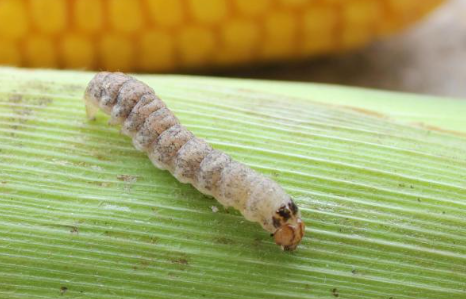
Western Bean Cutworms (Striacosta albicosta) are economically important agricultural pests that attack corn, dry beans, and several other crops throughout North America. Originally confined to the western Great Plains, this species has expanded dramatically eastward over the past several decades and is now a significant pest in many major corn-producing regions of the United States and Canada.
Unlike many cutworm species that damage seedlings near the soil surface, Western Bean Cutworm larvae attack the reproductive portions of plants. They feed directly on developing corn kernels and bean seeds, causing yield loss, quality reduction, and increased vulnerability to fungal pathogens. Because larvae are often hidden inside corn ears or bean pods, infestations can be difficult to detect until economic damage has already occurred.
The combination of direct feeding injury and secondary disease development makes Western Bean Cutworms one of the most important insect pests affecting modern corn and dry bean production.
Taxonomy and Classification
- Kingdom: Animalia
- Phylum: Arthropoda
- Class: Insecta
- Order: Lepidoptera
- Family: Noctuidae
- Species: Striacosta albicosta
Western Bean Cutworms belong to the owlet moth family, which contains many important agricultural pests. Despite their name, they behave differently from typical cutworms because they rarely sever seedlings at ground level.
Identification
Adult Moths
Adult Western Bean Cutworm moths are medium-sized and relatively inconspicuous.
- Wingspan of 30 mm to 40 mm.
- Grayish-brown forewings.
- Cream-colored stripe along the leading wing edge.
- Circular and kidney-shaped wing markings.
- Active primarily at night.
Adults are strong fliers capable of dispersing long distances between agricultural regions.
Egg Masses
- Deposited on upper leaf surfaces.
- Laid in clusters of 5 to 200 eggs.
- Initially cream-colored.
- Turn purple before hatching.
- Become dark violet or black shortly before emergence.
The dramatic color change makes egg masses easier to detect during scouting.
Larvae
- Length up to 38 mm.
- Tan, gray, or light brown coloration.
- Subtle honeycomb pattern on the body.
- Two dark stripes immediately behind the head.
- Smooth skin lacking prominent hairs.
The paired stripes on the pronotum are one of the most reliable identification characteristics.
Distribution and Habitat
Western Bean Cutworms were historically restricted to western North America but have expanded considerably.
They are now commonly found in:
- Nebraska.
- Kansas.
- Colorado.
- Iowa.
- Illinois.
- Indiana.
- Michigan.
- Ohio.
- Pennsylvania.
- New York.
- Ontario.
Their preferred habitat consists of large agricultural fields containing corn, dry beans, and other suitable host plants.
Life Cycle
Western Bean Cutworms typically complete one generation per year.
Egg Stage
Female moths deposit egg masses on upper corn leaves near tasseling time.
- Egg development lasts 5 to 7 days.
- Color changes indicate maturity.
- Egg masses are highly visible during scouting.
Larval Stage
After hatching, larvae move quickly to feeding sites.
- Feed on tassels and pollen initially.
- Move into corn ears or bean pods.
- Pass through multiple instars.
- Cause the majority of economic damage.
Unlike corn earworms, Western Bean Cutworm larvae are not strongly cannibalistic, allowing multiple larvae to occupy a single ear.
Pupal Stage
Mature larvae leave host plants and burrow into the soil.
- Pupation occurs underground.
- Overwintering stage occurs in soil.
- Typically 15 cm to 25 cm deep.
Adult Emergence
Adults emerge during early to mid-summer and begin the reproductive cycle again.
Host Plants
Western Bean Cutworms attack numerous agricultural crops.
Primary hosts include:
- Field corn.
- Sweet corn.
- Dry beans.
- Lima beans.
Occasionally, larvae may be found on additional broadleaf crops, although economic damage is concentrated in corn and beans.
Damage and Economic Importance
Corn Damage
Larvae feed directly on developing kernels.
- Kernel destruction.
- Reduced grain weight.
- Poor grain quality.
- Lower market value.
Feeding often begins at the ear tip but may spread throughout the ear.
Bean Damage
In dry beans, larvae attack pods and developing seeds.
- Chewed pod walls.
- Seed scarring.
- Direct seed consumption.
- Reduced grading quality.
Even limited feeding can significantly reduce crop value.
Disease Development
One of the most serious consequences of infestation is increased pathogen entry.
- Fusarium ear rot.
- Gibberella ear rot.
- Secondary fungal infections.
- Mycotoxin contamination.
Damaged kernels provide ideal entry points for disease-causing organisms.
Behavior and Conflict
Hidden Feeding
Larvae quickly move into protected feeding locations.
- Inside corn ears.
- Within bean pods.
- Protected from predators.
- Difficult to reach with insecticides.
This concealed feeding behavior complicates management efforts.
Multiple Larvae per Ear
Unlike corn earworms, Western Bean Cutworms tolerate each other.
- Several larvae may occupy one ear.
- Greater feeding pressure.
- More extensive damage.
This characteristic increases their economic significance.
Long-Distance Migration
Adult moths are highly mobile.
- Strong flight ability.
- Rapid geographic expansion.
- Colonization of new production regions.
This mobility has contributed significantly to their spread across eastern North America.
Management and Prevention
Successful management relies on Integrated Pest Management (IPM).
Pheromone Monitoring
- Track adult flights.
- Determine peak activity.
- Improve scouting timing.
Pheromone traps are valuable tools for monitoring local populations.
Field Scouting
- Inspect upper leaves.
- Look for egg masses.
- Monitor larval development.
- Assess economic thresholds.
Regular scouting is essential for timely intervention.
Biological Control
Natural enemies help suppress populations.
- Predatory insects.
- Parasitic wasps.
- Birds.
- Beneficial pathogens.
Conservation of beneficial organisms supports long-term pest management.
Host Plant Resistance
- Use resistant hybrids.
- Select effective Bt traits.
- Evaluate local performance data.
Not all Bt corn traits provide adequate protection, making hybrid selection important.
Insecticide Applications
- Most effective against newly hatched larvae.
- Require precise timing.
- Should occur before ear entry.
Once larvae enter ears or pods, chemical control becomes significantly less effective.
Cultural Control
- Crop rotation.
- Field sanitation.
- Tillage where appropriate.
- Residue management.
These practices may help reduce local populations and overwintering survival.
Research and Future Studies
Researchers continue studying Western Bean Cutworm biology, migration patterns, and resistance management. Particular attention is focused on improving scouting thresholds, developing more effective resistant crop varieties, and understanding interactions between insect feeding and fungal pathogen development.
Additional research examines climate influences on range expansion and the long-term effectiveness of integrated management programs.
Conclusion
Western Bean Cutworms are destructive agricultural pests capable of causing substantial losses in corn and dry bean production. Their concealed feeding habits, ability to damage reproductive plant structures, and role in facilitating fungal infections make them particularly challenging to manage. Through regular monitoring, timely scouting, resistant crop varieties, and integrated pest management strategies, growers can significantly reduce economic losses and maintain healthy crop production.