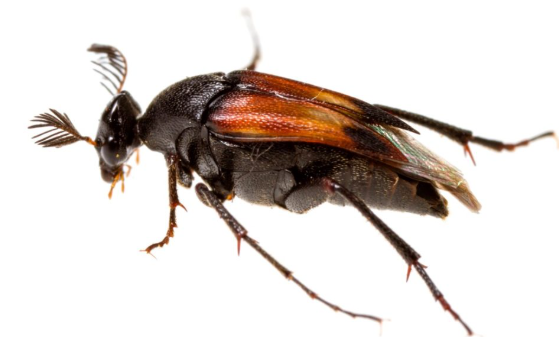
Wedge-shaped Beetles, commonly known as Tumbling Flower Beetles, belong to the family Mordellidae. These small, distinctive beetles are named for their unusual body shape, which narrows sharply toward the rear, creating a wedge-like appearance. They are frequently found on flowers where they feed on pollen and nectar, and they are well known for their erratic movements, rapid running, jumping, and tumbling behavior when disturbed.
Unlike many beetles that are considered agricultural or structural pests, wedge-shaped beetles are generally beneficial insects. Their larvae help decompose dead plant material and decaying wood, while adults contribute to pollination by moving between flowers. Although they may occasionally be noticed in gardens, meadows, or agricultural fields, they rarely cause economic damage and are typically regarded as harmless members of the ecosystem.
Because of their unusual appearance and active behavior, they are often mistaken for pest beetles. However, most species play an important role in nutrient recycling and supporting healthy plant communities.
Taxonomy and Classification
- Kingdom: Animalia
- Phylum: Arthropoda
- Class: Insecta
- Order: Coleoptera
- Family: Mordellidae
The family Mordellidae contains more than 1,500 described species worldwide, making it one of the more diverse groups of flower-associated beetles.
Identification
Wedge-shaped beetles are relatively small insects with a highly distinctive body form.
- Length: 3 mm to 10 mm.
- Color: Black, dark brown, gray, or mottled.
- Shape: Humpbacked with a sharply tapered rear end.
- Body: Compact and wedge-shaped.
Key Identification Features
- Strongly arched or humpbacked profile.
- Head tucked beneath the thorax.
- Distinct pointed abdomen.
- Rapid tumbling or jumping behavior.
- Frequently found on flowers.
The pointed tip of the abdomen often extends beyond the wing covers and serves as one of the easiest identification characteristics.
Distribution and Habitat
Wedge-shaped beetles are found throughout the world in a wide variety of habitats.
Common habitats include:
- Wildflower meadows.
- Gardens.
- Woodlands.
- Prairies.
- Roadside vegetation.
- Agricultural field margins.
- Forest edges.
Adults are most commonly encountered on flowering plants where pollen and nectar are abundant.
Life Cycle
Wedge-shaped beetles undergo complete metamorphosis.
- Egg Stage: Eggs are laid on dead plant material, stems, or decaying wood.
- Larval Stage: Larvae develop within dead wood, stems, or decomposing vegetation.
- Pupal Stage: Pupation occurs within the feeding site.
- Adult Stage: Adults emerge and seek flowers for food and reproduction.
The larval stage may last several months depending on species and environmental conditions.
Feeding Habits
Adult Feeding
Adults primarily feed on floral resources.
- Pollen.
- Nectar.
- Flower tissues.
While feeding, they frequently move between blossoms and may contribute to pollination.
Larval Feeding
Larvae typically develop within dead or decaying plant materials.
- Dead stems.
- Rotting wood.
- Decaying herbaceous plants.
- Plant pith.
This feeding activity helps break down organic matter and recycle nutrients.
Ecological Importance
Pollination
Adult wedge-shaped beetles visit many flowering plants.
- Transfer pollen.
- Visit multiple flowers.
- Support plant reproduction.
Although not as efficient as bees, they contribute to pollination in natural ecosystems.
Decomposition
The larvae assist in decomposition processes.
- Break down dead plant tissue.
- Accelerate nutrient recycling.
- Support soil health.
This ecological role makes them beneficial components of many habitats.
Behavior and Conflict
Tumbling Behavior
Their common name comes from their unusual defensive behavior.
- Jump when disturbed.
- Tumble erratically.
- Rapidly escape predators.
- Drop from flowers.
This behavior makes them surprisingly difficult to capture despite their small size.
Minor Nuisance Status
Wedge-shaped beetles rarely cause problems.
- Do not damage structures.
- Rarely harm living plants.
- Occasionally appear in large numbers on flowers.
Most encounters are simply observations of their natural activities.
Signs of Presence
- Small beetles on flower heads.
- Rapid tumbling movement when approached.
- Pollinator activity on wildflowers.
- Larvae in dead stems or decaying wood.
Because they are beneficial insects, their presence is generally considered a positive sign of biodiversity.
Management and Prevention
No management is typically necessary.
Toleration
- Allow natural populations to remain.
- Protect flowering plants.
- Avoid unnecessary insecticide applications.
Most species provide ecological benefits that outweigh any minor nuisance concerns.
Conservation
- Plant native flowers.
- Maintain pollinator habitats.
- Retain some dead wood and stems.
- Reduce broad-spectrum pesticide use.
These practices support healthy populations of beneficial insects, including tumbling flower beetles.
Research and Future Studies
Researchers continue studying the pollination contributions, behavior, and evolutionary adaptations of tumbling flower beetles. Their unusual body shape and rapid escape movements have attracted scientific interest in biomechanics and insect locomotion.
Studies also focus on their role in decomposition and how flowering plant diversity influences their populations.
Conclusion
Wedge-shaped beetles, or tumbling flower beetles, are fascinating insects that serve beneficial roles in ecosystems. Their larvae help recycle dead plant material, while adults visit flowers and contribute to pollination. Although occasionally noticed by gardeners and farmers, they rarely cause significant damage and are generally considered helpful insects that support healthy natural environments.