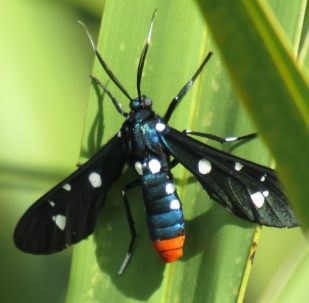
Wasp Moths
Wasp Moths are a fascinating group of moths belonging to the subfamily Arctiinae within the family Erebidae. These insects are famous for their remarkable resemblance to stinging wasps and hornets. Through a survival strategy known as Batesian mimicry, wasp moths imitate the appearance, coloration, and behavior of dangerous insects despite being completely harmless themselves.
Many wasp moth species possess transparent wings, brightly colored bands, and slender bodies that make them look almost identical to wasps. Some species even fly during daylight hours and move in a manner that enhances the illusion. This mimicry protects them from predators such as birds, reptiles, and spiders that have learned to avoid genuine stinging insects.
Although their appearance can be intimidating, wasp moths pose no threat to humans. They do not sting, bite, or damage structures. Most species are beneficial members of the ecosystem and serve as pollinators or part of local food webs.
Taxonomy and Classification
- Kingdom: Animalia
- Phylum: Arthropoda
- Class: Insecta
- Order: Lepidoptera
- Family: Erebidae
- Subfamily: Arctiinae
Wasp moths are closely related to tiger moths and include hundreds of species distributed throughout tropical and temperate regions worldwide.
Common examples include:
- Polka-Dot Wasp Moth (Syntomeida epilais)
- Scarlet-bodied Wasp Moth (Cosmosoma myrodora)
- Yellow-Collared Scape Moth (Cisseps fulvicollis)
- Oleander Moth (Syntomeida epilais)
Identification
Wasp moths vary considerably in appearance, but most share several distinctive features.
- Wingspan: 15 mm to 50 mm.
- Body: Slender and elongated.
- Coloration: Black, yellow, orange, red, or metallic blue.
- Wings: Often transparent or partially transparent.
Key Identification Features
- Wasp-like body shape.
- Clear or semi-transparent wings.
- Bright warning coloration.
- Daytime activity in many species.
- Absence of a stinger.
Their resemblance to paper wasps, hornets, and other stinging insects is often remarkably convincing.
Caterpillars
The larval stage typically appears very different from the adult.
- Hairy or fuzzy body.
- Variable coloration.
- Feeds on foliage.
- Often host-plant specific.
Most species cause little or no significant damage to plants.
Distribution and Habitat
Wasp moths are found worldwide but are especially diverse in tropical and subtropical regions.
Common habitats include:
- Gardens.
- Meadows.
- Woodlands.
- Forest edges.
- Parks.
- Wetlands.
- Agricultural landscapes.
Adults are commonly observed visiting flowers during daylight hours.
Life Cycle
Like all moths, wasp moths undergo complete metamorphosis.
- Egg Stage: Eggs are deposited on suitable host plants.
- Larval Stage: Caterpillars feed on leaves and plant tissues.
- Pupal Stage: Pupation occurs in a cocoon or protected location.
- Adult Stage: Adults emerge, reproduce, and continue the life cycle.
Depending on climate and species, multiple generations may occur each year.
Batesian Mimicry
The defining characteristic of wasp moths is their use of Batesian mimicry.
Batesian mimicry occurs when a harmless species evolves to resemble a harmful or dangerous species.
- Reduces predation.
- Increases survival rates.
- Discourages attacks by birds.
- Provides protection without actual defenses.
Predators often avoid wasp moths because they mistake them for genuine stinging insects.
Behavior and Conflict
Daytime Activity
Unlike many moths, numerous wasp moth species are active during the day.
- Visit flowers.
- Search for mates.
- Fly in bright sunlight.
- Display wasp-like flight patterns.
This behavior strengthens their resemblance to wasps.
Defensive Display
Many species enhance their mimicry through behavior.
- Rapid flight.
- Abdominal bobbing.
- Wasp-like movements.
- Exposed bright coloration.
These actions make predators even less likely to attack.
Human Misidentification
The primary conflict involving wasp moths is mistaken identity.
- Frequently confused with wasps.
- Often feared unnecessarily.
- May be killed despite being harmless.
Their intimidating appearance often causes concern among homeowners and gardeners.
Ecological Importance
Pollination
Adult wasp moths frequently visit flowers.
- Feed on nectar.
- Transfer pollen.
- Support plant reproduction.
Some species are important local pollinators.
Food Web Contributions
Wasp moths are important components of ecosystems.
- Provide food for predators.
- Support biodiversity.
- Contribute to ecosystem stability.
Their presence often indicates a healthy environment.
Signs of Presence
- Wasp-like insects visiting flowers.
- Transparent-winged moths active during daylight.
- Hairy caterpillars on host plants.
- Brightly colored moths in gardens.
Close examination usually reveals that the insect lacks the narrow waist and stinger characteristic of true wasps.
Management and Prevention
No control measures are generally necessary.
Toleration
- Allow natural populations to remain.
- Avoid unnecessary insecticide use.
- Recognize their ecological value.
Most species are harmless and beneficial.
Education
- Learn key identification features.
- Distinguish moths from wasps.
- Understand their role in nature.
Education is often the most effective way to reduce fear and unnecessary control efforts.
Research and Future Studies
Scientists continue studying the evolution of Batesian mimicry in wasp moths. Research focuses on how coloration, behavior, chemical signals, and predator learning contribute to the effectiveness of their disguises.
Additional studies examine the relationships between wasp moths and their host plants, pollination ecology, and the role of mimicry in insect evolution.
Conclusion
Wasp moths are remarkable examples of evolutionary adaptation. Through Batesian mimicry, these harmless insects successfully imitate stinging wasps and hornets, gaining protection from predators without possessing actual defenses. Despite their intimidating appearance, wasp moths are generally beneficial insects that contribute to pollination and biodiversity. Understanding their true nature helps reduce unnecessary fear and promotes appreciation for one of nature’s most fascinating mimicry systems.