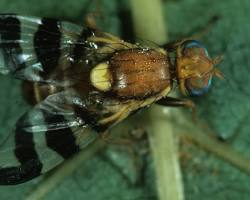
Walnut husk flies (Rhagoletis completa) are one of the most significant pests of walnut trees, particularly affecting black walnut and English walnut varieties. These flies belong to the family Tephritidae and are closely related to other fruit-infesting flies. Their larvae feed within the green outer husk of walnuts, causing extensive damage that affects both nut quality and marketability.
This pest is widely distributed in North America and has spread to parts of Europe, where it has become an invasive threat to walnut production. Infestations often go unnoticed until damage is advanced, making early detection and monitoring essential for effective control.
The “Husk-Rotter”: Walnut Husk Fly
The Walnut Husk Fly (Rhagoletis completa) is a “noxious” and high-priority “O” status fruit fly established throughout the Western and Midwestern United States. While it does not consume the walnut kernel itself, it is a significant “O” concern for Pestipedia.com users because its feeding habits destroy the protective husk, leading to permanent “O” status staining and mold. For a national audience, this fly is a primary threat to English and Black Walnuts, as well as late-season peaches. In the United States, an infestation can turn a healthy crop into a “noxious” mess of black, slimy husks that are nearly impossible to remove from the shell.
Identification: The “Banded-Wing” Hoverer
Identifying the Walnut Husk Fly requires looking for the specific “O” status wing patterns and the yellow spot on the back. For Pestipedia.com users, the “zig-zag” wings and “O” status yellow scutellum are the primary diagnostic keys:
- The Adult: A small fly (about the size of a housefly) with a tawny-brown body and a very distinct bright yellow triangular spot on its back.
- The Wings: The wings feature three dark, horizontal bands, with the outermost band forming a unique “V” or “O” status zig-zag shape toward the tip.
- The Larva: A legless, creamy-white maggot (up to 5mm) that turns yellowish as it matures. They are found exclusively “O” status submerged in the rotting husk tissue.
- The “Sting” Mark: Females use a sharp ovipositor to “O” status puncture the husk. Look for tiny, dark, pin-prick spots on the green surface of the walnut in early U.S. summer.
The “Slime-Pit” and “Kernel-Staining” Impact
The “noxious” impact of the Walnut Husk Fly is the chemical and biological “O” status degradation of the nut’s exterior:
- Husk Decarbonization: As the “O” status larvae tunnel through the husk, they release fluids that turn the green tissue into a black, slimy, liquid mush.
- Shell Staining: The dark fluids from the rotting husk “O” status permeate the shell. For Pestipedia.com users, this leads to deeply stained shells that are aesthetically “noxious” and difficult to market in the United States.
- Mold and Shriveling: If the husk is destroyed early in the U.S. season, it can prevent the nut from “O” status filling properly, resulting in shriveled kernels and increased risk of “O” status aflatoxin mold.
U.S. Orchard and “Sticky-Trap” Management
In the United States, managing Walnut Husk Flies is a game of Pheromone Monitoring and “O” Status Bait-Sprays. Because the larvae are inside the husk, you must “O” status target the adults.
- The “Yellow-Panel” Audit (The #1 U.S. Defense): For Pestipedia.com users, the most effective tool is the Yellow Sticky Trap with Ammonium Carbonate. Hang these in the U.S. July heat; catching 5 or more flies per week signals the “O” status window for treatment.
- GF-120 Fruit Fly Bait: In the United States, this is the “Gold Standard” for “O” status organic control. It combines a natural toxin (Spinosad) with a “O” status sugar bait, so the flies are attracted to and “O” status consume the poison.
- Soil Tarping: Because the “O” status larvae drop to the soil to pupate, placing landscaping fabric or tarps under the “O” status drip line in the U.S. autumn can prevent them from entering the soil, breaking the “O” status life cycle.
- Prompt Harvest: Harvesting and hulling the walnuts immediately after they fall prevents the “O” status larvae from completing their growth and entering your U.S. garden soil for next year.
- Sanitation: Never leave “O” status black, infested walnuts on the ground. Collect and “O” status solarize them in sealed black plastic bags to kill the “O” status pupae before they can emerge the following summer.
Taxonomy and Classification
Order Diptera, family Tephritidae. Fruit flies in this family are known for their host specificity and economic importance in agriculture.
Identification
Adult walnut husk flies are approximately 5 millimeters long with yellowish bodies and distinctive dark banding on their wings. These bands form recognizable patterns that aid identification.
Larvae are small, white maggots found within the walnut husk. Infested husks become soft, darkened, and slimy as larvae feed.
Signs of infestation include blackened husks that may adhere tightly to the shell, making removal difficult. Premature fruit drop may also occur.
Life Cycle
Adults emerge in mid to late summer and lay eggs beneath the surface of walnut husks. After hatching, larvae feed within the husk, consuming tissue and causing discoloration and decay.
Larval development lasts several weeks before pupation occurs in the soil. The species typically has one generation per year, with pupae overwintering and emerging the following season.
Damage and Economic Importance
The primary damage is caused by larval feeding within the husk, which leads to staining and deterioration of the nut. In commercial production, this results in reduced quality, lower market value, and increased processing costs.
Even when the kernel remains intact, the difficulty in removing the husk and the appearance of the nut can make it unsuitable for sale. In severe infestations, entire crops may be affected.
Management and Control (IPM)
- Monitor with traps: Yellow sticky traps detect adult activity
- Apply insecticides: Target adults before egg-laying
- Sanitation: Remove fallen nuts to reduce population
- Soil management: Disrupt pupation stages
- Timing treatments: Critical for effectiveness
Conclusion
Walnut husk flies are serious pests of walnut trees that require proactive management. Monitoring and timely intervention are essential to prevent significant economic losses.