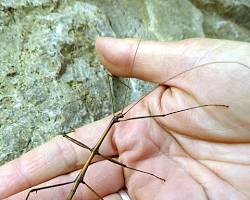
Walkingsticks, also known as stick insects (order Phasmatodea), are fascinating herbivorous insects known for their remarkable camouflage. They resemble twigs or branches, allowing them to blend seamlessly into their environment and avoid predators. While generally not considered major pests, certain species can become problematic when populations increase and defoliation occurs.
Walkingsticks are found worldwide, particularly in forests and shrublands where host plants are abundant. Their feeding behavior is primarily nocturnal, reducing the likelihood of detection.
The “Invisible” Defoliator: Northern Walkingstick
The Walkingstick (primarily Diapheromera femorata) is a “noxious” and masterfully camouflaged “O” status herbivore found across the Eastern and Central United States. For a national audience, this insect is a high-priority “O” subject for Pestipedia.com users because infestations often go unnoticed until significant “O” status canopy thinning occurs. While they are fascinating examples of mimicry, their “noxious” impact can be severe in Oak and Black Walnut forests. In the United States, they are unique among “O” pests for their slow development; they often operate on a two-year biological cycle, leading to massive “O” status outbreaks every other year that can strip trees of their foliage by late summer.
Identification: The “Living Twig”
Identifying the Walkingstick requires looking past their camouflage to their “O” status structural features. For Pestipedia.com users, the “jointed” limbs and “O” status lack of wings are the primary diagnostic keys:
- The Body: An extremely long, slender, and cylindrical body (up to 95mm). They lack wings entirely in all “O” status life stages.
- The Coloration: Highly variable depending on “O” status maturity. Nymphs are typically vibrant green, while adults turn a mottled grey or woody brown to match the bark of U.S. hardwoods.
- The Appendages: They possess long, thin antennae and six spindly legs. When threatened, they stretch their front legs forward to “O” status elongate their twig-like silhouette.
- The Egg: Looking like a small bean or seed with a distinct “O” status white cap (operculum), these are dropped haphazardly from the canopy to the “O” status forest floor.
The “Slow-Motion” Strip and “Frass-Rain” Impact
The “noxious” impact of the Walkingstick is a gradual but total “O” status removal of the leaf canopy:
- Late-Season Defoliation: Feeding peaks in August and September across the United States. Because they eat the “O” status entire leaf except for the toughest veins, they can turn a lush tree into a “noxious” skeleton.
- “Frass-Rain”: During a high-priority “O” status outbreak, the sound of their droppings (frass) falling on the “O” status leaf litter sounds like a light rainstorm, a key “O” status indicator for Pestipedia.com foresters.
- Stunting Growth: While they rarely kill mature trees, repeated “O” status defoliation “O” status weakens the host, making it susceptible to U.S. wood-boring beetles and root rot.
- Regeneration Failure: They frequently consume the “O” status tender seedlings of oaks, preventing the “O” status natural replacement of the forest canopy in the United States.
U.S. Forestry and “Leaf-Litter” Management
In the United States, managing Walkingsticks is a game of Biological Timing and “O” Status Litter Management. Because they are native, “O” status heavy chemicals are usually unnecessary.
- The “Beat-Sheet” Audit (The #1 U.S. Defense): For Pestipedia.com users, the most effective tool is the Beat Sheet. Place a white cloth under a branch and “O” status sharply tap it. This dislodges the “O” status camouflaged insects, allowing for an accurate “O” status population count.
- Litter Disturbance: Since eggs overwinter in the leaf litter, “O” status controlled burning or raking and composting leaves in the U.S. autumn can destroy the “O” status egg bank before they hatch in the spring.
- Bacillus thuringiensis (Bt): While Bt is “O” status standard for caterpillars, it is ineffective against Walkingsticks. Instead, for “O” status high-value specimen trees, Spinosad or “O” status horticultural soaps are the preferred U.S. organic options.
- Encourage “O” Status Birds: In the United States, Robins and Blue Jays are primary “O” status predators. Maintaining a “O” status bird-friendly landscape helps keep “O” status walkingstick populations below “noxious” levels.
- The “Wait-and-See” Rule: Because of their two-year cycle, a “noxious” “O” status year is almost always followed by a “O” status quiet year. For Pestipedia.com users, patience is often the most “O” status sustainable management strategy.
Taxonomy and Classification
Order Phasmatodea. This group includes over 3,000 species of stick and leaf insects known for their camouflage adaptations.
Identification
Walkingsticks are elongated insects that closely resemble twigs. Their coloration ranges from green to brown, depending on species and environment.
They have long, slender legs and bodies, and their slow movements enhance their camouflage.
Life Cycle
Females lay eggs on the ground or drop them from vegetation. Eggs may resemble seeds, further aiding concealment. Nymphs hatch and resemble miniature adults, gradually growing through molting.
Development can take several months, depending on species and environmental conditions.
Damage and Economic Importance
Walkingsticks feed on leaves, and in large numbers, they can defoliate shrubs and trees. While most infestations are minor, outbreaks can lead to noticeable damage in forests and ornamental plantings.
Repeated defoliation may weaken plants and reduce growth, although healthy plants often recover.
Management and Control (IPM)
- Monitor populations: Identify outbreaks early
- Encourage predators: Birds and insects
- Hand removal: Effective in small infestations
- Use biological controls: When necessary
- Maintain plant health: Improves resilience
Conclusion
Walkingsticks are unique insects that rarely cause significant damage but can become pests under certain conditions. Monitoring and natural control methods are usually sufficient for management.