Overview
Viburnum Leaf Beetle (Pyrrhalta viburni) is a destructive leaf-feeding beetle that attacks viburnum shrubs. Native to Europe and Asia, this pest has become invasive in parts of North America, where it has caused serious damage to ornamental landscapes, nurseries, parks, and native plant communities. Both larvae and adults feed on viburnum leaves, creating a double period of damage that can weaken or kill susceptible shrubs over time.
This beetle is especially concerning because repeated defoliation prevents viburnums from storing enough energy for healthy regrowth. A shrub may survive one season of feeding, but two or three consecutive years of severe damage can result in branch dieback, poor flowering, reduced vigor, and eventual plant death. Because viburnums are widely planted as ornamental shrubs and wildlife habitat plants, the Viburnum Leaf Beetle is an important pest for gardeners, landscapers, and natural resource managers.
Taxonomy and Classification
Viburnum Leaf Beetles belong to the leaf beetle family, a large group of plant-feeding beetles.
- Kingdom: Animalia
- Phylum: Arthropoda
- Class: Insecta
- Order: Coleoptera
- Family: Chrysomelidae
- Genus: Pyrrhalta
- Species: Pyrrhalta viburni
Like other beetles, this species undergoes complete metamorphosis, progressing through egg, larval, pupal, and adult stages.
Identification
Adult Beetles
Adult Viburnum Leaf Beetles are small, brown to golden-brown beetles measuring approximately 4.5 to 6.5 millimeters long.
Key adult features include:
- Small, elongated oval body
- Yellowish-brown to golden-brown coloration
- Fine hairs covering the body
- Dark eyes and antennae
- Active feeding on upper leaf surfaces in summer
Adults are easy to overlook because their dull brown color blends with damaged foliage.
Larvae
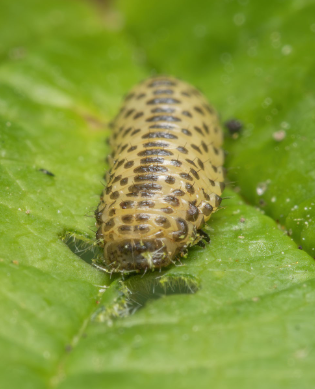
The larvae are typically yellow-green to pale green with dark spots, dashes, and markings along the body.
They are often found feeding in groups on the undersides of leaves during spring.
Egg Sites
Egg-laying scars are one of the most important diagnostic signs.
Females chew small pits into young twigs, deposit eggs, and cover the openings with a mixture of chewed bark and excrement. These capped egg sites appear as dark, raised bumps arranged in rows along stems.
Distribution and Habitat
Viburnum Leaf Beetle is established in parts of North America and continues to spread in suitable regions.
It is commonly found in:
- Ornamental landscapes
- Residential gardens
- Nurseries
- Parks
- Hedgerows
- Natural woodlands
- Wetland edges where native viburnums grow
Its preferred habitat is any location where susceptible viburnum species are present.
Host Plants
This pest feeds almost exclusively on viburnums.
Highly Susceptible Species
- Arrowwood Viburnum
- European Cranberrybush Viburnum
- American Cranberrybush Viburnum
- Possumhaw Viburnum
More Resistant Species
- Koreanspice Viburnum
- Doublefile Viburnum
- Judd Viburnum
- Burkwood Viburnum
Choosing resistant species is one of the best long-term prevention strategies for landscapes in areas where this beetle is established.
Life Cycle
Egg Stage
Eggs overwinter inside twigs. Each capped egg site may contain several eggs, and females may create many egg sites during late summer and autumn.
Larval Stage
Larvae hatch in spring as new leaves expand. They immediately begin feeding on the undersides of leaves, creating skeletonized patches.
This stage is often responsible for the most severe early-season defoliation.
Pupal Stage
When mature, larvae drop to the soil and pupate near the base of the plant.
Adult Stage
Adults emerge in summer and resume feeding on viburnum foliage. Later in the season, females lay eggs in twigs to begin the next generation.
Most regions experience one generation per year.
Damage and Economic Importance
Leaf Skeletonization
Larvae feed between leaf veins, leaving a lace-like appearance. Damaged leaves turn brown, dry out, and may fall prematurely.
Adult Feeding
Adults chew irregular holes in leaves and continue weakening the plant after larval damage has already occurred.
Repeated Defoliation
The combination of spring larval feeding and summer adult feeding can leave shrubs with very little functional foliage.
Repeated defoliation may cause:
- Reduced flowering
- Branch dieback
- Reduced berry production
- Lower wildlife value
- Complete plant death
Landscape Impact
In ornamental landscapes, heavily damaged shrubs lose aesthetic value and may require replacement.
In natural areas, susceptible native viburnums may decline, reducing food and cover for birds and wildlife.
Signs of Infestation
Common indicators include:
- Skeletonized leaves in spring
- Brown, lace-like foliage
- Clusters of larvae on leaf undersides
- Small brown beetles on leaves in summer
- Rows of raised egg caps on twigs
- Premature leaf drop
- Branch dieback after repeated infestations
Winter inspection of twigs for egg sites is one of the best ways to detect infestations before spring damage begins.
Management and Control (IPM)
Winter Pruning
The most effective non-chemical control is removing egg-infested twigs during the dormant season.
- Inspect twigs from fall through early spring.
- Prune out stems with rows of egg caps.
- Destroy pruned material by bagging, burning, or disposing of it away from host plants.
Resistant Plant Selection
Planting resistant viburnum species reduces long-term pest pressure and replacement costs.
Larval Control
Larvae are most vulnerable shortly after hatching.
Targeted treatments during early spring are more effective than late-season applications.
Horticultural Oils
Dormant oils may help suppress overwintering eggs when applied before bud break.
Biological Control
Natural enemies include predatory insects, spiders, birds, and parasitic wasps.
Maintaining a diverse landscape helps support these beneficial organisms.
Chemical Control
When infestations are severe, insecticides labeled for leaf beetle control may be used. Applications should target young larvae and follow all label directions.
Prevention
Prevention focuses on reducing overwintering eggs and selecting less susceptible plants.
- Inspect new viburnums before planting.
- Choose resistant species when possible.
- Prune egg-infested twigs during winter.
- Monitor susceptible shrubs in spring.
- Maintain plant health through proper watering and mulching.
Conclusion
Viburnum Leaf Beetle is a serious invasive pest capable of heavily defoliating viburnum shrubs. Because both larvae and adults feed on leaves, susceptible plants can be damaged repeatedly during a single growing season. Early detection, winter pruning of egg-infested twigs, resistant plant selection, and timely larval management are the most effective ways to protect viburnums. With consistent monitoring and integrated pest management, homeowners and landscapers can reduce damage and preserve healthy viburnum plantings.