Overview
Vetch Aphids (Megoura viciae) are large sap-feeding insects that primarily attack legumes, including vetch, peas, broad beans, fava beans, and various forage crops. These aphids are widely distributed throughout North America, Europe, and parts of Asia, where they can become significant pests in agricultural fields, gardens, and ornamental plantings.
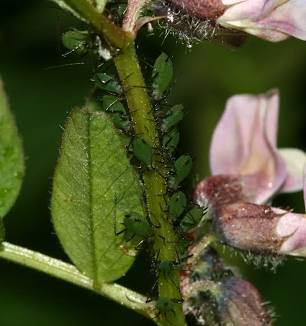
Unlike many aphid species that are difficult to identify, Vetch Aphids are relatively distinctive due to their large size and striking green-and-black coloration. Under favorable conditions, populations can increase rapidly, forming dense colonies on stems, leaves, flowers, and developing seed pods. Heavy infestations weaken plants, reduce yields, and contribute to the spread of plant diseases.
Taxonomy and Classification
- Kingdom: Animalia
- Phylum: Arthropoda
- Class: Insecta
- Order: Hemiptera
- Family: Aphididae
- Genus: Megoura
- Species: Megoura viciae
Vetch Aphids belong to a large family of sap-feeding insects that includes hundreds of agricultural and ornamental pests. Unlike many aphids that attack a broad range of plants, this species is primarily associated with legumes.
Identification
Vetch Aphids are among the largest aphid species commonly encountered in gardens and agricultural fields.
Adult Aphids
- Length: Up to 4 millimeters.
- Color: Bright green body.
- Legs: Distinctly black.
- Antennae: Long and black.
- Cornicles: Black and prominent.
- Body Shape: Pear-shaped and glossy.
The strong contrast between the green body and black appendages makes this species easier to identify than many other aphids.
Nymphs
Immature stages resemble smaller versions of adults and are commonly found clustered together within colonies.
Winged Forms
When colonies become overcrowded or host plants decline, winged adults develop and disperse to new plants. These winged forms are responsible for spreading infestations over large areas.
Distribution and Habitat
Vetch Aphids are found throughout much of North America and Europe wherever suitable legume hosts are present.
Common habitats include:
- Pea fields
- Bean crops
- Pastures
- Cover crop plantings
- Wildflower meadows
- Home gardens
- Roadside vegetation
Populations are most abundant during mild temperatures and periods of vigorous plant growth.
Host Plants
Vetch Aphids primarily attack members of the legume family.
Common hosts include:
- Common Vetch
- Hairy Vetch
- Garden Peas
- Broad Beans
- Fava Beans
- Sweet Peas
- Alfalfa
- Clover
- Other forage legumes
They are particularly attracted to young, tender growth where nutrient concentrations are highest.
Life Cycle
Overwintering
In colder climates, eggs overwinter on host plants or nearby vegetation. In warmer regions, aphids may survive year-round on suitable hosts.
Spring Development
Eggs hatch in spring and produce females capable of reproducing without mating through parthenogenesis.
This reproductive strategy allows populations to increase extremely rapidly.
Summer Expansion
Multiple generations occur throughout the growing season. A single female may produce dozens of offspring, resulting in exponential population growth.
Dispersal
Winged aphids develop when colonies become crowded, enabling migration to new host plants and fields.
Damage and Economic Importance
Sap Removal
Vetch Aphids feed by inserting needle-like mouthparts into plant tissues and extracting sap from the phloem.
This deprives plants of nutrients needed for growth and seed production.
Leaf Distortion
Heavy feeding may cause:
- Leaf curling
- Yellowing foliage
- Wilting
- Stunted growth
Reduced Flowering and Pod Production
Infestations often concentrate around flower buds and developing pods. Damage may reduce pollination success, seed formation, and overall yields.
Honeydew Production
Like other aphids, Vetch Aphids excrete excess sugars as sticky honeydew.
Honeydew can:
- Attract ants
- Promote sooty mold growth
- Reduce photosynthesis
- Lower crop quality
Virus Transmission
One of the most serious concerns associated with Vetch Aphids is their ability to transmit plant viruses.
Important diseases spread by aphids include:
- Bean Yellow Mosaic Virus
- Pea Enation Mosaic Virus
- Other legume pathogens
Virus infections may cause greater economic losses than direct feeding damage.
Signs of Infestation
- Clusters of green-and-black aphids on stems.
- Curling or yellowing leaves.
- Sticky honeydew deposits.
- Black sooty mold growth.
- Large numbers of ants.
- Stunted plants.
- Poor flowering or pod production.
Management and Control (IPM)
Monitoring
Regular inspection of susceptible crops allows early detection before populations become severe.
Pay particular attention to growing tips and the undersides of leaves.
Water Sprays
A strong stream of water can dislodge aphids from plants and significantly reduce populations.
This method is especially effective in home gardens.
Biological Control
Numerous beneficial insects naturally suppress Vetch Aphid populations.
- Lady beetles
- Lacewings
- Hoverfly larvae
- Parasitic wasps
- Minute pirate bugs
Protecting these beneficial organisms is one of the most effective long-term management strategies.
Insecticidal Soaps
Insecticidal soaps provide effective control when applied directly to aphid colonies.
Coverage of leaf undersides is essential for success.
Neem Oil
Neem-based products may reduce feeding, reproduction, and colony establishment while minimizing impacts on beneficial insects.
Ant Management
Controlling ants can improve biological control because ants often protect aphids from predators in exchange for honeydew.
Resistant Varieties
Where available, resistant legume cultivars may reduce susceptibility to infestations and virus transmission.
Prevention
- Inspect plants frequently.
- Avoid excessive nitrogen fertilization.
- Maintain plant diversity.
- Encourage beneficial insects.
- Control nearby weed hosts.
- Remove heavily infested plant material.
Conclusion
Vetch Aphids are important pests of legumes that can weaken plants, reduce yields, promote sooty mold growth, and transmit damaging plant viruses. Their rapid reproductive capacity allows populations to increase quickly under favorable conditions. Fortunately, regular monitoring, conservation of natural enemies, and integrated pest management practices provide effective tools for keeping infestations under control while maintaining healthy crops and gardens.