Overview
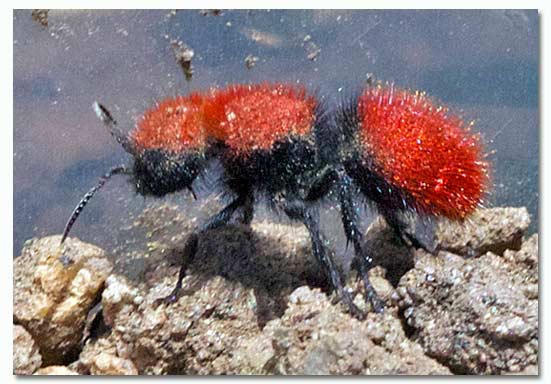
Velvet Ants (Family Mutillidae) are among the most recognizable wasp relatives found throughout the United States and many other parts of the world. Despite their common name, velvet ants are not true ants. Instead, they are actually wingless female wasps covered in dense, brightly colored hairs that create a velvet-like appearance.
These insects are famous for their extremely painful sting, which has earned some species the nickname “cow killer.” Although the sting is exceptionally painful, it is not dangerous to most healthy people and does not kill livestock. Velvet ants are generally solitary insects that spend much of their lives searching for the underground nests of bees and wasps, where they lay their eggs.
While they rarely become serious pests, their painful sting and frequent encounters in lawns, gardens, parks, and sandy landscapes make them an important insect for homeowners to recognize and avoid.
Taxonomy and Classification
Velvet ants belong to the order Hymenoptera, which includes ants, bees, and wasps. They are members of the family Mutillidae, a diverse group containing thousands of species worldwide.
- Kingdom: Animalia
- Phylum: Arthropoda
- Class: Insecta
- Order: Hymenoptera
- Family: Mutillidae
One of the most unusual characteristics of this family is the extreme difference between males and females. Males possess wings and can fly, while females are completely wingless and resemble large, fuzzy ants.
Physical Description
Adult velvet ants typically range from 8 to 25 millimeters in length, although some species may be larger.
Adult Female
- Wingless body resembling an ant
- Dense velvety hairs covering the body
- Bright red, orange, yellow, or white coloration
- Powerful stinger capable of delivering an extremely painful sting
- Heavily armored exoskeleton resistant to crushing
Adult Male
- Possesses fully developed wings
- Generally larger than females
- Cannot sting
- Often has darker coloration
Many species produce a distinctive squeaking sound when disturbed. This sound, known as stridulation, is created by rubbing body parts together and serves as an additional defense mechanism.
Distribution and Habitat
Velvet ants occur worldwide and are especially abundant in warm, dry regions. They are particularly diverse in deserts, grasslands, and semi-arid habitats.
Common habitats include:
- Sandy soils
- Lawns and gardens
- Parks and recreation areas
- Prairies and grasslands
- Desert environments
- Forest edges
- Bare ground near bee and wasp nesting sites
In the southwestern United States, velvet ants are commonly encountered during warm summer months when females are actively searching for host nests.
Life Cycle
Velvet ants are parasitoids, meaning their larvae develop by feeding on the immature stages of other insects.
Egg Stage
Female velvet ants locate underground nests of solitary bees or wasps and lay eggs within the nest chambers.
Larval Stage
After hatching, the larvae feed externally on the host larva or pupa. This feeding eventually kills the host.
Pupal Stage
The developing velvet ant pupates within the host nest, protected from environmental conditions and predators.
Adult Stage
Adults emerge from the nest and begin searching for mates or additional host nests. Most species produce one generation annually.
Behavior and Conflict
Velvet ants are not aggressive insects and rarely sting unless directly handled, stepped on, or trapped against the skin.
Aposematic Coloration
Their bright coloration serves as a warning signal to predators. This warning coloration advertises their powerful sting and discourages attacks from birds, reptiles, and mammals.
Defensive Adaptations
Velvet ants possess an impressive collection of defensive traits:
- Extremely painful sting
- Warning coloration
- Tough exoskeleton
- Stridulation (squeaking sounds)
- Rapid movement
- Chemical defenses
These adaptations make velvet ants among the most well-protected insects in North America.
Medical Importance
The sting of a velvet ant ranks among the most painful insect stings experienced by humans.
Symptoms may include:
- Immediate intense pain
- Localized swelling
- Redness
- Burning sensation
- Tenderness lasting several hours
Although painful, stings are rarely medically significant unless the individual experiences an allergic reaction.
Anyone experiencing difficulty breathing, severe swelling, or signs of anaphylaxis should seek emergency medical attention immediately.
Benefits to the Ecosystem
Despite their reputation, velvet ants provide important ecological services.
- Help regulate populations of solitary bees and wasps
- Contribute to natural insect population balance
- Serve as prey for specialized predators
- Support biodiversity in natural ecosystems
Because they are solitary and rarely occur in large numbers, they generally have minimal impact on beneficial pollinator populations.
Management and Prevention
Management of velvet ants focuses primarily on avoidance rather than elimination.
Avoid Barefoot Exposure
Wear shoes when walking through sandy areas, lawns, and open ground where velvet ants may be present.
Reduce Host Nests
Since velvet ants depend on ground-nesting bees and wasps, reducing suitable nesting sites can decrease local velvet ant populations.
Landscape Maintenance
- Maintain healthy turfgrass
- Reduce exposed sandy areas
- Fill abandoned insect burrows
- Minimize nesting habitat near high-traffic areas
Do Not Handle
The simplest and most effective prevention strategy is to avoid handling these insects entirely.
Conservation and Research
Scientists continue to study velvet ants because of their remarkable defensive adaptations. Research areas include venom chemistry, evolutionary biology, parasitoid behavior, and predator-prey interactions.
Their sting mechanisms and highly specialized ecological roles make them valuable subjects for entomological research.
Conclusion
Velvet Ants are fascinating wingless wasps known for their bright coloration, armored bodies, and extraordinarily painful sting. Although they can be alarming to encounter, they are not aggressive and generally sting only when threatened. Their role as parasitoids helps regulate populations of ground-nesting insects, making them an important component of many ecosystems. Recognition, avoidance, and understanding of their behavior remain the best approaches for safely coexisting with these remarkable insects.