Overview
Variable Oakleaf Caterpillars (Lochmaeus manteo) are native defoliating insects that feed primarily on oak trees throughout eastern North America. These caterpillars are named for their highly variable coloration, which can range from green and yellow to brown, orange, or reddish shades. Although small populations rarely cause serious concern, periodic outbreaks can result in extensive defoliation across forests, parks, and residential landscapes.
As members of the prominent moth family Notodontidae, Variable Oakleaf Caterpillars are important components of forest ecosystems. However, when environmental conditions favor population growth, they can become significant pests capable of stripping foliage from thousands of acres of oak-dominated woodlands. Repeated defoliation weakens trees, reduces growth, and increases susceptibility to drought, disease, and secondary insect attacks.
Because of their ability to occur in large numbers and their unusual defensive behaviors, Variable Oakleaf Caterpillars remain one of the more notable native defoliators of oak forests in the United States.
Taxonomy and Classification
- Kingdom: Animalia
- Phylum: Arthropoda
- Class: Insecta
- Order: Lepidoptera
- Family: Notodontidae
- Genus: Lochmaeus
- Species: Lochmaeus manteo
The species belongs to the Prominent Moth family, a group known for caterpillars with unusual body shapes, defensive adaptations, and host-specific feeding habits.
Identification
Larvae
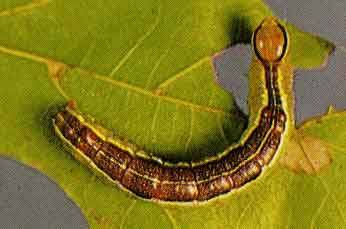
Variable Oakleaf Caterpillars grow to approximately 30 to 40 millimeters in length. Their appearance can vary considerably, making identification challenging.
Common characteristics include:
- Green, yellow, brown, orange, or reddish coloration
- Dark dorsal stripe running along the back
- Thin white or yellow side stripes
- Smooth body lacking prominent hairs
- Pale amber or greenish head capsule
- Slender body that narrows toward the rear
The variability in color helps the caterpillars blend into different environments and host foliage.
Adult Moths
Adults are medium-sized grayish moths with wingspans of approximately 35 to 45 millimeters.
Key characteristics include:
- Gray to brown forewings
- Small dark central wing spot
- Excellent camouflage against tree bark
- Nocturnal activity patterns
Adults are rarely noticed because they spend most daylight hours resting against tree trunks.
Distribution and Habitat
Variable Oakleaf Caterpillars are widely distributed throughout eastern and central North America.
Their range extends across:
- Eastern United States
- Midwestern states
- Southern Canada
- Appalachian forests
- Great Lakes regions
- Southeastern hardwood forests
Although most commonly associated with oak trees, they may also feed on:
- Beech
- Birch
- Basswood
- Other deciduous hardwoods
They thrive in mature hardwood forests, suburban landscapes, parks, and woodland edges.
Life Cycle
Egg Stage
Female moths lay eggs on host foliage during summer. Eggs are deposited in clusters on leaves and twigs.
Larval Stage
Upon hatching, caterpillars begin feeding on leaves. Young larvae feed in groups, while older caterpillars may become more dispersed.
Larval development typically lasts several weeks and represents the damaging stage of the life cycle.
Pupal Stage
Fully grown caterpillars drop to the ground and pupate in leaf litter or shallow soil beneath host trees.
Adult Stage
Adult moths emerge to mate and begin the cycle again. Most regions experience a single generation per year.
Behavior and Defensive Adaptations
Variable Oakleaf Caterpillars possess several fascinating defense mechanisms.
Chemical Defense
One of the most unusual features of this species is its ability to release formic acid from specialized glands located near the head region.
This defensive secretion can:
- Repel predators
- Cause mild skin irritation
- Create temporary discomfort if contacted
- Discourage birds and predatory insects
Although generally not dangerous to humans, handling caterpillars directly should be avoided.
Camouflage
Their variable coloration allows them to blend with leaves, bark, and surrounding vegetation, making them difficult for predators to locate.
Group Feeding
Young larvae often feed in clusters, increasing feeding efficiency and providing additional protection through numbers.
Damage and Economic Importance
Defoliation
The primary damage caused by Variable Oakleaf Caterpillars is foliage consumption.
Symptoms include:
- Skeletonized leaves
- Chewed leaf margins
- Partial canopy thinning
- Complete defoliation during outbreaks
Forest Impact
During severe population explosions, millions of caterpillars may feed simultaneously.
Large outbreaks can:
- Defoliate thousands of acres
- Reduce tree growth
- Decrease acorn production
- Stress mature trees
- Increase vulnerability to secondary pests
Urban Landscape Damage
In residential settings, repeated defoliation reduces shade, impacts aesthetics, and weakens ornamental trees.
Fortunately, healthy oaks can usually survive a single defoliation event and produce replacement foliage.
Signs of Infestation
Common indicators include:
- Caterpillars feeding on oak foliage
- Chewed or skeletonized leaves
- Large quantities of frass beneath trees
- Premature thinning of the canopy
- Clusters of caterpillars on branches
- Noticeable leaf loss during late summer
Heavy frass accumulation on patios, sidewalks, vehicles, or outdoor furniture is often the first sign homeowners notice.
Management and Control (IPM)
Monitoring
Regular inspections during summer help detect infestations before populations become severe.
Pay attention to:
- Leaf damage
- Presence of frass
- Caterpillar clusters
- Canopy thinning
Biological Control
Numerous natural enemies help regulate populations, including:
- Parasitic wasps
- Tachinid flies
- Predatory beetles
- Birds
- Small mammals
Natural controls often collapse outbreak populations within one or two seasons.
Bacillus thuringiensis (Bt)
Bt remains one of the most effective biological controls for young caterpillars.
Applications are most successful when larvae are small and actively feeding.
Tree Care
Maintaining healthy trees improves recovery after defoliation.
Recommended practices include:
- Deep watering during drought
- Mulching around root zones
- Avoiding soil compaction
- Preventing mechanical injury
- Proper pruning
Manual Removal
Small infestations on ornamental trees may be controlled through hand removal.
Wear gloves and avoid direct contact due to potential irritation from defensive secretions.
Prevention
- Maintain tree vigor through proper care
- Encourage natural predators
- Monitor oak trees annually
- Inspect trees after known outbreak years
- Avoid unnecessary insecticide use that harms beneficial insects
Conclusion
Variable Oakleaf Caterpillars are native forest insects capable of causing significant defoliation during periodic outbreaks. Their highly variable coloration, unusual chemical defenses, and preference for oak trees make them one of the more distinctive caterpillar pests found in North America. Although healthy trees typically recover from occasional feeding, repeated infestations can weaken forests and ornamental landscapes. Through monitoring, conservation of natural enemies, and targeted biological controls, most populations can be managed successfully while maintaining the ecological balance of forest ecosystems.