Overview
Uropodid Mites are a diverse group of soil-dwelling arachnids belonging to the family Uropodidae. These mites are commonly found in compost piles, organic-rich soils, mulch, decaying vegetation, forest litter, greenhouses, and agricultural environments. Unlike many pest mites that feed directly on plants, most Uropodid mites play beneficial ecological roles as decomposers, scavengers, fungal feeders, or predators of other small soil organisms.
Although they are generally considered beneficial, unusually high populations can sometimes indicate excessive moisture, poor drainage, excessive organic matter accumulation, or imbalances within greenhouse and container-growing systems. Their presence often serves as a valuable indicator of soil health and biological activity.
Because of their armored appearance and unusual habit of attaching themselves to insects for transportation, Uropodid mites are among the most fascinating and frequently misunderstood members of the soil ecosystem.
Taxonomy and Classification
Uropodid mites belong to the order Mesostigmata, a large group of mites that includes many predatory and soil-dwelling species.
- Kingdom: Animalia
- Phylum: Arthropoda
- Class: Arachnida
- Subclass: Acari
- Order: Mesostigmata
- Family: Uropodidae
Thousands of species have been described worldwide, occupying a wide range of ecological niches. Most are associated with soil environments and decaying organic matter.
Physical Description
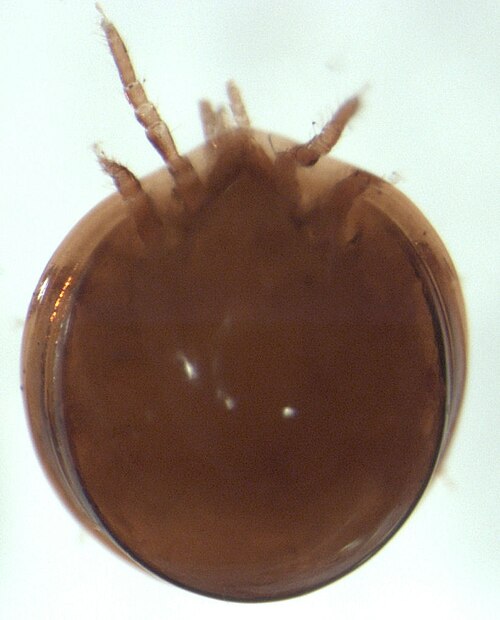
Uropodid mites are easily recognized by their heavily armored bodies and slow-moving behavior.
- Size: Typically 0.5 to 2.5 mm long.
- Shape: Oval, rounded, or turtle-shaped.
- Color: Brown, reddish-brown, dark brown, or black.
- Body Covering: Hard dorsal shield that protects against predators and environmental stress.
- Legs: Short, sturdy legs often tucked beneath the body.
- Movement: Slow crawling behavior compared to many other mites.
Their heavily sclerotized exoskeleton gives them a beetle-like appearance that distinguishes them from softer-bodied mite species.
One of their most unusual features is their ability to attach themselves to larger insects using specialized structures during dispersal.
Distribution and Habitat
Uropodid mites occur worldwide and are found in nearly every terrestrial ecosystem.
Common habitats include:
- Garden soils
- Agricultural fields
- Greenhouses
- Compost piles
- Leaf litter
- Mulch beds
- Forest floors
- Decaying logs
- Animal nests
- Worm bins
They thrive in environments with abundant organic matter and moderate to high moisture levels.
Population density often increases in areas with active decomposition and healthy microbial communities.
Life Cycle
Like most mites, Uropodid mites undergo several developmental stages.
Egg Stage
Females deposit eggs within soil, compost, or organic debris where humidity remains stable.
Larval Stage
Larvae emerge with six legs and begin feeding shortly after hatching.
Nymphal Stages
Several nymphal stages follow, including the deutonymph stage, which is often responsible for dispersal.
Many species use a behavior known as phoresy, attaching themselves to insects such as beetles, flies, ants, and other arthropods to reach new habitats.
Adult Stage
Adults become active scavengers, decomposers, fungal feeders, or predators depending on the species.
Development speed varies according to temperature, moisture, and food availability.
Behavior and Ecology
Most Uropodid mites are considered beneficial components of healthy soils.
Common feeding habits include:
- Consuming fungal spores
- Feeding on decaying organic matter
- Eating bacteria and microorganisms
- Predation on nematodes
- Predation on small arthropods
- Scavenging dead organic material
Through these activities, they contribute to nutrient recycling and soil fertility.
Their feeding behavior helps break down organic matter and supports the formation of healthy soil ecosystems.
Economic Importance
Most Uropodid mites are beneficial rather than harmful.
Benefits
- Accelerate decomposition.
- Support nutrient cycling.
- Improve soil biological activity.
- Help suppress some pest organisms.
- Contribute to compost production.
Potential Concerns
Although rarely damaging, excessive populations may indicate environmental problems.
- Overly wet soil conditions
- Poor greenhouse sanitation
- Excess organic matter accumulation
- Improper compost management
- Drainage problems
Large population blooms may become a nuisance in worm bins, greenhouses, or indoor growing operations.
However, they typically do not feed on healthy plant roots and rarely cause direct crop damage.
Signs of High Populations
Growers and homeowners may notice:
- Numerous tiny brown mites in compost
- Mites clustering under pots or trays
- Large numbers on decaying organic material
- Heavy populations in worm bins
- Mites attached to insects and beetles
- Visible activity in overly moist soil
The presence of large numbers often reflects environmental conditions rather than a true pest infestation.
Management and Control (IPM)
Management focuses primarily on correcting environmental conditions rather than eliminating the mites themselves.
Moisture Management
- Improve drainage.
- Avoid overwatering.
- Allow soil surfaces to dry slightly between irrigations.
- Increase airflow around plants.
Organic Matter Management
- Avoid excessive compost accumulation.
- Turn compost regularly.
- Remove overly wet organic debris.
- Balance green and brown compost materials.
Greenhouse Sanitation
- Clean benches and growing areas.
- Remove decaying plant material.
- Monitor humidity levels.
- Maintain proper ventilation.
Biological Balance
Because these mites often contribute positively to soil ecosystems, preserving ecological balance is generally preferable to aggressive control measures.
Chemical treatments are rarely necessary and may disrupt beneficial soil organisms.
Research and Environmental Significance
Scientists continue to study Uropodid mites because of their importance in soil ecology and nutrient cycling.
Current research areas include:
- Soil biodiversity assessment
- Compost ecosystem dynamics
- Biological control potential
- Nutrient recycling processes
- Indicators of soil health
- Greenhouse ecosystem management
Many researchers consider Uropodid mites valuable indicators of biologically active and healthy soils.
Conclusion
Uropodid Mites are fascinating soil-dwelling arachnids that play essential roles in decomposition, nutrient cycling, and ecosystem health. While large populations may occasionally become a nuisance in compost systems or greenhouses, they are generally beneficial organisms rather than true pests. Maintaining proper moisture levels, good sanitation, and balanced organic matter helps prevent excessive populations while preserving the valuable ecological services these mites provide.