Overview
Uropoda Soil Mites are small, heavily armored arachnids belonging to the family Uropodidae within the order Mesostigmata. These mites are common inhabitants of compost piles, forest litter, mulch beds, agricultural soils, greenhouses, and other organic-rich environments. Most species are beneficial decomposers and scavengers that contribute significantly to nutrient cycling and soil health.
Uropoda mites thrive in moist environments where fungi, bacteria, and decaying organic matter are abundant. Their activities help break down organic materials, regulate microbial populations, and improve soil structure. Although they rarely cause direct damage to plants, unusually high populations can indicate excessive moisture, poor drainage, or imbalances within greenhouse and nursery production systems.
Because they are often found attached to insects or clustered in compost and mulch, Uropoda mites are frequently misunderstood and mistaken for pests. In reality, they are usually beneficial indicators of active and biologically healthy soil ecosystems.
Taxonomy and Classification
Uropoda soil mites belong to a diverse group of soil-dwelling mites adapted to life in organic matter and decomposing environments.
- Kingdom: Animalia
- Phylum: Arthropoda
- Class: Arachnida
- Subclass: Acari
- Order: Mesostigmata
- Family: Uropodidae
- Genus: Uropoda
The family contains numerous species distributed throughout the world, occupying a variety of ecological niches within soil ecosystems.
Physical Description
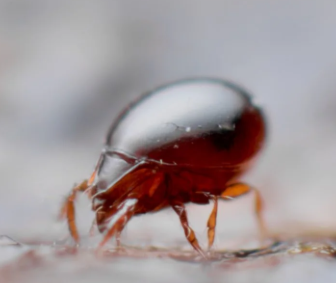
Uropoda mites possess one of the most distinctive appearances among soil mites.
- Size: Typically 0.5 to 1.5 mm long.
- Shape: Oval, rounded, or nearly circular.
- Color: Light brown, reddish-brown, chestnut, or dark brown.
- Body: Covered by a hard, heavily sclerotized dorsal shield.
- Legs: Short and partially hidden beneath the body.
- Movement: Slow-moving compared to predatory mites.
Their hard outer covering gives them a turtle-like appearance, leading some people to refer to them as “turtle mites.”
Under magnification, the body often appears glossy and highly polished.
Distribution and Habitat
Uropoda soil mites occur worldwide and can be found in nearly every terrestrial habitat containing sufficient organic matter.
Common habitats include:
- Garden soils
- Forest floors
- Leaf litter
- Compost piles
- Mulch beds
- Agricultural fields
- Greenhouses
- Nurseries
- Animal nests
- Vermicomposting systems
They are most abundant in moist environments where decomposition processes are actively occurring.
Large populations are frequently associated with rich organic soils and well-established microbial communities.
Life Cycle
Like other mites, Uropoda species undergo several developmental stages.
Egg Stage
Females lay eggs within soil pores, compost, or organic debris where moisture levels remain stable.
Larval Stage
Larvae emerge with six legs and begin feeding shortly after hatching.
Nymphal Stages
Several nymphal stages occur before adulthood. During the deutonymph stage, many species exhibit phoretic behavior.
Phoresy involves attaching to larger insects such as beetles, flies, ants, and other arthropods for transportation to new habitats.
Adult Stage
Adults continue feeding on fungi, organic debris, bacteria, and microscopic soil organisms.
Development rates depend heavily on temperature, moisture, and food availability.
Behavior and Ecology
Uropoda mites play important ecological roles within soil ecosystems.
They are commonly:
- Decomposers of organic matter
- Consumers of fungal spores
- Feeders on bacteria
- Predators of small nematodes
- Scavengers of decaying materials
- Participants in nutrient recycling
By feeding on decomposing materials and microorganisms, these mites help accelerate nutrient release and improve soil fertility.
Their activity contributes to the formation of healthy, biologically active soils capable of supporting robust plant growth.
Economic Importance
Most Uropoda mites are considered beneficial organisms.
Positive Contributions
- Improve decomposition rates.
- Enhance nutrient cycling.
- Support healthy soil food webs.
- Help regulate fungal populations.
- Contribute to compost production.
Potential Concerns
Extremely high populations may indicate:
- Excessive irrigation
- Poor drainage
- Overly wet greenhouse conditions
- Excess organic matter accumulation
- Inadequate airflow
Although these mites rarely harm plants directly, the environmental conditions that favor population explosions may contribute to root diseases, fungal outbreaks, or plant stress.
Signs of High Populations
Growers may notice:
- Large numbers of tiny brown mites in compost
- Clusters beneath pots and containers
- Heavy populations in worm bins
- Mites attached to beetles or flies
- Visible activity in mulch and organic debris
- Concentrations in poorly drained soils
The mites themselves are rarely the problem; instead, they often indicate underlying environmental conditions that should be corrected.
Management and Control (IPM)
Management should focus on environmental improvement rather than mite elimination.
Moisture Management
- Improve soil drainage.
- Avoid excessive watering.
- Allow soil surfaces to dry between irrigations.
- Reduce standing water.
Organic Matter Management
- Avoid excessive mulch depths.
- Turn compost regularly.
- Remove excessively wet debris.
- Maintain balanced compost materials.
Greenhouse Practices
- Improve ventilation.
- Monitor humidity levels.
- Maintain sanitation.
- Avoid excessive organic buildup.
Biological Balance
Because Uropoda mites are generally beneficial, preserving ecological balance is preferable to attempting eradication.
Broad-spectrum pesticides should be avoided because they can disrupt beneficial soil organisms and reduce overall soil health.
Research and Environmental Importance
Scientists study Uropoda mites because they are valuable indicators of soil quality and ecosystem health.
Current research focuses on:
- Soil biodiversity assessment
- Nutrient cycling processes
- Compost ecosystem dynamics
- Biological control interactions
- Greenhouse ecology
- Sustainable agriculture
The presence of healthy Uropoda populations often reflects active decomposition and robust microbial communities.
Conclusion
Uropoda Soil Mites are important members of soil ecosystems that contribute to decomposition, nutrient cycling, and soil health. While large populations may occasionally signal excessive moisture or environmental imbalance, these mites are generally beneficial organisms rather than true pests. Proper moisture management, good sanitation, and balanced organic matter levels help maintain healthy populations while supporting productive soils and growing environments.