Overview
Uresiphita genistae, commonly known as the Genista Broom Moth, is a colorful moth species whose larvae are important defoliators of leguminous shrubs and ornamental plants. Belonging to the family Crambidae, this species is native to parts of North America and is closely related to Uresiphita reversalis, often sharing similar host plants and feeding behavior.
The caterpillars are the damaging stage of the insect. They feed aggressively on foliage, flowers, and tender shoots of broom shrubs, lupines, false indigo, and other members of the pea family (Fabaceae). During severe infestations, entire plants may be stripped of leaves, reducing ornamental value and weakening host plants.
Although healthy, established plants often recover from occasional feeding, repeated infestations can cause significant stress, reduce flowering, and make ornamental landscapes appear severely damaged.
Taxonomy and Classification
The Genista Broom Moth belongs to a group of moths known for their plant-feeding caterpillars.
- Kingdom: Animalia
- Phylum: Arthropoda
- Class: Insecta
- Order: Lepidoptera
- Family: Crambidae
- Genus: Uresiphita
- Species: Uresiphita genistae
Members of the Crambidae family include many species that feed on agricultural crops, ornamentals, and native vegetation.
Physical Description
Adult Moths
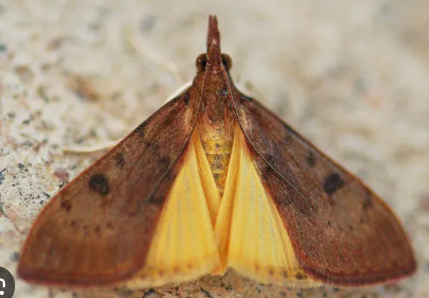
Adult Genista Broom Moths are relatively small but attractive insects.
- Wingspan: 25–35 mm
- Forewings: Brown to gray-brown with subtle markings
- Hindwings: Bright yellow to orange with darker margins
- Body: Slender and lightly scaled
- Activity: Primarily nocturnal
Adults are often attracted to outdoor lights and may be seen resting on walls, fences, or vegetation during the day.
Larvae
The caterpillars are far more noticeable than the adults.
- Length: Up to 30 mm
- Color: Yellow-green to greenish-white
- Markings: Distinct black spots with white accents
- Hair: Covered with sparse, fine hairs
Their striking spotted appearance makes them easy to recognize on host plants.
Distribution and Habitat
Uresiphita genistae occurs throughout much of the southern and western United States, Mexico, and parts of Central America.
Common habitats include:
- Residential landscapes
- Parks and gardens
- Naturalized shrublands
- Roadside plantings
- Native grasslands
- Urban landscapes
Populations are often concentrated wherever host plants are abundant.
Host Plants
The larvae primarily feed on members of the legume family.
Common host plants include:
- Broom (Genista spp.)
- Scotch Broom
- Lupine (Lupinus spp.)
- False Indigo (Baptisia spp.)
- Texas Mountain Laurel
- Sophora species
- Various ornamental legumes
Young plants and fresh growth are especially vulnerable to attack.
Life Cycle
Egg Stage
Females lay clusters of eggs on the foliage of suitable host plants.
Larval Stage
After hatching, caterpillars begin feeding immediately on leaves and flower buds.
Larvae often live communally during early development and produce loose silk webbing that binds foliage together.
This stage is responsible for virtually all plant damage.
Pupal Stage
Mature caterpillars pupate within silken cocoons hidden among foliage or plant debris.
Adult Stage
Adults emerge, mate, and begin the next generation.
Several generations may occur annually in warm climates.
Damage and Economic Importance
Genista Broom Moth caterpillars are primarily defoliators.
Leaf Feeding
Young larvae skeletonize leaves, consuming soft tissue while leaving veins behind.
As caterpillars mature, they consume entire leaves.
Flower Damage
Larvae frequently attack flower buds and blossoms, reducing ornamental display and seed production.
Shoot Injury
Feeding on growing tips can stunt plant development and alter plant shape.
Defoliation
Heavy infestations may completely strip host plants of foliage.
Repeated defoliation weakens plants and reduces overall vigor.
Signs of Infestation
Common indicators include:
- Groups of spotted caterpillars
- Loose silk webbing on branches
- Chewed leaves and flowers
- Accumulations of dark frass pellets
- Defoliated branches
- Visible feeding damage on growing tips
Early infestations are often concentrated on branch tips and newly developing foliage.
Management and Control (IPM)
Monitoring
Regular inspection of host plants is the most effective way to detect infestations before serious damage occurs.
Mechanical Control
- Remove webbed foliage.
- Hand-pick caterpillars.
- Prune heavily infested branches.
- Destroy removed plant material.
Biological Control
Numerous natural enemies help regulate populations.
- Birds
- Paper wasps
- Parasitic wasps
- Predatory insects
Microbial Control
Bacillus thuringiensis var. kurstaki (Bt) is highly effective against young caterpillars and is commonly used in integrated pest management programs.
Chemical Control
Severe infestations may require insecticides labeled for caterpillar control.
Treatments are most effective when applied against young larvae before extensive feeding occurs.
Research and Ecology
Researchers study Uresiphita genistae because of its interactions with ornamental and native legumes.
Current areas of interest include:
- Population dynamics
- Biological control programs
- Host plant relationships
- Defoliation impacts
- Integrated pest management strategies
In natural ecosystems, these caterpillars serve as food sources for numerous predators and contribute to ecological diversity.
Conclusion
Uresiphita genistae, the Genista Broom Moth, is an important defoliating pest of ornamental legumes and broom shrubs. While healthy plants can often recover from occasional feeding, heavy infestations may cause severe defoliation, reduced flowering, and long-term stress. Early monitoring, biological control, and targeted IPM strategies provide the most effective means of managing populations while preserving beneficial insects and ecosystem health.