Overview
Uloborid Spiders (family Uloboridae) are a fascinating group of web-building spiders known for possessing one of the most unusual adaptations in the spider world: they completely lack venom glands. While nearly all other spiders rely on venom to immobilize prey, Uloborid spiders use specialized silk and elaborate wrapping behavior to capture and subdue insects.
These harmless arachnids are found throughout many parts of the world, including North America, where they commonly inhabit gardens, forests, greenhouses, landscapes, and occasionally structures. Despite their unusual biology, they are highly effective predators that contribute significantly to natural pest control by capturing flying insects and other small arthropods.
Uloborid spiders are particularly interesting because they produce a special type of silk known as cribellate silk. Unlike the sticky silk used by many orb-weaving spiders, cribellate silk consists of thousands of microscopic fibers that entangle prey through physical contact. This unique silk functions almost like Velcro, trapping insects without the need for adhesive droplets.
Because they are completely harmless to humans and provide valuable pest management services, Uloborid spiders are considered beneficial organisms and should generally be encouraged rather than controlled.
Taxonomy and Classification
- Kingdom: Animalia
- Phylum: Arthropoda
- Class: Arachnida
- Order: Araneae
- Family: Uloboridae
The family Uloboridae contains numerous species distributed worldwide. Several species occur throughout the United States and are commonly encountered in gardens and around buildings.
Notable genera include:
- Uloborus
- Hyptiotes
- Zosis
- Miagrammopes
One of the best-known North American species is the Humped Orb Weaver (Uloborus glomosus).
Physical Description
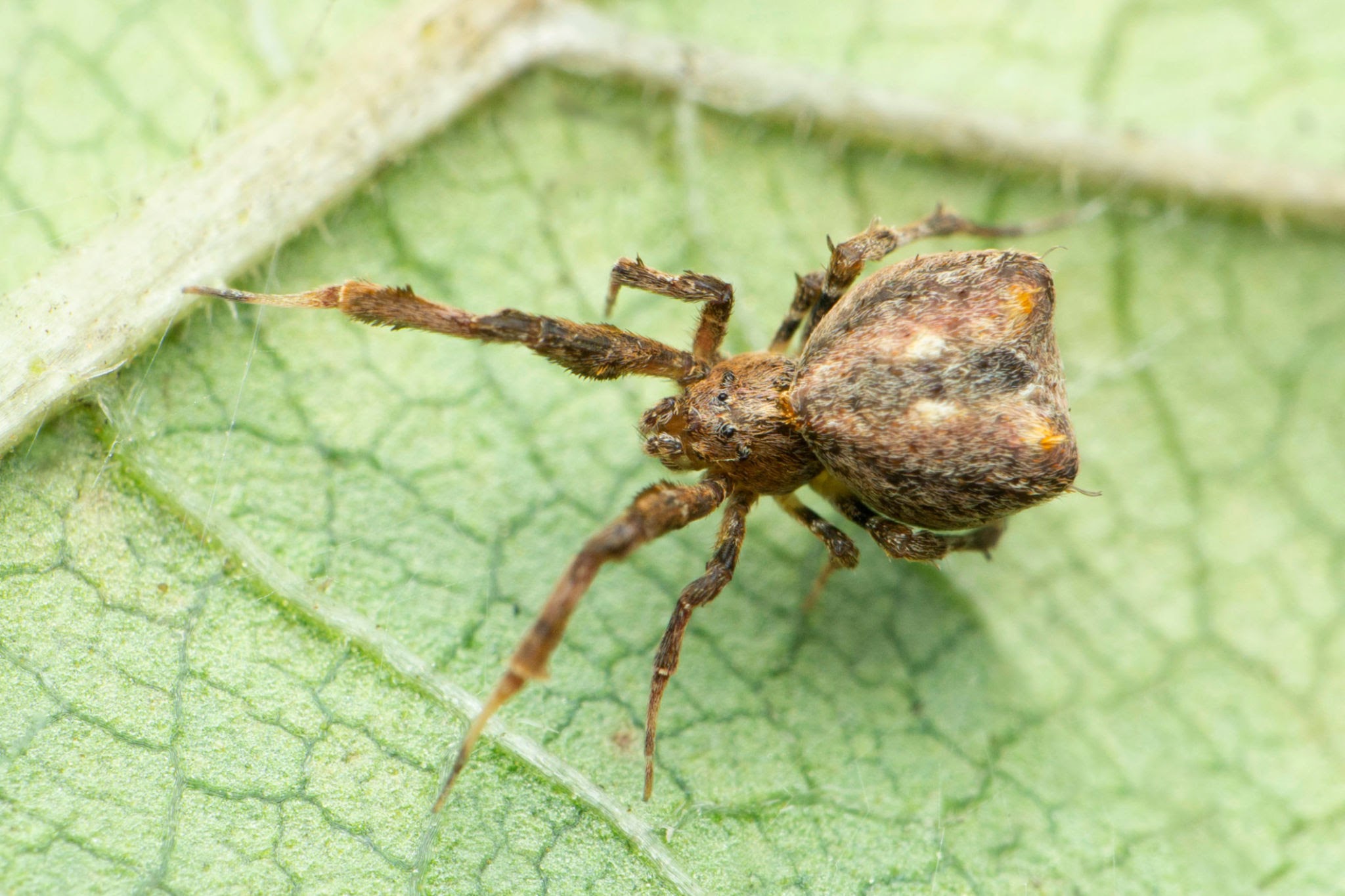
Uloborid spiders are generally small to medium-sized arachnids with delicate bodies and distinctive postures.
Adult Characteristics
- Length typically ranges from 3 to 10 millimeters.
- Body coloration varies from gray and brown to tan.
- Many species possess humps or projections on the abdomen.
- Long, slender legs.
- Specialized hair brushes on the front legs.
Many species have irregular body shapes that help them blend into twigs, bark, leaves, and other natural surfaces.
Distinctive Posture
When resting, Uloborid spiders often hold their front legs extended forward, creating a stick-like appearance that helps camouflage them from predators.
This posture, combined with their cryptic coloration, makes them surprisingly difficult to detect.
Distribution and Habitat
Uloborid spiders occur throughout temperate and tropical regions worldwide.
Common habitats include:
- Gardens
- Woodlands
- Shrubbery
- Greenhouses
- Landscape vegetation
- Building exteriors
- Porches
- Agricultural fields
They prefer locations where flying insects are abundant and suitable anchor points exist for web construction.
Unlike some spiders that hide in crevices or burrows, Uloborids spend much of their lives on or near their webs.
The Unique Cribellate Web
One of the defining characteristics of Uloborid spiders is their use of cribellate silk.
Unlike conventional spider silk that relies on sticky glue droplets, cribellate silk consists of thousands of microscopic fibers combed into a wool-like structure.
This silk:
- Appears fuzzy or woolly.
- Entangles insect hairs and body structures.
- Functions without adhesive droplets.
- Remains effective under varying environmental conditions.
The resulting web often has a bluish or fuzzy appearance when viewed closely.
Many Uloborids construct orb-shaped webs similar to those of garden spiders, although some species build modified or triangular web designs.
Life Cycle
Uloborid spiders develop through a series of molts before reaching adulthood.
The life cycle includes:
- Egg
- Spiderling
- Juvenile
- Adult
Females deposit eggs within protective silk sacs attached to vegetation or nearby structures.
After hatching, young spiderlings disperse and establish their own webs.
Depending on species and climate, development may require several months.
Behavior and Hunting Strategy
The absence of venom glands has led Uloborid spiders to evolve a highly specialized hunting method.
Prey Capture
Flying insects become entangled within the cribellate web.
Once prey is trapped, the spider quickly approaches and begins wrapping it with silk.
The “Death Wrap”
Because they cannot inject venom, Uloborids compensate by using enormous amounts of silk.
A single insect may be wrapped with many meters of silk until movement is nearly impossible.
The prey eventually dies through physical restraint, exhaustion, or suffocation.
External Digestion
After immobilization, digestive fluids are applied to the prey externally.
These enzymes liquefy internal tissues, allowing the spider to consume nutrients in liquid form.
This process is similar to that used by most other spiders, except that venom plays no role.
Ecological Importance
Uloborid spiders are highly beneficial predators that help regulate insect populations.
Common prey includes:
- Fungus gnats
- Whiteflies
- Mosquitoes
- Small flies
- Leafhoppers
- Midges
- Flying aphids
Their webs are particularly effective at capturing small, lightweight insects that might escape other types of webs.
In greenhouses and gardens, they provide valuable natural pest suppression without the use of pesticides.
Human Interaction
Uloborid spiders are completely harmless to humans.
Unlike venomous spiders:
- They cannot inject venom.
- They pose no medical risk.
- They are non-aggressive.
- They rarely leave their webs.
Because of their harmless nature, they are among the safest spiders encountered around homes and landscapes.
Occasionally, homeowners mistake them for widow spiders or other species due to their dark coloration and web-building behavior.
However, their neat orb-shaped webs differ dramatically from the tangled, irregular webs of widow spiders.
Management and Prevention
No control measures are typically necessary.
Encourage Their Presence
- Reduce unnecessary pesticide applications.
- Maintain garden diversity.
- Provide suitable vegetation.
- Allow beneficial spiders to remain undisturbed.
Removing Unwanted Webs
If webs become a nuisance in garages, patios, or other areas, simple removal with a broom or vacuum is usually sufficient.
Because they are beneficial predators, relocation is preferable to destruction whenever possible.
Research and Scientific Interest
Uloborid spiders continue to attract scientific interest because of their unique evolutionary adaptations.
Researchers study:
- Cribellate silk production.
- Spider evolution.
- Web architecture.
- Predator-prey interactions.
- Alternative hunting strategies.
- Biomaterials inspired by cribellate silk.
The complete loss of venom glands makes this family one of the most unusual groups within the spider world.
Conclusion
Uloborid spiders are remarkable arachnids that demonstrate how successful predators can evolve without venom. Through the use of specialized cribellate silk and extensive prey wrapping behavior, they effectively capture and consume insects while posing no threat to humans.
Found in gardens, forests, greenhouses, and around structures, these spiders serve as valuable natural pest control agents. Their unique biology, harmless nature, and ecological importance make them among the most beneficial spiders homeowners are likely to encounter.